Creator plays GTA 6 with EEG headset, steering jets through thought alone
Perri Karyal trained a wireless electroencephalogram to recognize her brainwaves and translate them into Xbox controller inputs, allowing her to steal and pilot aircraft in the game using only her mind.
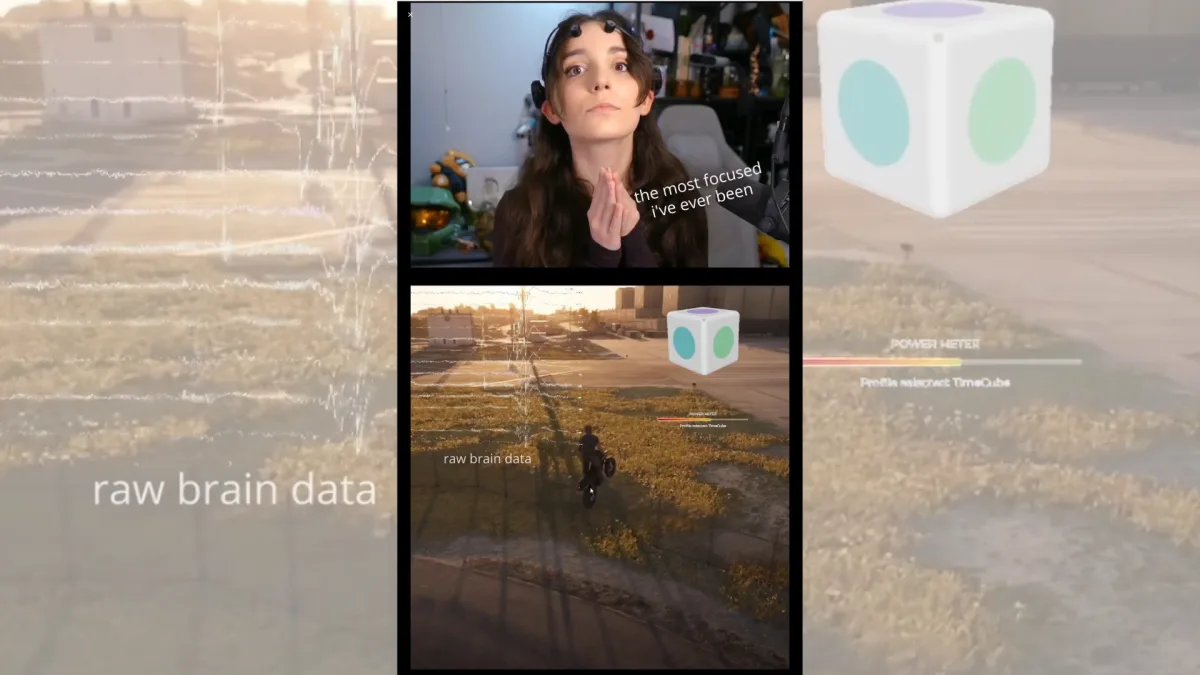
Electroencephalogram devices measure and monitor electrical activity in the brain, and one developer decided to harness that capability for interactive entertainment. Perri Karyal demonstrated the capability on X, broadcasting her gameplay while wearing a wireless EEG system designed for research applications.
I STOLE A JET WITH MIND CONTROL IN GTA6this took me AGES you have no ideawhat should I do next??This electroencephalogram (EEG) records my brain activity and when I'm imagining something I've trained the software to recognise (like pushing a cube forward), a button will be pressed on my virtual xbox controller. For this run, I was imagining pushing a boulder to accelerate, getting angry to interact with vehicles, and imagining a cricket hopping to jump. I use eyetracking and gyro for joysticks :)
Perri Karyal, November 22, 2026
During her stream, Karyal navigated her character to a parked fighter jet alongside a companion on a motorcycle, then proceeded to commandeer and fly the aircraft. The display showed her brain activity overlaid in real time as she played, revealing her intense concentration throughout the sequence.
Karyal's approach involved training the software to detect particular patterns of neural activity and linking them to specific controller commands. Visualizing the motion of pushing an object forward triggered a button press; generating anger enabled her to operate vehicles; and imagining a cricket in mid-hop caused her character to jump. Eye tracking and gyroscopic sensors in the headset managed the analog stick inputs.
Despite appearing seamless in execution, operating the EEG device for gaming presents substantial challenges. When asked about the difficulty, Karyal stated, "People don't realize how challenging it is!" A viewer remarked on the enormous spike in brainwave activity visible when she took off in the jet, prompting her to respond, "I was so stressed out. DO YOU KNOW HOW MANY TIMES I TRIED TO DO THIS." Although wireless EEG use in gaming carries no documented adverse effects, Karyal noted that extended play sessions cause headaches due to the pressure the headset exerts on her skull.
Brain-controlled gaming is not unprecedented. Neuralink has previously demonstrated one of its trial participants engaging in target shooting against computer-controlled enemies and executing precision maneuvers with a speedboat through a surgically implanted brain-computer interface chip. The fundamental distinction between Karyal's system and Neuralink's technology lies in the invasiveness of the approach—Neuralink's solution requires surgical implantation.
While it may seem counterintuitive that an independent creator could match Neuralink's capabilities, Neuralink maintains the advantage of having already deployed its technology across multiple clinical trial participants. Their patients have tackled demanding titles including World of Warcraft and Counter-Strike 2, while others have leveraged the interface for non-gaming purposes such as video editing and other creative work.
Both of these technologies remain in experimental and developmental stages, with some being tested by independent creators and technology enthusiasts. Beyond entertainment applications, these innovations offer meaningful possibilities for individuals with mobility limitations, potentially enabling them to regain degrees of control and autonomy that could transform their daily lives.