Orkes ParticleDB: Moving AI agents from demos to dependable enterprise systems
As companies shift from experimenting with generative AI to running agents in production, Orkes is positioning its new database technology and orchestration platform to handle the data integration, reliability and auditability that enterprise deployments demand.
Demonstrating an AI agent that works is straightforward. Deploying one that can securely process financial transactions, manage customer refunds, or make business decisions while protecting sensitive information presents an entirely different challenge.
This gap matters as enterprises graduate from proof-of-concept work with generative AI to running agentic applications at scale. Beyond access to capable language models, developers require reliable connections to company data, workflow management, security guarantees, failure recovery, and mechanisms to audit what an AI agent has done. Orkes contends that its newly unveiled ParticleDB addresses a major portion of these requirements.
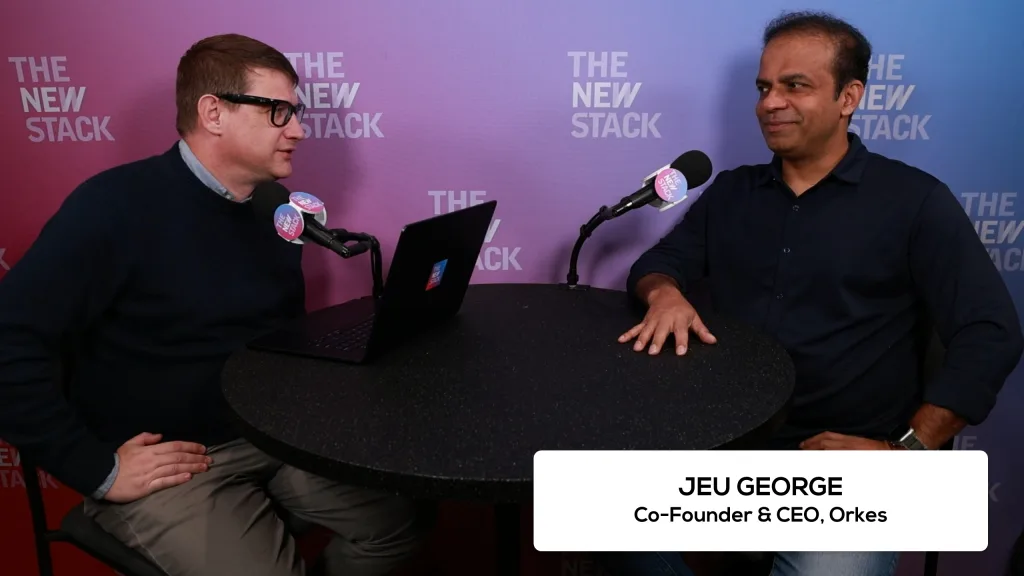
At AgentCon and MCPCon 2026 in San Jose, California last month, Orkes co-founder and CEO Jeu George spoke with The Silicon Ledger about how ParticleDB and the company's existing Conductor orchestration platform aim to streamline enterprise AI development while improving reliability.
Why ParticleDB matters to developers
During its Orkes Shift developer conference in San Francisco, the company showed off ParticleDB, which it describes as an agentic database meant to consolidate data capabilities that typically demand separate systems. Most enterprise development teams juggle relational databases, key-value stores, vector databases, and analytics platforms. Linking these systems usually requires constructing intricate extract, transform, and load pipelines, overseeing data transfers, and sustaining infrastructure that grows harder to manage.
ParticleDB's central idea is that these functions should coexist in a single engine, cutting down the work required to integrate them. George argues this becomes critical when AI agents are involved.
When do AI agents and LLM models become useful? When they have data.
Orkes CEO Jeu George
Yet that information typically sits behind strict security boundaries. Organizations cannot simply grant autonomous agents unrestricted access to customer data, financial information, or sensitive business operations.
George proposes an alternative model: A secure intermediary platform delivers only the particular data and context agents require. Working alongside Orkes Conductor, ParticleDB is designed to keep applications, agents and their data tightly connected within the customer's own cloud infrastructure.
Reliability is still the hardest problem
Beyond consolidating data, George highlighted a persistent headache for those building distributed systems: Failures happen. Connectivity problems, code defects, hardware failures, and security breaches cannot be prevented. When AI agents run workflows that may take hours or days, the ability to recover without repeating transactions becomes critical.
If you design systems from the ground up that things are always going to fail, you simulate failures all the time, and that's how you get to a robust application.
Jeu George
Orkes Conductor tackles this through workflow orchestration, recovery procedures, access controls, and complete audit logs. Teams can merge deterministic business logic with AI-powered reasoning while maintaining a clear record of every step.
For sectors under regulatory oversight like banking and insurance, this transparency proves especially valuable. Firms must be able to trace an agent's reasoning, pinpoint which models and systems participated, and justify results to stakeholders or compliance authorities.
Knowing when to use an agent
A particularly illuminating segment of the discussion centers on a basic e-commerce scenario involving a customer refund. George outlines why agents excel at ambiguous work—parsing customer concerns, for instance—while routine tasks like processing refunds, updating ledgers, and creating receipts belong in conventional workflows. Edge cases and high-stakes situations get routed to people.
…successful agentic applications aren't necessarily the most autonomous. They're the ones that combine intelligence with dependable execution.
Jeu George
The takeaway for developers: The most effective agentic applications are not always the most independent ones. They succeed by pairing AI reasoning with trustworthy, predictable operations.