Nextcloud Opens Developer Academy to Expand App Ecosystem
The self-hosted cloud platform has launched an educational program to train developers in building apps, as the company shifts toward becoming a full software platform with over 800 third-party applications.
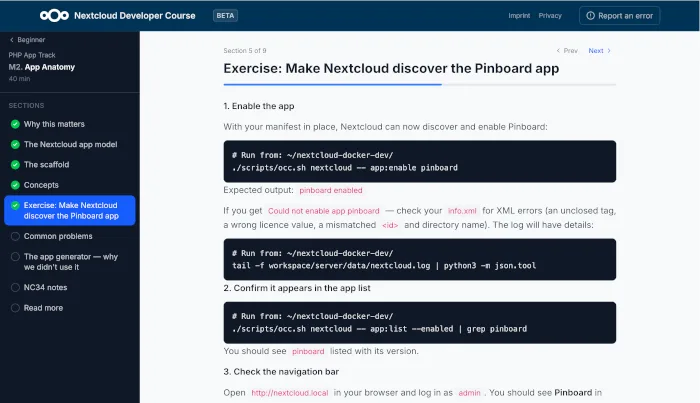
Nextcloud has unveiled Nextcloud Academy, a new training initiative designed to onboard developers interested in creating applications for its self-hosted cloud infrastructure. The program offers structured learning paths for both newcomers and seasoned developers working with the platform. Beginner-level content is now available, while intermediate and advanced modules are slated for future release.
The Academy debuted officially on Thursday, though it was first shown to the public on September 16 during the unveiling of Nextcloud Hub 26 Summer and again at the Nextcloud Community Conference in Berlin on September 19. The platform is currently in beta status, meaning its curriculum may still undergo changes.
The program features two distinct learning paths that guide developers through constructing the same application using different technical approaches. The PHP track covers the development of traditional Nextcloud applications that execute within the server environment, utilizing controllers, the OCP API, QBMapper, and migrations. The Python ExApp track demonstrates how to create standalone applications that operate as independent Docker services via AppAPI, leveraging FastAPI, nc_py_api, and dedicated SQLite or Postgres databases.
A foundational guide already existed to teach the essentials of how Nextcloud operates and to address common obstacles that developers encounter when transitioning from local development environments to production.
From File Sharing to Platform
Nextcloud has evolved considerably since its origins as a self-hosted, open-source alternative to Dropbox. The platform now serves enterprises of all sizes, as well as technically proficient individuals and households, enabling them to construct self-hosted collaborative environments. These environments integrate online productivity suites, calendar systems, email, video communication tools, and an embedded artificial intelligence assistant.
A robust developer community has grown around Nextcloud, with contributors building specialized applications for the platform that can generate revenue through the integrated app marketplace, or developing custom solutions for organizations deploying Nextcloud for internal or customer-facing uses.
"Nextcloud turns more and more into a software platform," stated Frank Karlitschek, Nextcloud's CEO and co-founder, at the Nextcloud Hub 26 Summer launch. "For example, at the beginning of the year we had about 500 third-party apps in Nextcloud. Now we've surpassed 800 and it's only September, so it's really amazing what the community is doing."
Expanding the catalog of available applications serves multiple purposes for Nextcloud—advancing the platform's capabilities, supporting European digital sovereignty initiatives, and creating monetization opportunities for developers. Over the past year, the platform has enabled developers to solicit financial support through its App Store, with some creators already seeing financial returns.
Beyond supporting developer income, Nextcloud Academy enables smaller development teams to migrate applications from local-only deployments to cloud-based architectures.
A Significant Year for Growth
The Academy represents one element of a particularly strong period for the Germany-based organization. The company is marking 2026 as the tenth anniversary of its separation from ownCloud, a milestone that reflects its transformation from a promising Dropbox competitor into a comprehensive self-hosted cloud solution.
Nextcloud has positioned itself as a primary beneficiary of European sovereignty initiatives, offering a comprehensive, functional alternative to international proprietary cloud services. The platform's European origin, combined with its open-source nature and absence of licensing costs, makes it an attractive option for governments and large organizations seeking to reduce dependence on foreign technology vendors.
The open and free nature of the software carries particular significance, as it provides assurance to institutional users that the platform cannot be withdrawn or restricted without their consent.
The expanding software ecosystem adds further value to the platform. "Sometimes I'm browsing through the app store and it's really so cool to see what is happening," Karlitschek said. "For example, there are bookkeeping apps, there are time tracking apps, content management systems, and even full CRM systems. Of course, there is also cool stuff from the community, for example applications to manage your movie database or your music collection."