AAIF's CTO: The agent stack will keep shifting, and that's by design
As the Agentic AI Foundation adds major contributions from Anthropic, OpenAI, Hugging Face and Alibaba, its co-founder warns developers to prepare for constant change in how AI agents will work together.
Building systems where AI agents coordinate across different frameworks remains a thorny challenge for developers. The obstacles are familiar: companies locking customers into their platforms, incompatible communication standards, and the loss of context when moving tasks between different agent systems.
The pace of change in this space has been remarkable. Just 10 months after the Linux Foundation-backed Agentic AI Foundation (AAIF) launched in December 2025 to address these problems, the foundation has already grown substantially. The organization provides neutral governance for shared agent infrastructure, starting with three initial projects including the Model Context Protocol (MCP), which enables AI applications to connect with external tools and information sources.
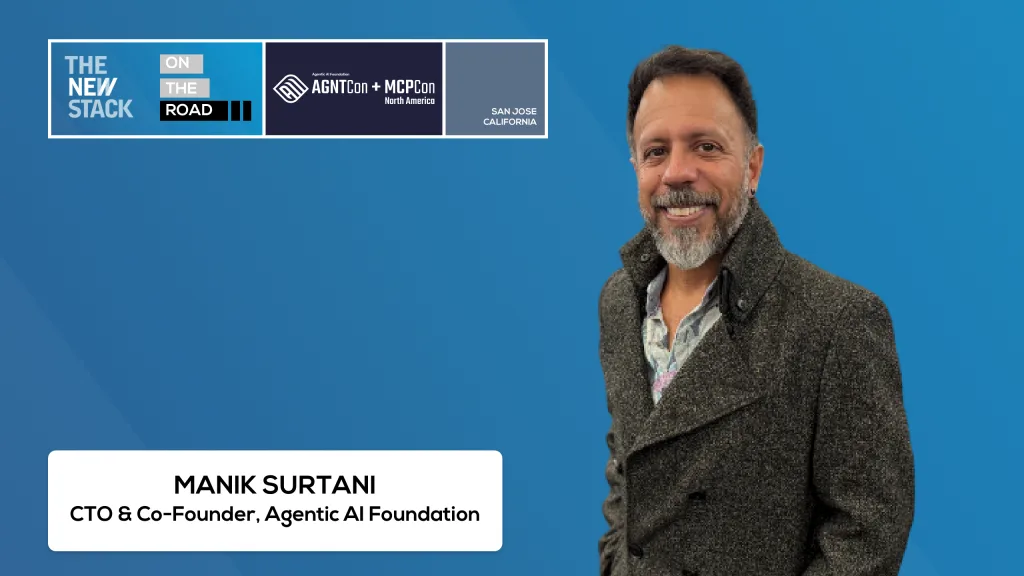
On October 22, the foundation announced a significant expansion when Anthropic contributed Agent Skills and OpenAI contributed Open Responses, joined by contributions from Hugging Face and Alibaba. These additions brought AAIF's total hosted projects to 10. Manik Surtani, the foundation's co-founder and CTO, discussed these developments at AGNTCon + MCPCon in San Jose shortly after announcing the news.
Four major projects strengthen the foundation
Each of the new contributions addresses a specific challenge in the agent ecosystem:
- Agent Skills (Anthropic): A standardized format for packaging instructions, scripts, and reference materials that agents can load when performing specific tasks. Developers write instructions once and reuse them across compatible agents.
- Open Responses (OpenAI): An open specification derived from OpenAI's Responses API that defines how applications communicate with language models and receive outputs. A unified format reduces conversion overhead when developers work with different model providers.
- OpenEnv (Hugging Face): A framework for constructing and distributing reinforcement learning environments where agents can practice tasks and gather feedback for training purposes.
- OpenSandbox (Alibaba): An execution platform for running agent-generated code and other operations in isolated environments, keeping that work separate from the host system.
The alignment of Anthropic, OpenAI, Hugging Face, and Alibaba around a vendor-neutral foundation represents a significant shift. Yet Surtani emphasized that demand for independent governance has existed since the foundation's inception. "More than faster, I think people are going to be able to build on top of things that they can trust more," Surtani said. "It's not like you couldn't trust open responses before. Of course you could. But now everyone has a say in how it's going to grow and how it's going to get shaped."
This reflects lessons learned during the early cloud-native era, when organizations discovered the risks of building critical infrastructure on technologies they could not influence.
Agent memory and portability remain urgent challenges
When asked about the most pressing issue facing the field, Surtani pointed to agent memory and context management—the operational state and history an agent requires to continue working on a task. A harness, the software layer surrounding a model that orchestrates its tools and workflow, must carry this context when transferring work between different models or harnesses. Currently, this remains difficult, and Surtani wants teams to share context seamlessly across agents and people collaborating on the same problem.
Beyond preserving context across systems, Surtani urged software engineering teams to build for model independence now, using abstractions, intermediary layers, and consistent interfaces. In practice, this means preventing applications from becoming tightly coupled to a single model vendor. A proxy or router positioned between the application and the model allows teams to swap the underlying model without changing the application layer. While not a complete solution, this approach handles much of the complexity.
The agentic AI stack differs fundamentally from the cloud-native stack governed by the Cloud Native Computing Foundation (CNCF), which Surtani characterized as already largely settled. The agent stack, by contrast, remains inherently unstable.
My advice to people is just be ready for change. Change is going to happen.
Manik Surtani
Surtani added that instability need not be frightening. "Now, the good thing in all of this is that change is actually easy as well. With agents actually building themselves and writing code, it's not going to be that expensive or that hard to migrate from one thing to the other."
A sandbox for emerging projects
The foundation has attracted over 300 member organizations in its first 10 months, spanning fintech companies and non-technology enterprises like the Gates Foundation. This rapid growth revealed that the foundation's initial entry requirements, modeled on the mature CNCF framework, were poorly suited for a field moving at extraordinary speed.
In response, AAIF introduced a new Sandbox lifecycle phase on September 1. This category allows promising early-stage projects with strong community momentum to develop under neutral governance before reaching widespread production deployment. The Sandbox phase is distinct from the isolated execution environments that OpenSandbox provides.
Surtani's primary message to developers is straightforward: demand that vendors commit to open standards, publish transparent specifications, and demonstrate genuine long-term commitment.