YouTubers Prove Triple 8-Pin Connectors Can Power RTX 5090 at 900W
Modders at TecLab have successfully retrofitted an RTX 5090 with traditional 8-pin PCIe power connectors, demonstrating that the older standard remains viable even under extreme power loads.
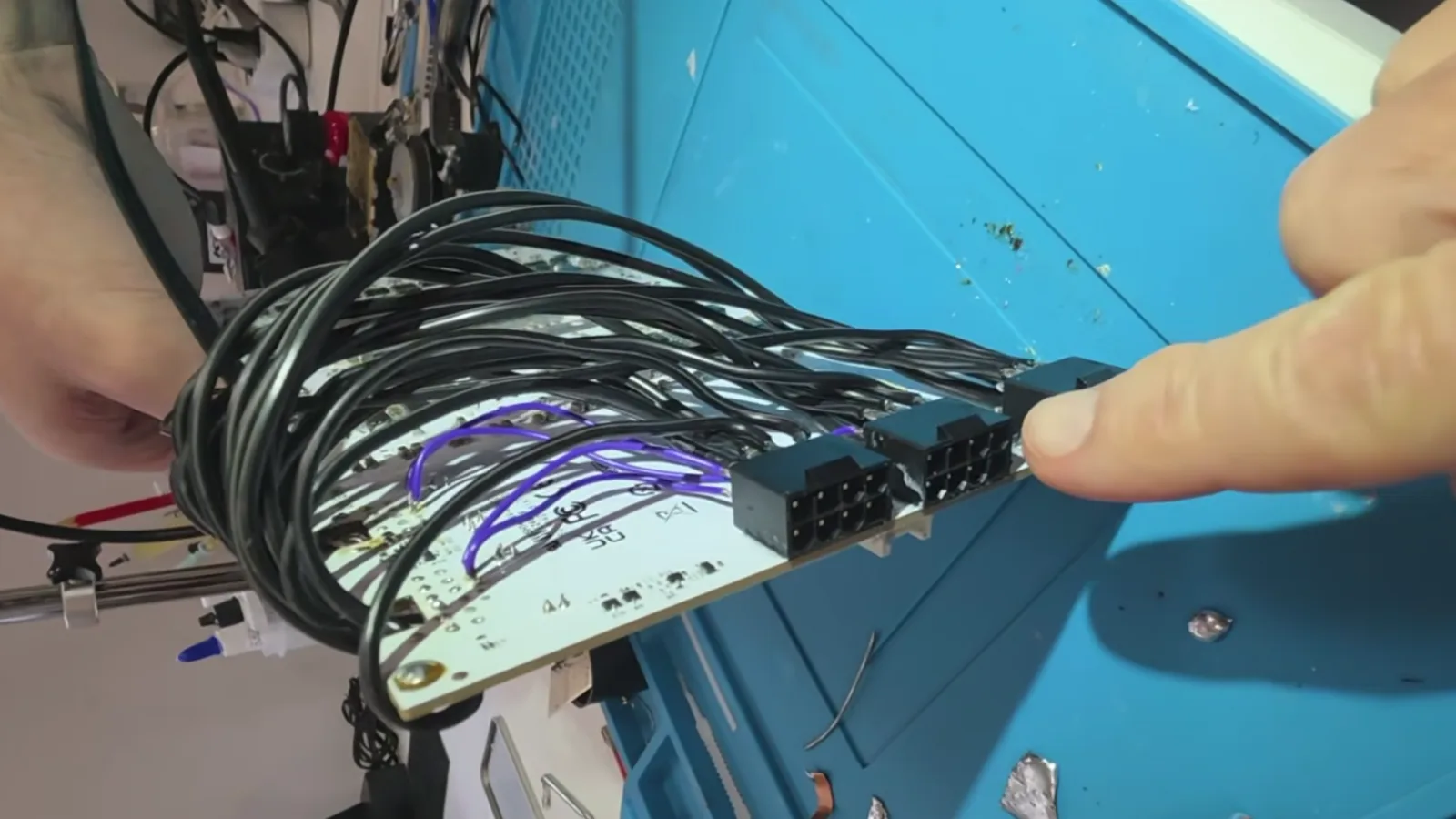
The limits of legacy power delivery continue to surprise. Creators operating the YouTube channel TecLab have demonstrated what they claim is the first RTX 5090 to run entirely on conventional 8-pin PCIe connectors. Their work revealed that this aging connector design can sustain the severe electrical demands placed on contemporary flagship graphics processors.
Hardware Modification and Testing Setup
The experiment centered on a Galax GeForce RTX 5090D HOF OC LAB XOC, a premium variant equipped with a substantial cooling solution and dual 16-pin power connectors. The modders completely disassembled the card, removed the factory 16-pin connectors, and reduced it to its bare circuit board. They then installed three 8-pin connectors at the rear, soldering each directly to the power regulation circuitry using heavy-gauge wiring. The sense pins underwent rewiring to permit the card to draw its full rated power without throttling. A liquid cooling loop with a dedicated GPU block maintained thermal stability throughout testing.
During a one-hour livestream, the team incrementally raised power consumption, beginning at 400W and scaling to 900W across the three 8-pin cables. The modified card drew over 120A at peak operation, with frequencies climbing to 3,400 MHz. Critically, the modification involved only hardware changes; no software adjustments or BIOS modifications were applied.
Performance With Reduced Connector Count
To further evaluate 8-pin connector reliability, the team ran additional tests using fewer cables. With two connectors, current draw fell to 66A while clock speeds held steady at 3,200 MHz. Even with a single cable, the figures declined only modestly to 65A and 3,100 MHz, suggesting substantial headroom in the older connector design.
Industry Context and Implications

The PCI Special Interest Group (PCI-SIG) has already revised the 16-pin connector specification (12V-2x6) to address reliability concerns, yet reports of melted connectors persist among users. This problem affects high-performance cards particularly severely, spanning not only Nvidia's RTX 50 and RTX 40 lineups but also certain AMD Radeon models equipped with the 16-pin standard. TecLab's findings suggest that GPU makers might benefit from reconsidering whether the proven 8-pin connector could serve as a practical alternative for future high-end designs.