Webb detects ancient interstellar ice in the disk around young star Beta Pictoris
Astronomers using the James Webb Space Telescope have identified water and carbon dioxide ice in the debris disk surrounding Beta Pictoris, a 20-million-year-old star 64 light-years from Earth, suggesting that the building blocks of water-rich planets may be widespread.
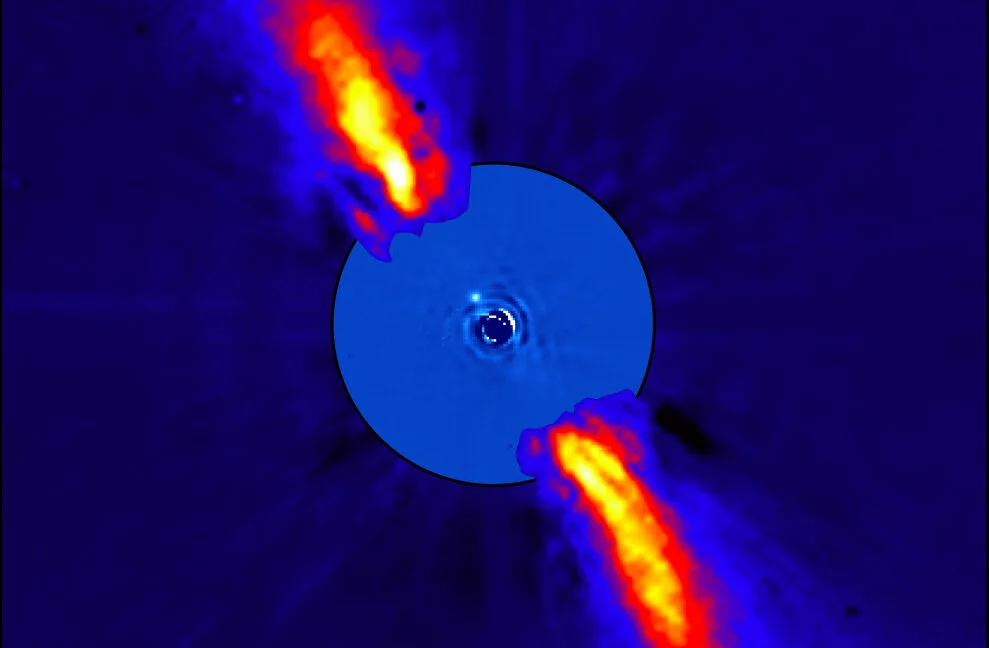
Beta Pictoris, a relatively young star approximately 20 million years old situated roughly 64 light-years away, hosts a sprawling disk of dust and debris where planetary formation continues. Astronomers have already catalogued three planets orbiting the star. Using the James Webb Space Telescope, a research team headed by Sarah Betti from the Space Telescope Science Institute in Baltimore conducted observations documented in a new Science paper, searching for frozen volatiles within this disk. The investigation revealed the presence of both water ice and carbon dioxide ice.
The water ice exhibits a glassy rather than crystalline structure and exists in combination with carbon dioxide at proportions resembling those found in comets within our own Solar System. This discovery hints that the chemical components required for the development of water-abundant planets may be prevalent around young stellar systems.
The missing ice
Among all stars studied by astronomers, Beta Pictoris ranks among the most thoroughly examined. Its disk became one of the earliest ever photographed in 1984, and its nearly edge-on orientation relative to Earth provides an ideal setting for investigating planetary system development. Astronomers classify it as a debris disk, where dust undergoes constant replenishment through collisions between comets and planetesimals—the small rocky bodies that serve as planetary building blocks.
In the disk's outer regions, distances from the star are sufficient for water and other volatile substances to condense into solid ice. The system contains an abundant supply of carbon monoxide gas, which ultraviolet radiation from the star should eliminate within 50 to 300 years. The persistence of this gas indicates ongoing replenishment, most probably released when volatile-containing comets undergo collisions. Additionally, the characteristics of planet Beta Pictoris b suggest formation from material rich in ice.
Despite substantial theoretical reasons to expect the system contains abundant ice, prior detection efforts proved unsuccessful. Searches for water vapor yielded no results, and attempts to identify the characteristic absorption signature of water ice at 3 micrometers similarly failed.
Computational models indicate that ultraviolet radiation emanating from the star can destroy small particles of pure ice more rapidly than collisions generate them. Conversely, particles composed of contaminated ice mixed with additional substances should persist for extended periods.
Reading the reflection
On December 7, 2023, Betti and collaborators examined Beta Pictoris utilizing Webb's Near Infrared Spectrograph (NIRSpec) in spectroscopic mode. This configuration captures complete spectral data spanning 0.6 to 5.2 micrometers for each location within the image. Following removal of the star's intense radiation, researchers quantified the proportion of stellar light reflected by disk particles across different wavelengths to identify ice signatures.
Water ice demonstrates strong light absorption near 3 micrometers, whereas carbon dioxide ice absorbs at 4.27 micrometers or 4.39 micrometers when containing the heavier carbon-13 isotope. The research group initially charted water ice characteristics throughout the disk, discovering remarkable consistency. Subsequently, they extracted comprehensive spectral information from two locations positioned on opposite sides of the star, each approximately 100 astronomical units distant.
Both spectral measurements revealed water and carbon dioxide ices, including both the standard form and the less common carbon-13 variant of carbon dioxide. However, the configuration of these features conveyed additional information beyond their mere presence.
Dirty glass
The carbon dioxide features displayed a slight displacement toward shorter wavelengths and exhibited considerably greater width than pure carbon dioxide ice measured under laboratory conditions. According to the paper, this pattern reflects how carbon dioxide behaves when its molecules become enclosed within water ice. The two ices therefore do not exist as distinct neighboring particles—they are intimately combined, representing the variety of contaminated ice that theoretical models proposed could withstand the star's ultraviolet radiation.
Calculations performed by the team determined approximately one carbon dioxide molecule exists for every 10 water molecules, representing roughly 11 percent of the ice composition. This proportion falls within the 2.5 to 30 percent interval documented in Solar System comets and the 7 to 20 percent observed in ice surrounding other young stars. This suggests the ices at Beta Pictoris may have accumulated through mechanisms identical to those in our Solar System, accumulating on dust particles in frigid, compressed, water-abundant clouds during the initial phases of stellar formation.
The organization of the water ice provided additional corroboration for this hypothesis. When water solidifies at moderate temperatures, its molecules arrange into an ordered crystalline framework, and crystalline ice generates a distinct peak in the spectrum just beyond 3 micrometers. This peak was conspicuously absent at Beta Pictoris. The ice exists almost entirely in an amorphous state, an unstructured, glass-resembling substance that develops when water molecules freeze rapidly and at extremely low temperatures, adhering wherever they land. The team estimates that fewer than 7 percent of the water ice molecules in the system display crystalline characteristics, a finding that somewhat defied expectations.
Predictive models anticipated that ice in debris disks should predominantly exhibit crystalline properties. For amorphous ice to maintain that condition, it must stay below approximately 100 Kelvin, equivalent to minus 173 degrees Celsius. Otherwise, something must continuously disrupt its crystalline arrangement, such as intense ultraviolet radiation, cosmic ray bombardment, or charged particles emanating from the star. In either scenario, the investigators determined the ice most probably originated in the interstellar medium, substantially before the Beta Pictoris planetary system began forming.
One remaining puzzle concerned the mechanism distributing icy particles so uniformly throughout the disk.
Constant collisions
The research team proposes that achieving such uniform ice distribution necessitates recurrent collisions between planetesimals. Every collision would discharge newly exposed icy material, encompassing ice that had been sheltered deep within the colliding objects, compensating for material destroyed by starlight. Evidence already exists confirming such collisions transpire. Earlier infrared observations documented a curved, asymmetrical dust trail in the disk's southwestern region, believed to represent debris from a violent collision occurring somewhat less than halfway from the star.
The conclusions reached by Betti's group reinforce the hypothesis that the disk's carbon monoxide gas originates from colliding icy bodies and furnish a mechanism explaining ice survival in an environment perpetually bathed in ultraviolet radiation. The team's investigation could not establish the precise quantity of crystalline ice present or exclude additional substances potentially concealed within the composition.
Should a young planetary system located 64 light-years distant have commenced with fundamentally identical icy constituents as our own, then primordial interstellar ice might represent a ubiquitous component of planetary systems broadly. This implies that the foundational materials for water-rich, conceivably habitable worlds may likewise be widespread.
Science, 2026. DOI: 10.1126/science.adw7770