Trial Lawyer Upgrades Homemade AI Server to Higher Precision, Trading Speed for Accuracy
A South Carolina attorney running DeepSeek on eight used V100 GPUs has shifted most of his model's computation from 2-bit to near-NVFP4 precision, improving output fidelity while accepting modest performance costs.
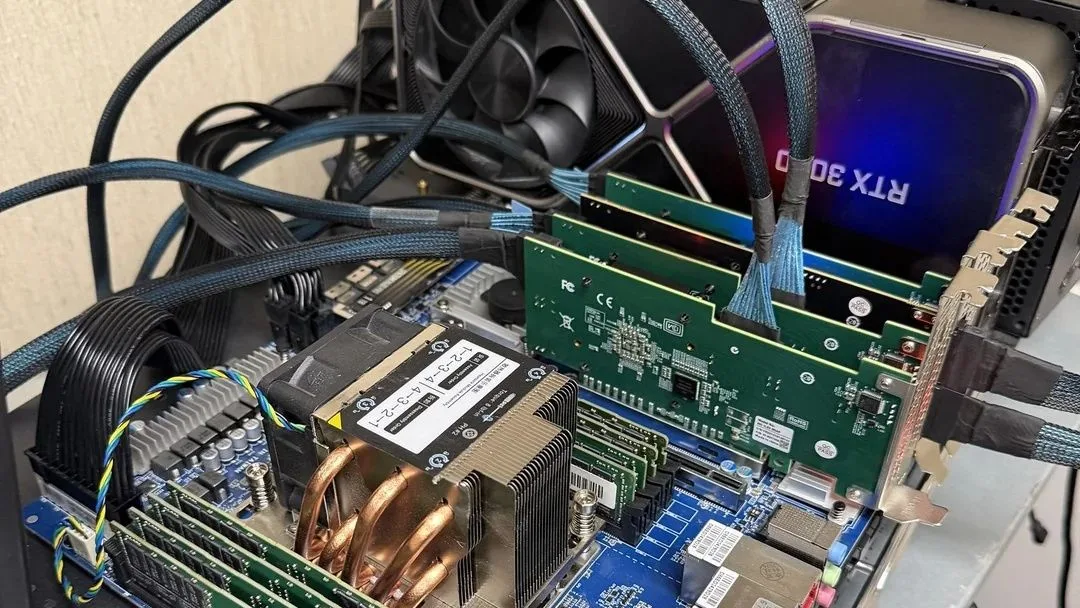
Nick Mermiges, a trial lawyer based in Columbia, South Carolina, has published an update to his custom AI server setup. The system, built around eight Nvidia V100 GPUs, now executes roughly 80 percent of DeepSeek V4.1 Flash's operations at NVFP4 precision—a 4-bit floating-point format—rather than the previous 2-bit quantization. The upgrade required adding 1TB of RAM and an RTX 3090 to the configuration. The tradeoff is measurable: throughput declined from 160–215 tokens per second to 150–180 tokens per second, though the system stability issues that plagued the earlier build have disappeared.
Mermiges founded PLI Labs and proprietarylegal.ai, which provides on-premises language model hosting. His other company, PLI (Proprietary Legal Intelligence), operates as a technology consultancy. He wraps DeepSeek with what he calls a "legal harness"—a set of workflows and validation checks designed for legal practice. The original build, dubbed "Volta sPLIt," has been renamed "Volta Max uPLIft" to reflect the improvements.
Mermiges built the software layer using Claude Code, an AI tool that wrote custom kernels and executed benchmarks under his direction. Anthropic's Opus 5.5 and Fable 5.2 models handled optimization work and re-quantization tasks. He initially attempted to build a legal harness around Claude from February through July, but those efforts with local models failed until DeepSeek V4.1 Flash became available. He successfully ported the system to that model, though he acknowledges it does not match frontier models in capability.
The V100 GPUs remain on "borrowed time," running on R580, the final Nvidia driver branch that supports them. Mermiges has emphasized that "the documents never leave the office," underscoring the on-premises nature of the deployment. The system now meets his earlier goal of handling multiple simultaneous requests.
Precision and Expert Routing
DeepSeek V4.1 Flash relies on a mixture-of-experts architecture, with 384 routed experts across 40 layers totaling 15,360 experts. At official precision, the full model requires approximately 269 GiB. Eight V100 GPUs provide 256 GiB of memory before accounting for other system requirements, making full-precision loading impossible.
Mermiges's solution keeps all experts on the cards at 2-bit precision and selectively upgrades the most-used experts to NVFP4 until memory fills. This approach loaded approximately 38.7 percent of experts—5,949 out of 15,360—at the higher precision. The determination of "most-used" experts came from analyzing a balanced mix of four text categories, including traffic from his own legal harness.
During inference, between 80 and 86 percent of expert routing calls land on the NVFP4 experts when running a single request, with the lowest percentage for general text and the highest for source code. When running two simultaneous requests, the prediction drops to 78 to 85 percent, with the remaining 15 to 22 percent of calls routing to 2-bit experts.
Fidelity Improvements
Benchmarked against Nvidia's official NVFP4 version of DeepSeek V4.1 Flash, the upgraded system showed measurable gains in output fidelity. The percentage of tokens matching the reference model increased to 95.1 percent from 92.2 percent. KL divergence, which quantifies the distance between the system's probability distributions and the reference's, fell to 0.079 nats from 0.196. On a standard multiple-choice knowledge test with 513 questions, the number of answers that differed from the reference dropped from 79 to just 8.
These measurements reflect improvements in fidelity rather than accuracy, which remained roughly constant across all configurations. The tests were conducted on the initial single-request build, not on the current two-request setup.
Performance Trade-offs
The precision upgrade reduced throughput across different workload types. Code output slowed by 3 to 30 percent depending on prompt length, while legal writing output decreased by 9 to 23 percent. Before the upgrade, Mermiges targeted approximately 80 tokens per second for legal and prose tasks; the new single-request benchmarks achieved 86 to 106 tokens per second for legal writing and 78 to 86 for prose.
Running two requests simultaneously raises total throughput to 159.0 tokens per second, compared to 118.9 with a single request. First-token latency also improved, arriving in 108.4 seconds versus 118.7 seconds at 256K tokens.
Each additional request consumes a "slot" that maintains its own state on the GPUs, reducing the number of experts that can be stored at NVFP4 precision. With one, two, and three slots, the system can maintain 6,215, 5,949, and 5,663 NVFP4 experts respectively. Adding slots pushes one to two percentage points of routing calls back to 2-bit precision, potentially affecting output quality.
Hardware Changes
Mermiges upgraded the system's memory this week, replacing eight 32GB modules running at DDR4-2666 with eight 128GB modules operating at 2,933 MT/s. The previous configuration suffered from ECC errors. After the upgrade, the system reported two NUMA nodes; two boot attempts hung during inter-board transfers, prompting a software reordering of the GPU arrangement. The GPUs remain capped at 1,522 MHz.
Stability issues in the earlier build were traced to a faulty power supply rather than PCIe problems as initially suspected. After replacing the power delivery and adding additional cooling fans, nine consecutive long inference runs completed without errors. Temperature readings showed no change after the fan addition, indicating airflow was not the underlying issue.
Future Expansion
Mermiges already operates two DGX Sparks running the same model at 1M context for agent workloads, supporting three or four concurrent sessions. His expansion plans include eight additional V100s and a second server equipped with 512GB of 3,200 MT/s ECC RAM. The second system would run another high-precision DeepSeek instance for additional agent work or parallel task execution. He also intends to offload DeepSeek's small draft model from the V100s to the RTX 3090, though this has not yet been implemented.