Top External SSDs and Hard Drives: Our Latest Test Results
We've evaluated dozens of external storage devices to identify the models that deliver the best combination of speed, reliability, and value for different use cases.
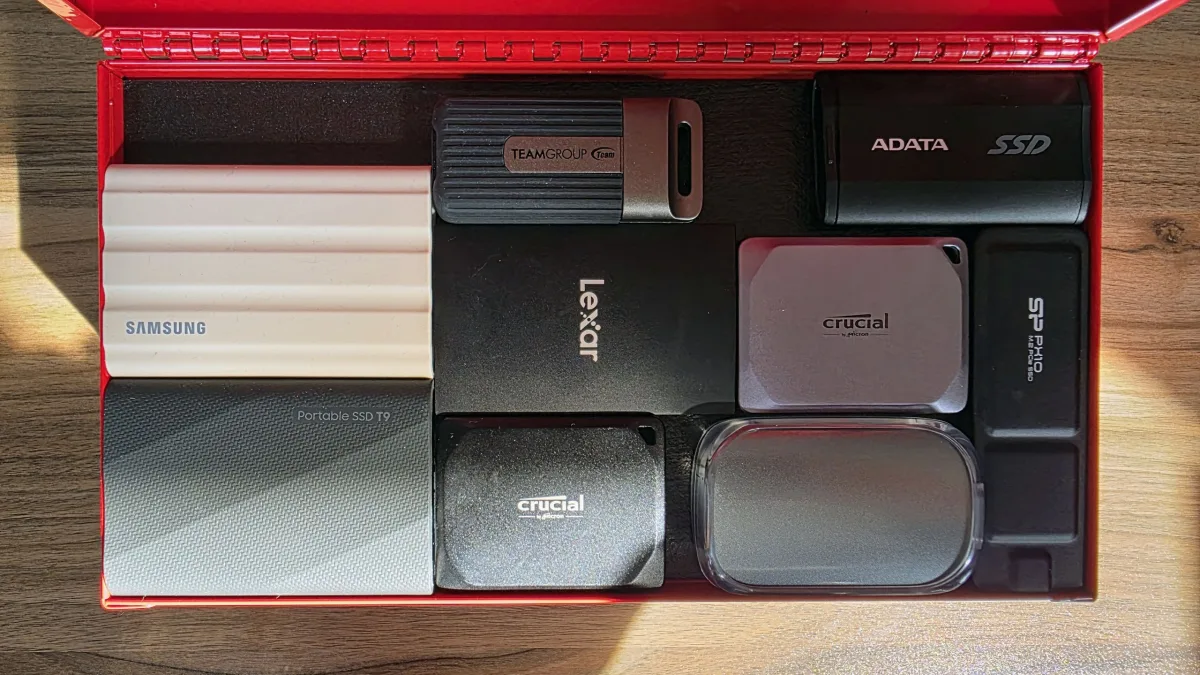
Our testing team has assessed numerous external SSDs and hard drives available today. My experience with storage technology spans from the early days of OCZ and Intel SATA drives in the early-to-mid 2010s—when Samsung already dominated the market—through the evolution to M.2 form factors, from SATA to PCIe and eventually NVMe PCIe. At Tom's Hardware, I've maintained focus on external storage and flash drive testing while tracking the industry's ongoing advances.
As of September 9, 2026, the storage market faces significant headwinds. More than a year of AI hyperscaler-driven hardware shortages has disrupted availability and driven up prices for products containing RAM and storage. While older, more established portable SSDs remain relatively stable in cost, newer models command premium pricing, and inventory for budget-friendly options fluctuates considerably. Price swings for individual models can be dramatic over short periods. We work to track these shifts, but some recommendations below may face stock issues or higher-than-expected costs when you attempt to purchase.
Recent testing updates include Orico's BookDrive P10Plus (March 2, 2026), which features MagSafe-compatible magnetic backing and a PD passthrough charging port, though sustained write performance fell short of our standards. We also examined USB4 drives from LaCie and SanDisk in November 2025. LaCie's Rugged SSD4 impressed with cross-platform speed, while the SanDisk Extreme Pro With USB4 delivered disappointing write results in our benchmarks.
Best Portable SSD
1. SanDisk Pro-G40 SSD
Specifications
- Drive Type: Portable, Internally M.2 2280
- Transfer Protocol: USB-C / Thunderbolt 3 & USB Gen 3.2 Gen 2x1
- Sequential Reads: Up to 2,700/1,900 MBps (1,050/1,000 MBps USB) R/W
The SanDisk Pro-G40 stands out as a well-rounded portable SSD with solid performance and dependable consistency. Supporting both Thunderbolt 3 and USB modes, it accommodates a wide range of devices, though you may require a Type-C to Type-A adapter or cable. Performance across the board is reliable, with particularly strong write capabilities and consistently fast operation. Although built on mature hardware, this platform delivers excellent results for portable use. The metal and rubberized exterior provides both thermal management and environmental protection.
The main drawback is cost. Those without Thunderbolt requirements might prefer alternatives like the Samsung T7 Shield. You could also assemble your own portable solution using an appropriate enclosure paired with a separate drive. For users prioritizing premium portability and performance in a rugged form factor, the Pro-G40 merits consideration.
Best External Hard Drive
2. WD My Passport
Specifications
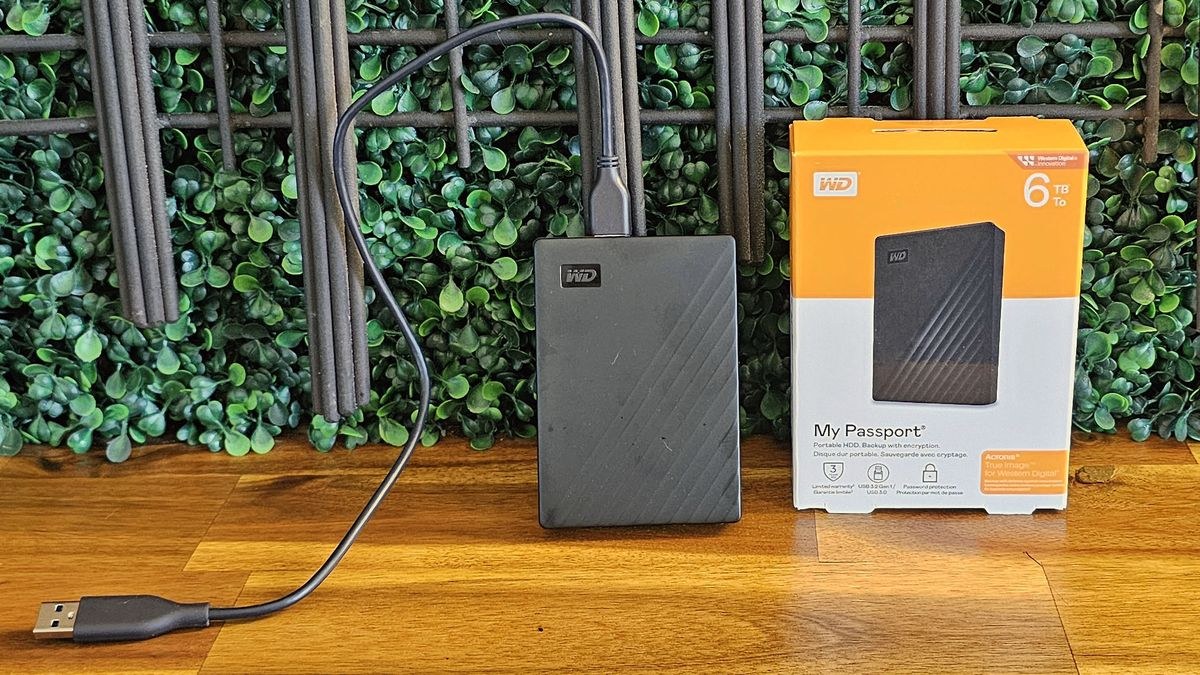
- Transfer Protocol: USB 3.2 Gen1 (USB 3.0)
Western Digital's My Passport represents an excellent choice for external hard drive shoppers. It brings a proven track record, password protection, and recently expanded capacity options reaching 6TB, enabling substantial data storage with security. Street pricing has declined, improving its value proposition. The design is attractive, and it includes a generous 3-year warranty. Security features consist of AES 256-bit hardware encryption with password protection to safeguard your files.
We recently tested the 6TB variant of the My Passport. This version is somewhat thicker and heavier than the 5TB model but delivers comparable performance. For those requiring additional capacity, it functions well. However, the extra terabyte carries a $50 premium, so evaluate whether you genuinely need that additional space before committing to purchase.
Best USB4 SSD
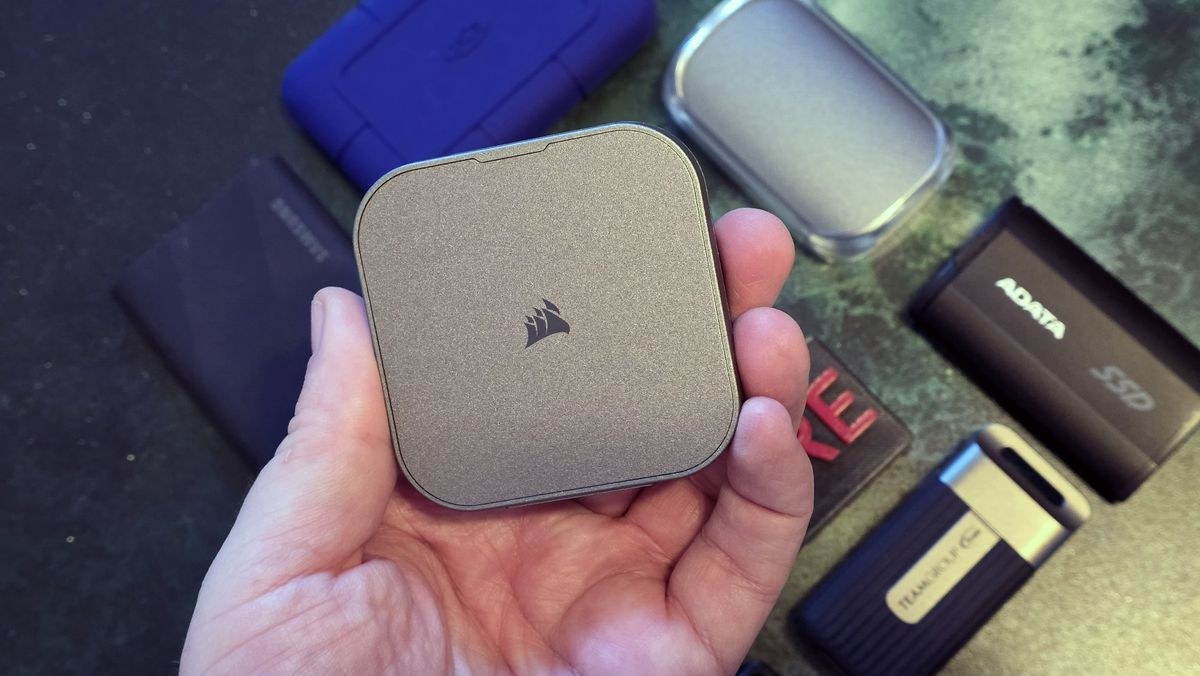
3. Corsair EX400U
In the USB4 category, which enjoys broader adoption than the faster Thunderbolt 5 standard, Corsair's EX400U achieves an appealing equilibrium between performance and affordability. Sequential testing demonstrates read capabilities exceeding 4,000 MBps and write speeds surpassing 3,700 MBps. Sustained Iometer testing revealed the drive maintaining write speeds between 1,600 and 1,700 MBps across 15 minutes, demonstrating minimal slowdown after cache depletion. At approximately $189 for the 2TB model and $349 for 4TB, it's not inexpensive, yet it undercuts LaCie's Rugged SSD Pro5 Thunderbolt 5 drive, which commanded $329 for 2TB and $529 for 4TB at the time of writing. The Corsair includes a rear magnet enabling attachment to modern iPhones and certain Android phones, proving useful for high-resolution video capture.
Corsair also offers a 1TB configuration (around $119), which LaCie's drive lacks. Given that Corsair's drive surpasses the speed and future-readiness of 20Gbps options like the Crucial X10 Pro, those older drives become difficult to justify, as they frequently sell at comparable prices to the speedier EX400U.
Best SSD for Travel
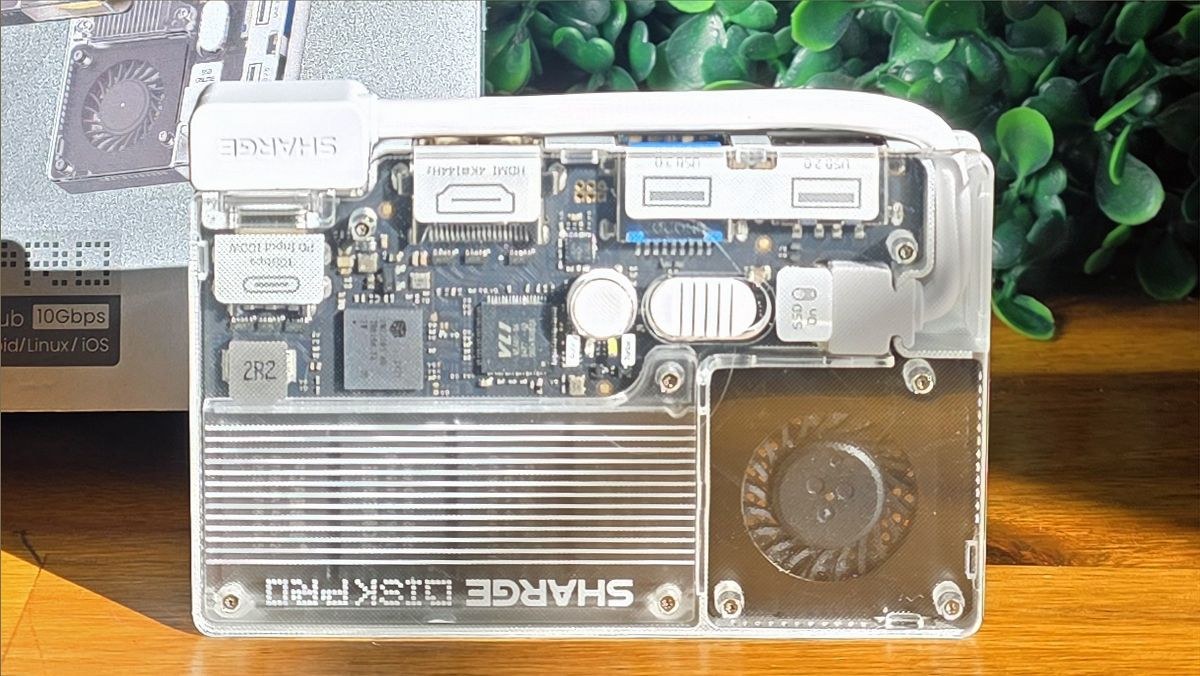
4. Sharge Disk Pro
The Sharge Disk Pro may represent the most compelling, creative, and practically valuable 10 Gbps drive I've encountered in testing. Its integrated USB and HDMI hub makes it ideal for travel or mobile work scenarios (provided you carry a USB-C connector with a slim profile). Performance aligns closely with category leaders—differences would only appear in benchmark results.
For professional applications, Sharge's drive demonstrated outstanding sustained write performance, likely benefiting from active cooling, maintaining speeds above 900 MB/s throughout our complete 30-minute Iometer benchmark. For workflows involving massive file transfers or write-intensive tasks, this ranks among the finest 10 Gbps drives I've tested. A magnetic rear surface simplifies use with compatible phones.
Among all drives tested in recent years, if 10 Gbps sufficed for my needs, this would be my choice for travel. Since my laptop lacks sufficient ports, I avoid concerns about performance degradation when transferring terabytes of photos, video, or other content to the drive.
Best Fast Cross-Platform SSD
5. LaCie Rugged SSD4 4TB
Specifications
- Warranty: 3 Years (includes data recovery)
LaCie's Rugged SSD4 occupies a distinctive market position. Windows and Android users with USB4 access will find Corsair's EX400U nearly equivalent in many tests while spending less. Mac users with current hardware may prefer LaCie's Rugged SSD Pro5, which delivers significantly faster performance on Thunderbolt 5 equipped machines.
For creators and enthusiasts managing production workflows or portable file requirements spanning multiple platforms, the LaCie Rugged SSD4 provides the fastest performance we've documented across Windows and Mac systems. Testing revealed sequential speeds around 4,000 MB/s reads and 3,700 MB/s writes in Windows 11, with somewhat reduced but still competitive reads on a current-generation Mac Mini of 3,440 MB/s reads and 3,093 MB/s writes. Combined with three years of included data recovery service, the Rugged SSD4 merits recommendation for those prioritizing speed and security while operating across Windows, macOS, and potentially Android and iOS platforms (though we did not test the latter two).
Most Conveniently Secure Portable SSD
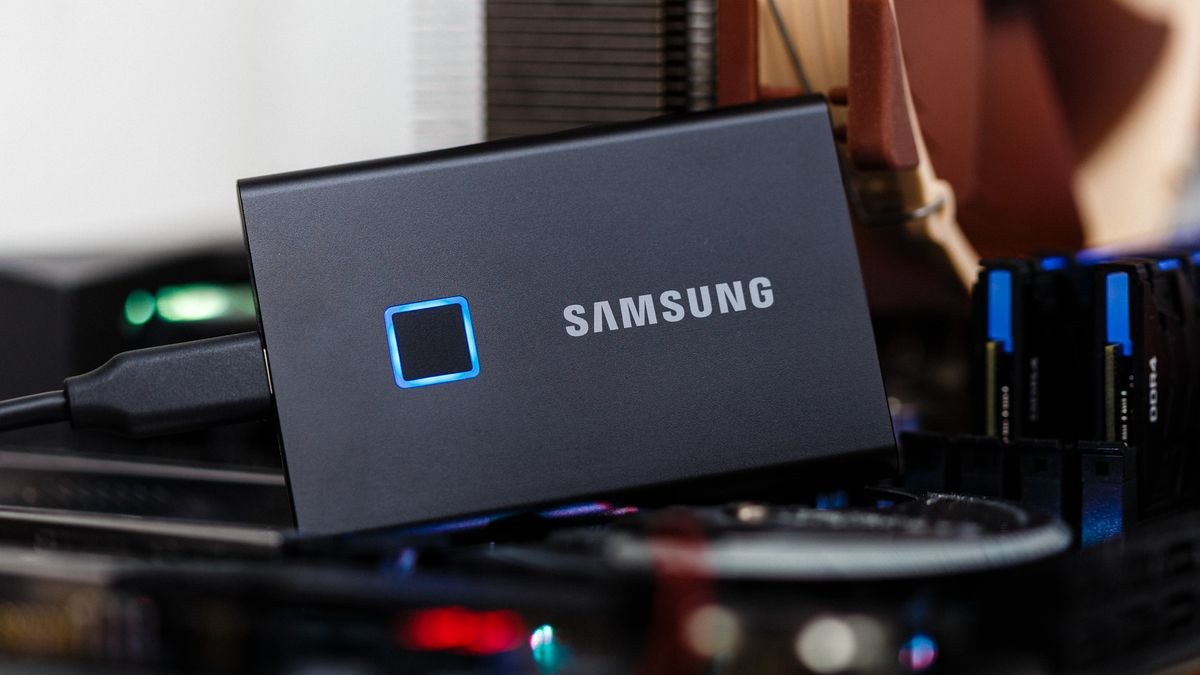
6. Samsung T7 Touch
Samsung's T7 Touch merges USB 3.2 Gen 2 performance with convenient AES 256-bit hardware security unlocked via fingerprint authentication. The integrated fingerprint scanner represents the most user-friendly data access method we've encountered. The aesthetic is refined, surpassing typical portable drive design standards. Aluminum construction provides durability, and multiple color choices accommodate personal preferences.
That said, G-Technology's recent ArmorLock drive presents competition in the secure storage category by employing an app and key stored on your Android or iOS phone to unlock access. While less convenient than swiping a finger across an onboard sensor, this approach may offer superior security.
Best Thunderbolt 5 Portable SSD
7. LaCie Rugged SSD Pro5
Specifications
- 6GBps / 5GBps reads / writes over Thunderbolt 5
- Warranty includes 5 years of data recovery service
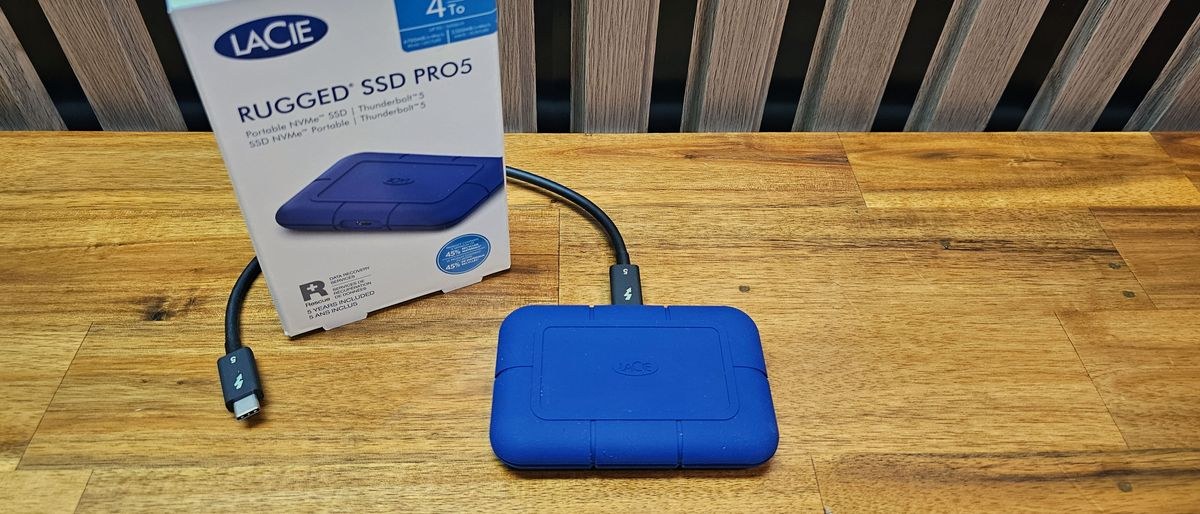
The LaCie Rugged SSD Pro 5 pairs a battle-tested rugged design with the fastest single-drive speeds we've ever measured on an external SSD when tested on Thunderbolt 5-equipped Mac hardware. It includes five years of Seagate data recovery service, making it straightforward to recommend for Mac users—particularly those exclusively or primarily using current-generation Mac systems and requiring maximum performance for media production or other write-heavy operations.
Compatibility with older hardware proves complex enough to warrant its own dedicated page. In Windows 11 testing via USB4 and Thunderbolt 4 ports, it underperformed compared to native USB4 drives. Until Thunderbolt 5 becomes more prevalent across Mac and PC platforms, this drive isn't optimal for workflows incorporating Windows computers.
Drives that didn't make the list
Not every drive we test earns a top recommendation. However, pricing fluctuates, and storage requirements vary by user. Should any of these models go on sale and appeal to your needs based on performance, they warrant consideration.
The SK hynix Tube T31 functions as a flash drive or SSD stick due to its familiar flash drive form factor, though it houses an actual M.2 SSD on a compact PCB internally. It delivers impressive speeds for a flash drive, features a USB-A port capped at 10Gbps, and comes in 512GB and 1TB capacities only. If these constraints suit your needs, it deserves consideration and appears on our best flash drives list.
Adata's SD810 functions as a conventional external SSD and offers surprising affordability for a 20Gbps device. It excels at bursty operations like moving several gigabytes of files or running light applications. However, our testing revealed that under sustained high-speed writes, its cache depletes rapidly, causing the drive to write at hard-drive speeds until the cache recovers. This limitation won't affect everyone. But if you're investing in a 20Gbps drive, you should probably select one that maintains that speed more effectively.
Team Group's PD20 is a 20Gbps drive available in capacities up to 4TB. It features an attractive silver plastic and black rubber shell, but its performance in our testing didn't distinguish itself against competitors, particularly regarding sustained writes. The drive still performs adequately for most everyday tasks that many users will find satisfactory. If the design appeals to you, it's worth considering, especially if you locate it at a discount.
How We Test External SSDs
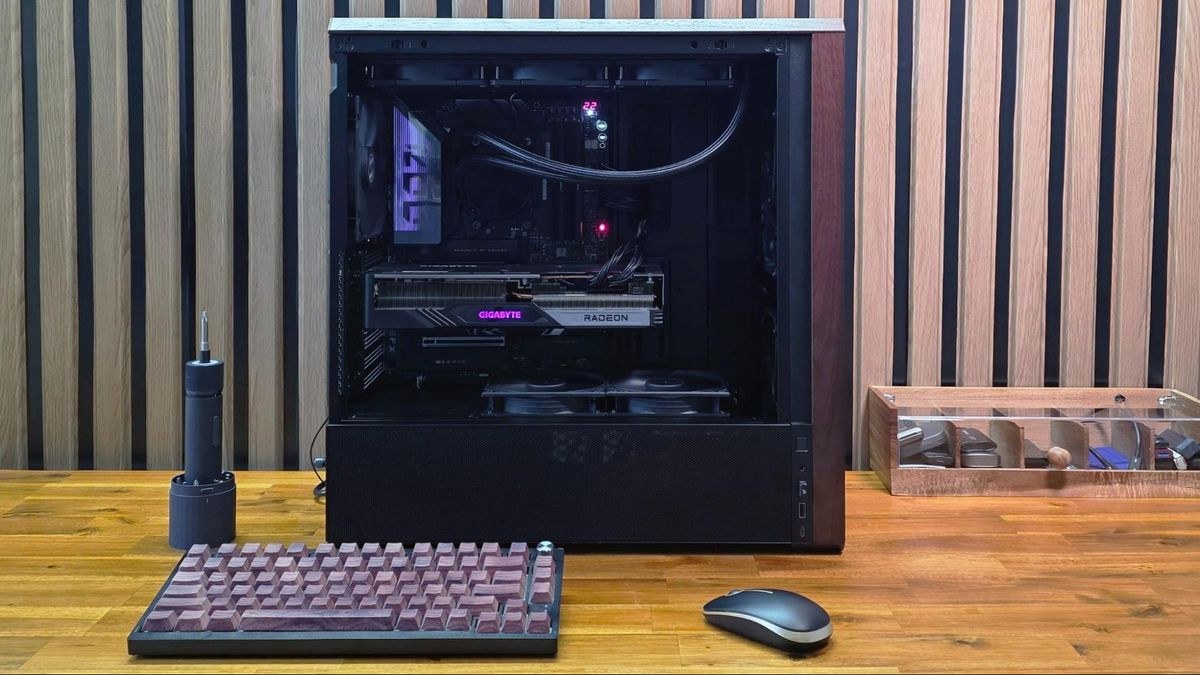
During 2025, we refreshed our external storage testing platform to an AMD Ryzen 7600X-based PC with an Asus ROG Crosshair X870E Hero motherboard, housed in Lian Li's Lancool 217 case. This upgrade was necessary partly because we required a system with native USB4 support.
All drives listed below underwent retesting on the new X870E system, with the exception of the final Iometer sustained sequential test. This benchmark emphasizes endurance over peak speed, measuring how long a drive can write before exhausting onboard fast cache. We also transitioned to CrystalDiskMark 8, replacing the older and incomparable version 7 used on the previous testbed.
Trace Testing: PCMark 10 Storage Benchmark
PCMark 10 employs trace-based methodology, utilizing a comprehensive collection of real-world traces from popular applications and routine tasks to evaluate storage device performance. We document both the proprietary overall score and bandwidth measured during execution.
Transfer Rates: DiskBench
DiskBench storage benchmarking software measures real-world file transfer performance using a custom 50GB dataset. We transfer 4,617 files (images, videos, and software ISO files) to a test drive folder (write operation). After a five-minute idle period, we reverse the test, moving the folder to a different location on our PCIe 4.0 testing drive—a separate drive from our boot drive to prevent operating system background task interference that could skew results.
Synthetic Testing: CrystalDiskMark
CrystalDiskMark is a free, accessible storage benchmarking tool that SSD manufacturers commonly use to establish product performance specifications. It provides insight into how each device handles varying file sizes. We execute this test using default settings.
The sequential read and write test represents a best-case scenario, typically aligning closely with manufacturer specifications. The 4K read and write test measures how effectively the drive handles numerous small files, simulating workloads encountered when running programs, operating systems, or games directly from the drive.
Sustained Write Performance: Iometer
Rated write specifications tell only part of the performance story. Most external SSDs, like their internal counterparts, employ a write cache—a fast flash area programmed to function like faster SLC—that absorbs incoming data.
Sustained write speeds frequently suffer significantly when workload saturates the cache and transitions to native TLC or QLC flash. We employ Iometer to subject the SSD to sequential writes for 15 minutes, measuring write cache size and post-saturation performance. This test particularly distinguishes professional-grade drives from consumer models. Users regularly transferring massive file libraries to external drives, often filling them completely in single sessions, require fast sustained write speeds. Casual storage users transferring smaller files or libraries under 100GB may benefit from fast sustained writes but may not require them if they rarely write sufficient data at once from a fast source to deplete an SSD's fast SLC cache.
You can also make your own external SSD
If you possess a spare drive, constructing your own portable solution is straightforward. Numerous 2.5-inch drive enclosures available online for $10–$25 (£15–25) permit easy drive installation, converting old storage into external hard drives or SSDs. Faster 20, 40, or 80 Gbps enclosures command significantly higher prices.
Should you have an M.2 drive removed from a gaming laptop, ultrabook, or upgraded from a gaming PC, we've evaluated several DIY options to identify the Best SSD and Hard Drive Enclosures that accommodate drives you already own, transforming an old upgrade drive into speedy portable storage.
Ensure your enclosure matches your drive type—whether SATA or NVMe. Remember that DIY external drives typically lack sealing, so they won't resist dust and moisture as effectively as purpose-built external SSDs and portable hard drives.
Best External SSD FAQs
When selecting an external drive or SSD, evaluate the following considerations:
Portable Hard Drive or SSD?
What USB connection?
How much capacity?
Don't Use a Portable Hard Drive as Your Only Backup
Finding Discounts on the Best External Storage Drives
Whether shopping for a top-rated external storage drive or exploring alternatives not featured in our list, you may discover savings through current promotional offers from Crucial, Newegg, Amazon, Corsair, Samsung, or Micro Center.