SpaceX Pivots to AI Infrastructure, Plans Ambitious Starship Reuse Schedule
During an earnings call, SpaceX leadership outlined a shift toward data center deployment and revealed plans to attempt catching both stages of Starship on the next test flight, targeting a weekly launch cadence by mid-2027.
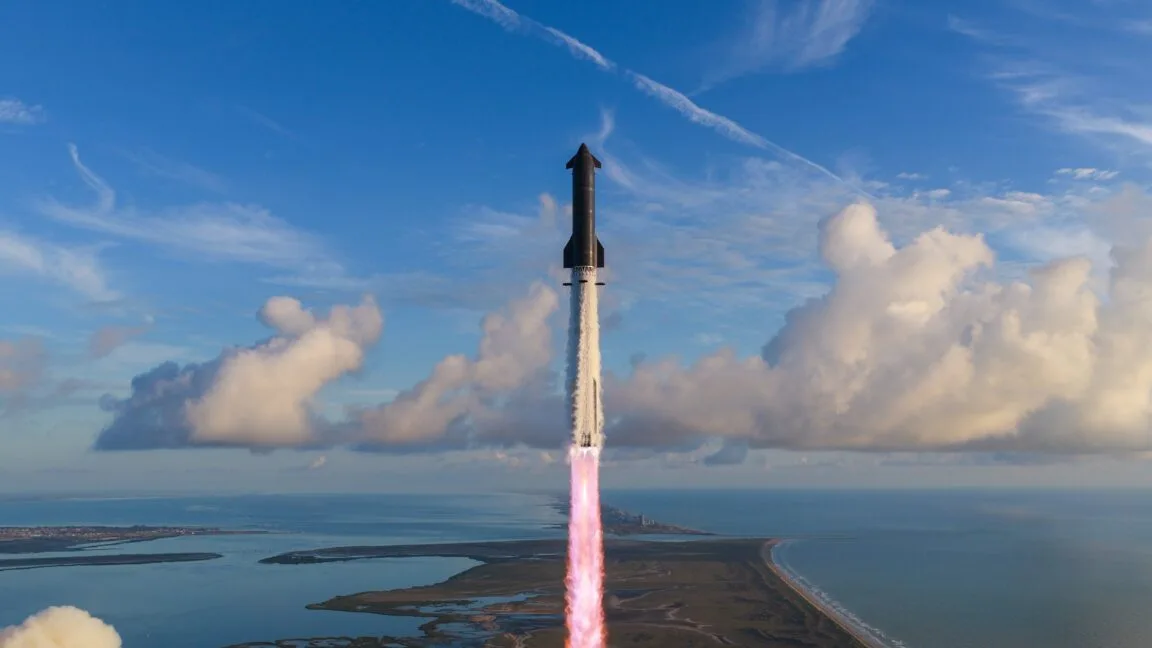
SpaceX has repositioned itself as a data infrastructure company focused on delivering artificial intelligence compute capacity rather than pursuing its earlier Mars settlement ambitions. At a Tuesday earnings call, executives outlined plans to deploy as much as 10 GW of compute capacity by 2027, with infrastructure based on the ground.
The company's long-term vision for delivering data services from orbit—beginning with the Starlink satellite network and eventually through a "Starmind" constellation of orbital data centers—still depends on a functioning launch vehicle. That vehicle is Starship, and during the earnings presentation, SpaceX founder Elon Musk and president and chief operating officer Gwynne Shotwell disclosed new performance milestones for the system.
More than three weeks have passed since Starship's 14th test flight, which proceeded largely without major incident despite some Raptor engine complications. The data gathered from that mission has given SpaceX sufficient confidence to pursue catching both the Super Heavy booster and the Starship upper stage during the next flight attempt, Musk stated. He characterized the likelihood of success as "more likely than not," though he noted the company maintains sufficient hardware inventory to absorb potential failures. Both capture operations would occur at the Starbase facility in South Texas, with SpaceX targeting November for the 15th test flight.
Landing over land
A significant regulatory challenge stands in the way: Starship must complete its return trajectory over land, including airspace above northern Mexico. Shotwell stated that "We have had significant constructive engagement with the FAA, and we expect the license for our Flight 15 to include return to launch site and tower catch for both stages."
Following this test flight, SpaceX intends to reflew a Starship upper stage "early" in the coming year, according to Shotwell. The company also plans to execute a long-pending in-space refueling demonstration in early 2027. This Starship-to-Starship propellant transfer test represents a critical validation point for both SpaceX and NASA, establishing whether Starship can be refueled while in low-Earth orbit to support lunar landing missions.
No orbital vehicle has previously attempted refueling at this scale. SpaceX requires operational data on transfer efficiency and the rate at which liquid oxygen and methane boil away in the space environment. These measurements will inform calculations regarding the number of launches required to position a Starship on the Moon under NASA's Artemis Program.
For SpaceX, the immediate focus centers on accelerating Starship's flight rate and maximizing vehicle reusability to make that acceleration sustainable.
A weekly cadence?
Musk, known for setting aggressive timelines, projected that Starship would achieve a "weekly" flight cadence during the first half of 2027, escalating to twice-weekly launches in the second half. The determining factor will be how effectively Starship components can be reused across missions.
According to Musk, "The rate at which we launch Starship will increase dramatically as we solve rapid and complete reusability. At first there will be a little bit of refurbishment that's needed between each flight, and we'll iron out the need for any refurbishment such that you can immediately land the rocket and launch it again, just like an airplane."
This represents the theoretical end state, though achieving complete reusability with an orbital-class rocket remains unproven. SpaceX's engineering organization will certainly encounter substantial technical obstacles along the way. Nevertheless, the trajectory suggests the company may eventually approach a model where rockets launch, land, and return to flight without extended downtime.
SpaceX plans to dedicate most of 2027 Starship launches to its own payloads. Shotwell indicated the company would continue deploying Starlink V3 satellites—the second generation of "mobile" satellites providing direct-to-cell service—alongside Starmind data center prototypes. Neither Musk nor Shotwell addressed questions during the earnings call regarding the controversial throttling of Starlink capabilities for Ukraine amid its conflict with Russia.