Researchers trace Chinese AI models to Nvidia Blackwell GPUs via statistical fingerprinting
An independent research team has identified statistical signatures in the weights of DeepSeek, Kimi, and other Chinese AI models that match patterns produced by Nvidia's export-controlled Blackwell chips during training.

U.S. export restrictions on advanced Nvidia and AMD AI accelerators bound for China have become a focal point of industry scrutiny, and new findings suggest those controls may be circumvented in practice. UnemploymentLabs, a research organization, has produced evidence indicating that Nvidia's Blackwell silicon was used to train several open-weight Chinese language models, among them DeepSeek V4, Kimi K3.1, MiniMax-M3, and Ling-3.1-Flash.
The researchers emphasize caution in interpreting their work, stating that while their analysis is mathematically sound, it does not establish the physical location of the hardware, the means by which it was accessed, or whether any breach of export controls occurred. Renting Blackwell equipment from abroad by Chinese firms does not currently violate U.S. law, and American companies retain the ability to provide such services, as demonstrated by a recent arrangement between Tencent and Oracle.
The technique applies only to models with publicly available weights and relies on knowledge of both the hardware and software configurations used during training. Despite these constraints, the methodology proves both elegant and straightforward.
How the fingerprinting works
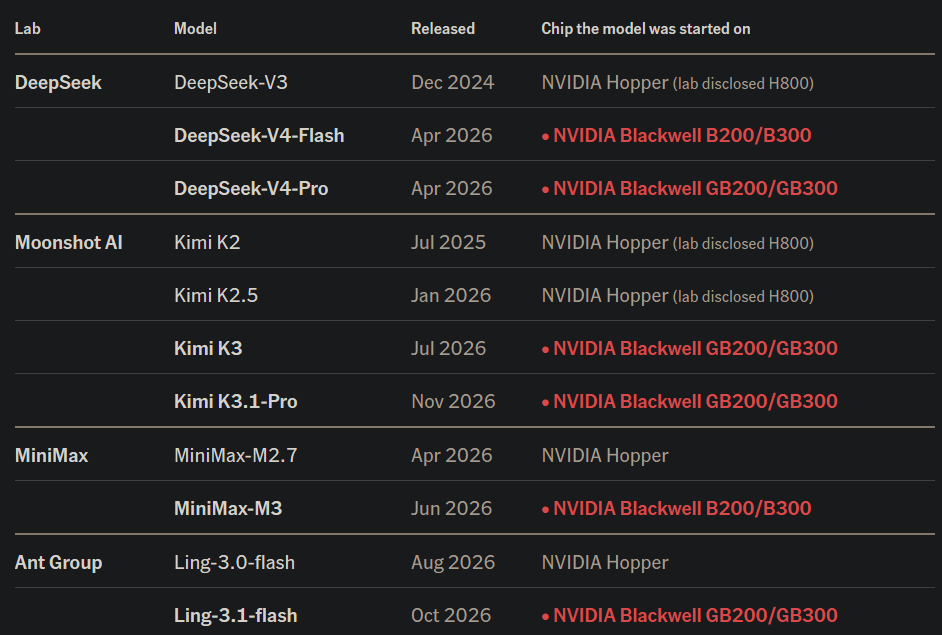
The foundation of this analysis rests on two key observations. Different GPU families contain distinct quantities of shader modules (SMs)—roughly equivalent to CPU cores—with Hopper chips featuring 132, Blackwell B series containing 148, and Blackwell GB variants holding 152. Additionally, PyTorch and its CUDA-compatible variants dominate the landscape of AI model training software on Nvidia hardware.
Model training begins with weight initialization, which determines how strongly the model processes each input. Modern large language model architectures randomize these initial values using cuRAND, a pseudo-random number generator that produces identical results when seeded with the same starting value.
This initialization process distributes computational tasks across all available SMs, which are further divided into threads. On both Blackwell and Hopper architectures, each SM manages 2,048 threads—a figure likely selected and refined for optimal performance.
The UnemploymentLabs team replicated the initialization procedure using identical hardware, software, and thread configurations. Through basic statistical methods, they discovered that the resulting weight distribution matched precisely with that of DeepSeek, Kimi, and comparable models. When they adjusted the SM and thread counts, the correlation vanished entirely, confirming the specificity of their approach.
This technique enabled identification of which Blackwell or Hopper chip family trained each model and provided an approximate estimate of the number of cards deployed. The analysis cannot, however, distinguish between specific variants within a family, as the fingerprint depends solely on initialization structure—SM count and usage patterns—rather than on VRAM capacity, memory bandwidth, or other distinguishing characteristics.
Testing alternative hardware
The researchers considered whether AMD accelerators such as the MI300X or other processors with sufficient SM counts running the same software stack could produce similar signatures. While theoretically possible to configure an AMD card to emulate two groups of 152 or 148 shaders, they noted little practical incentive to do so. For DeepSeek V4 specifically, they examined the actual weight values themselves and determined that AMD hardware could not generate the same weight distribution pattern.