OpenAI Engineer Arrested for Planting Hidden Recording Device in Executive Conference Room
A 35-year-old Saudi national employed at OpenAI has been charged with installing a covert listening device in a company meeting room, facing up to five years in prison and a $250,000 fine.

Abdulrahman Alfozan, a 35-year-old national of the Kingdom of Saudi Arabia, was arrested after allegedly concealing a recording device inside OpenAI's executive conference room. According to the Department of Justice, Alfozan installed the covert listening apparatus in the back of a television on or about September 28, and it was discovered days later. The device was identified as a Seeed Xiao ESP32-S3 Sense, a thumb-sized development board available for $14 on seeedstudio.com and listed at $24 on Amazon.
According to the complaint unsealed today, Abdulrahman Alfozan allegedly concealed a covert recording device inside his employer's executive conference room to secretly capture sensitive communications about the company's super intelligence technology. Protecting American SI innovation is essential to safeguarding our nation's economic strength and national security, and the FBI views that mission as one of our highest counterintelligence priorities.
FBI Director Kash Patel

The FBI characterized the Seeed Xiao ESP32-S3 Sense as featuring a detachable camera sensor, digital microphone, and microSD storage. Seeed Studio markets the device for embedded machine learning applications, including intelligent voice and vision AI. The device's built-in microphone and support for 2.4 GHz Wi-Fi and Bluetooth Low Energy would have enabled Alfozan to retrieve recordings remotely without physically accessing the television. Security personnel observed Alfozan on October 5 examining the back of the television where the device had been placed. Additionally, when OpenAI security inspected his unattended bag, they allegedly found another similar recording device alongside his wallet and identification.
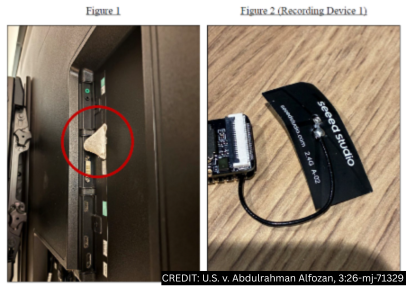
Investigators discovered that Alfozan used a productivity tool to access information about OpenAI's office locations, meeting rooms, calendars, external partner meetings, and the whereabouts of company leadership. He also allegedly used a chatbot account registered under his spouse's name—which bore similarities to his own account—to research how to construct, customize, install, test, conceal, and remotely access audio recording equipment. His searches included queries such as "build a continuous audio recorder," "customize Wi-Fi connectivity," "improve audio and live listening," and "encrypt the SD card." The DOJ noted that the same chatbot account submitted prompts specifically about the recording device discovered in the meeting room, including references to its custom header and unique MAC address.
The motivation behind Alfozan's alleged actions remains unclear—whether he was acting independently, on behalf of a competing AI company, or as an agent of a nation-state. While Anthropic and OpenAI have previously accused Chinese AI laboratories of conducting distillation attacks, this marks the first documented arrest of an individual for installing surveillance equipment inside an American AI research facility. The FBI continues its investigation to determine whether Alfozan acted alone or as part of a broader scheme involving commercial and industrial espionage targeting artificial intelligence companies. If convicted, Alfozan faces a maximum of five years in prison, a $250,000 fine, and three years of supervised release.