Modders Successfully Port RTX 50-Series Feature to Older GPUs, Raising Questions About Nvidia's Restrictions
A new mod brings Multi Frame Generation to RTX 40-series cards, and testing shows the feature works reliably on older hardware—though latency behavior reveals some quirks in the unofficial implementation.
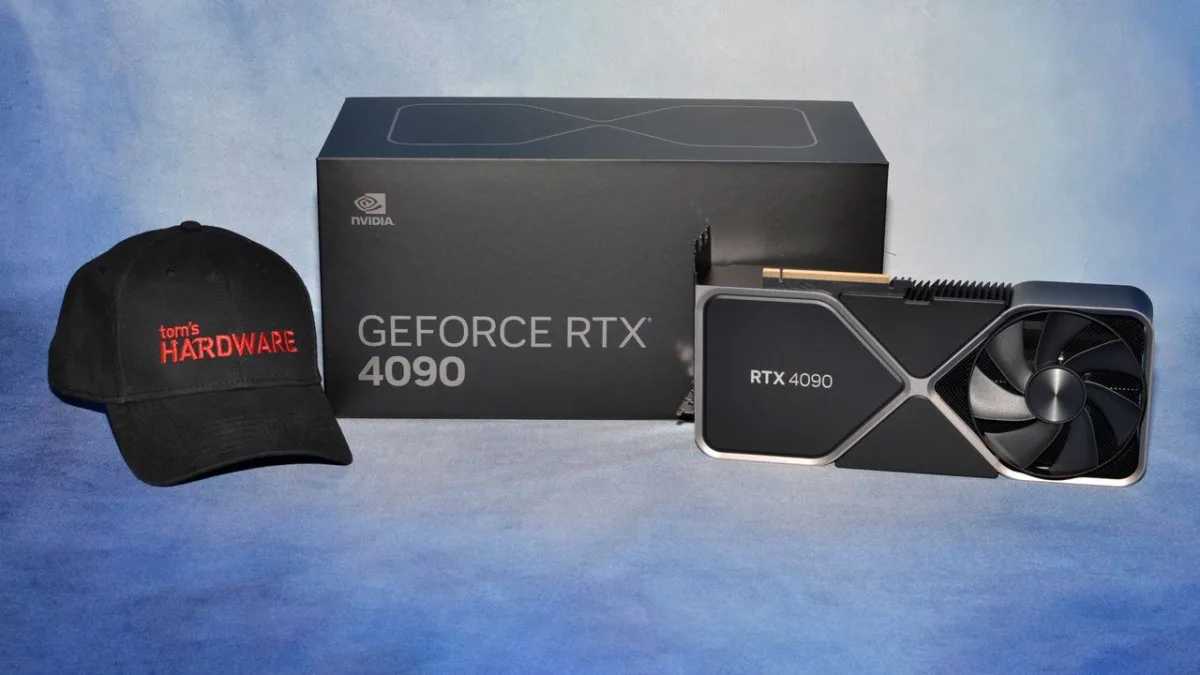
The modding community has achieved what Nvidia positioned as impossible: enabling Multi Frame Generation on GeForce RTX 40-series graphics cards. Following the discovery of DLSS 5 code in a prerelease build of NBA 2K27, modder dashdogy developed a workaround that ports this smoothness-boosting feature—marketed as exclusive to the new RTX 50-series lineup—to older Ada architecture cards.
With graphics card costs climbing and hardware upgrades becoming increasingly expensive, PC gamers are motivated to extend the lifespan of existing RTX 40-series equipment. The availability of performance-enhancing features like MFG through mods could make that strategy viable, especially if implementation proves stable and responsive.
To evaluate the mod's effectiveness, we tested it in Cyberpunk 2077 using the latest instructions available on dashdogy's GitHub page. The game's comprehensive support for modern rendering techniques—including ray tracing, path tracing, DLSS Super Resolution, Ray Reconstruction, and Multi Frame Generation—made it an ideal testbed for pushing older hardware to its limits.
Functionality and Visual Behavior
Initial testing confirmed the mod functions as intended. When panning the camera at high speeds, increasing MFG multipliers beyond the standard 2X factor supported on Ada cards noticeably enhanced perceived smoothness in motion. The same visual artifacts that appear on RTX 50-series hardware when using MFG 4X and higher—including visual distortion at the bottom of frames—also manifested on RTX 40-series cards, suggesting the underlying technology operates identically across architectures.
Frame pacing remained stable during testing, though results depend heavily on display capabilities. A high-refresh-rate, G-Sync-compatible monitor like the ROG Strix XG27UCS mitigates most pacing issues. Without such a display, the practical benefits of MFG diminish significantly.
The Latency Question
The critical factor determining whether MFG delivers a playable experience involves input latency rather than raw frame rates. When frame generation allows nearly unlimited output frame rates, responsiveness becomes the limiting factor for usability. Testing employed Nvidia's FrameView app to measure latency, with 60 milliseconds identified as the threshold where player inputs and displayed frames begin noticeably decoupling in single-player AAA titles like Cyberpunk.
Exceeding this threshold significantly degrades the experience, introducing noticeable input lag and visual artifacts as the MFG model struggles to generate frames from increasingly sparse input data.
Testing Methods and Notes
Cyberpunk 2077 served as the primary test platform due to its comprehensive implementation of modern rendering features and high AI-generated pixel density per frame. All advanced rendering options were enabled to stress-test the modded implementation and expose potential weaknesses on RTX 40-series hardware.
Testing also incorporated a modded version of DLSS 5 to assess whether Blackwell GPUs demonstrate distinct advantages in neural rendering workloads. Since DLSS 5 is scheduled to arrive on RTX 40-series cards later this year, understanding current performance baselines proved valuable despite the same disclaimers applying to both mods.
Benchmarks used maximum raster settings, path tracing, and MFG 4X across three resolutions: 1080p with DLSS Balanced, 2560x1440 with DLSS Performance, and 4K with DLSS Ultra Performance. Testing covered cards from the RTX 4090 down to the RTX 4070, limited by time constraints and Cyberpunk's VRAM requirements. The 12GB RTX 4070 represented the lower boundary to avoid VRAM exhaustion complications.
1080p Performance Results
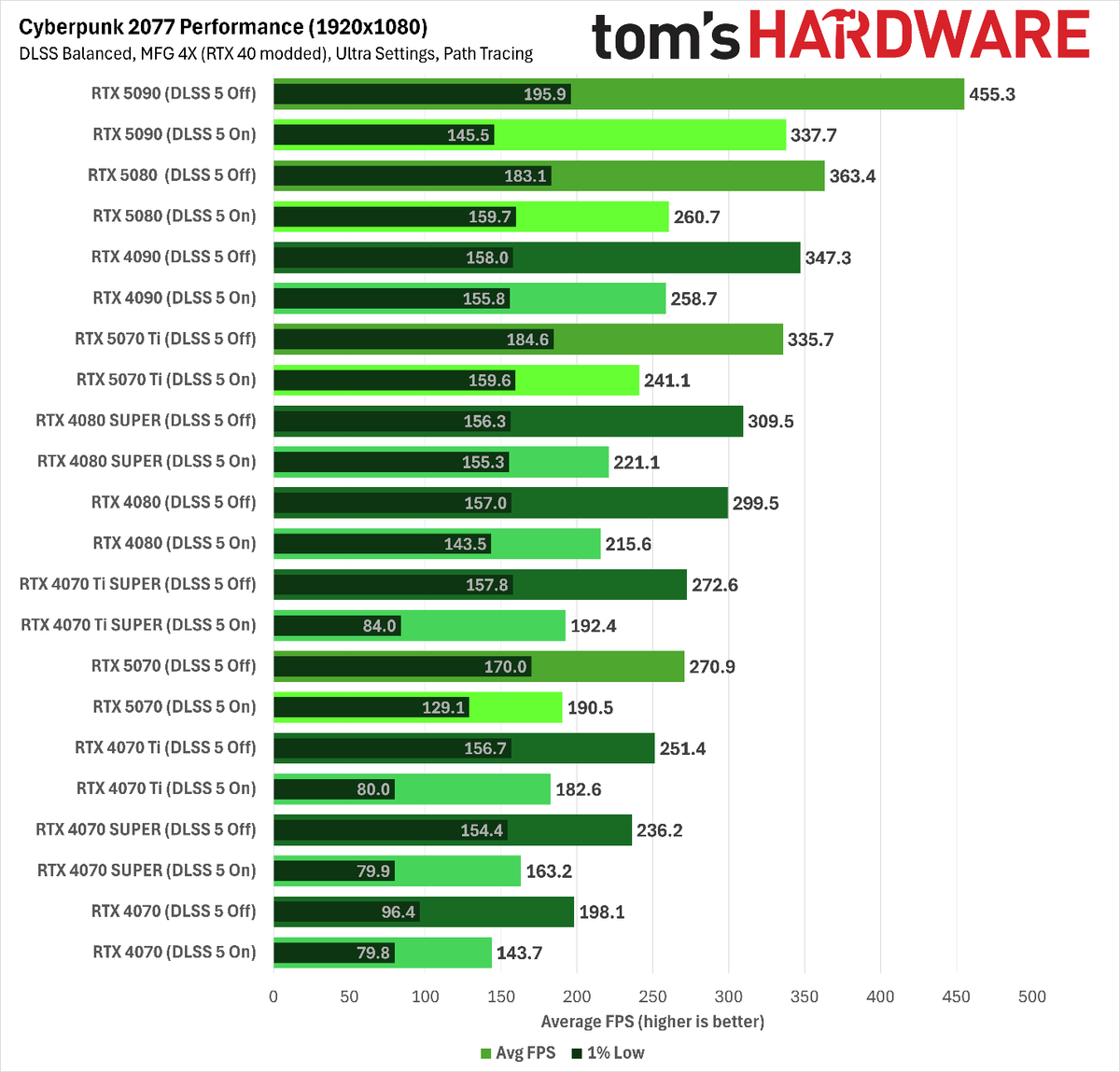
At 1080p, Ada architecture cards handled MFG 4X adequately, though Blackwell demonstrated superior scaling. The RTX 4090 positioned itself between the RTX 5070 Ti and RTX 5089. Adding the DLSS 5 mod widened gaps between average frame rates and 1% lows on the RTX 4070 Ti Super, RTX 4070 Ti, RTX 4070 Super, and RTX 4070, while the RTX 5070 maintained consistency.
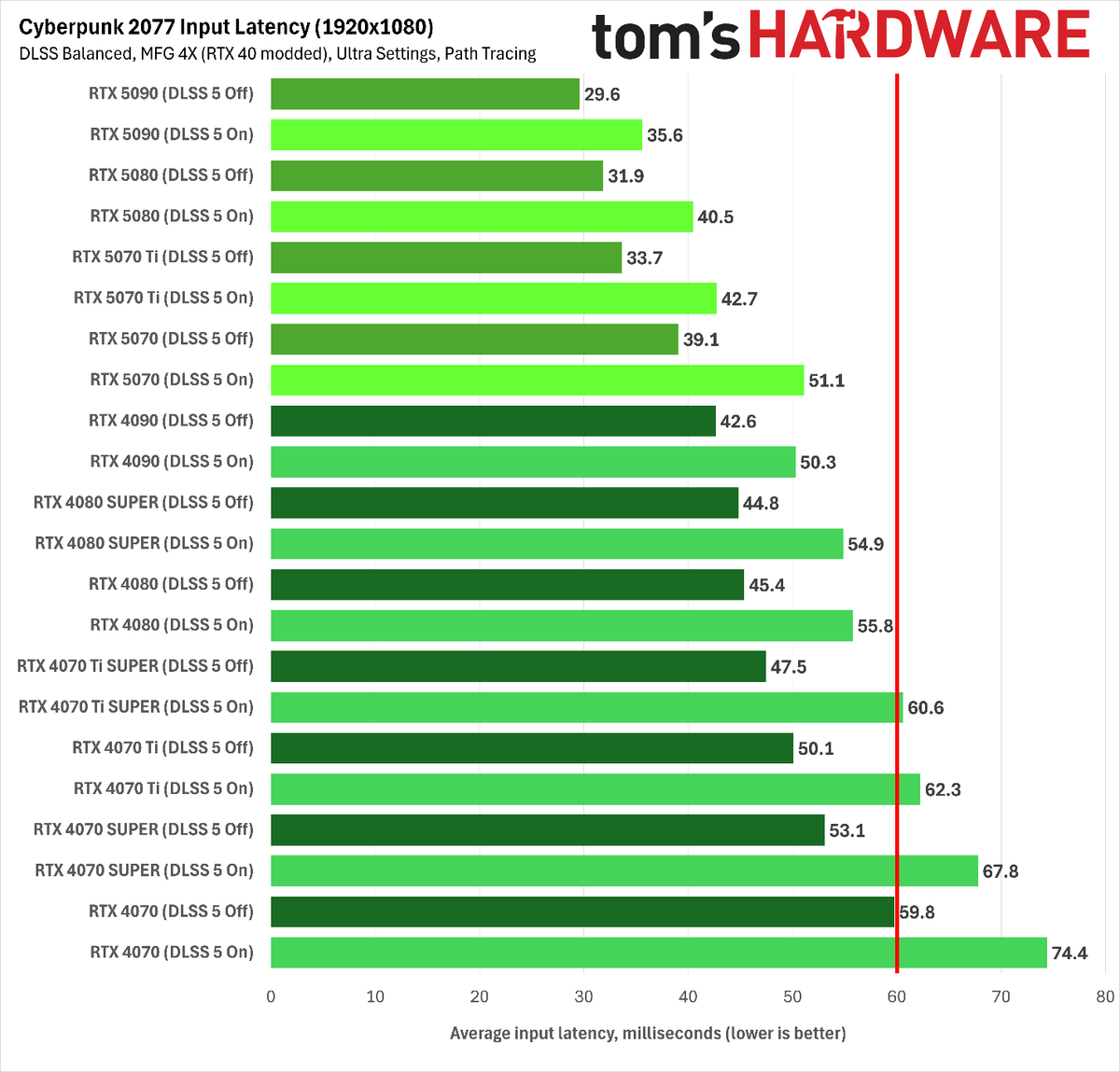
Latency measurements revealed all tested cards remained below the 60ms threshold with MFG 4X alone. Blackwell hardware showed clear advantages, with even the RTX 5070 delivering lower input latency than the RTX 4090 when DLSS 5 remained disabled. Only the RTX 4070 Super and RTX 4070 exceeded acceptable latency thresholds when DLSS 5 was enabled, but the RTX 4070 and higher cards provided sufficient headroom for practical use.
A streamlined version of the RTX 40-series MFG mod eliminating ReShade dependency emerged near publication, potentially reducing latency further, though it currently causes Cyberpunk 2077 crashes. This exemplifies the unpredictable nature of unofficial implementations compared to Nvidia's validated RTX 50-series support.
2560x1440 Performance Results
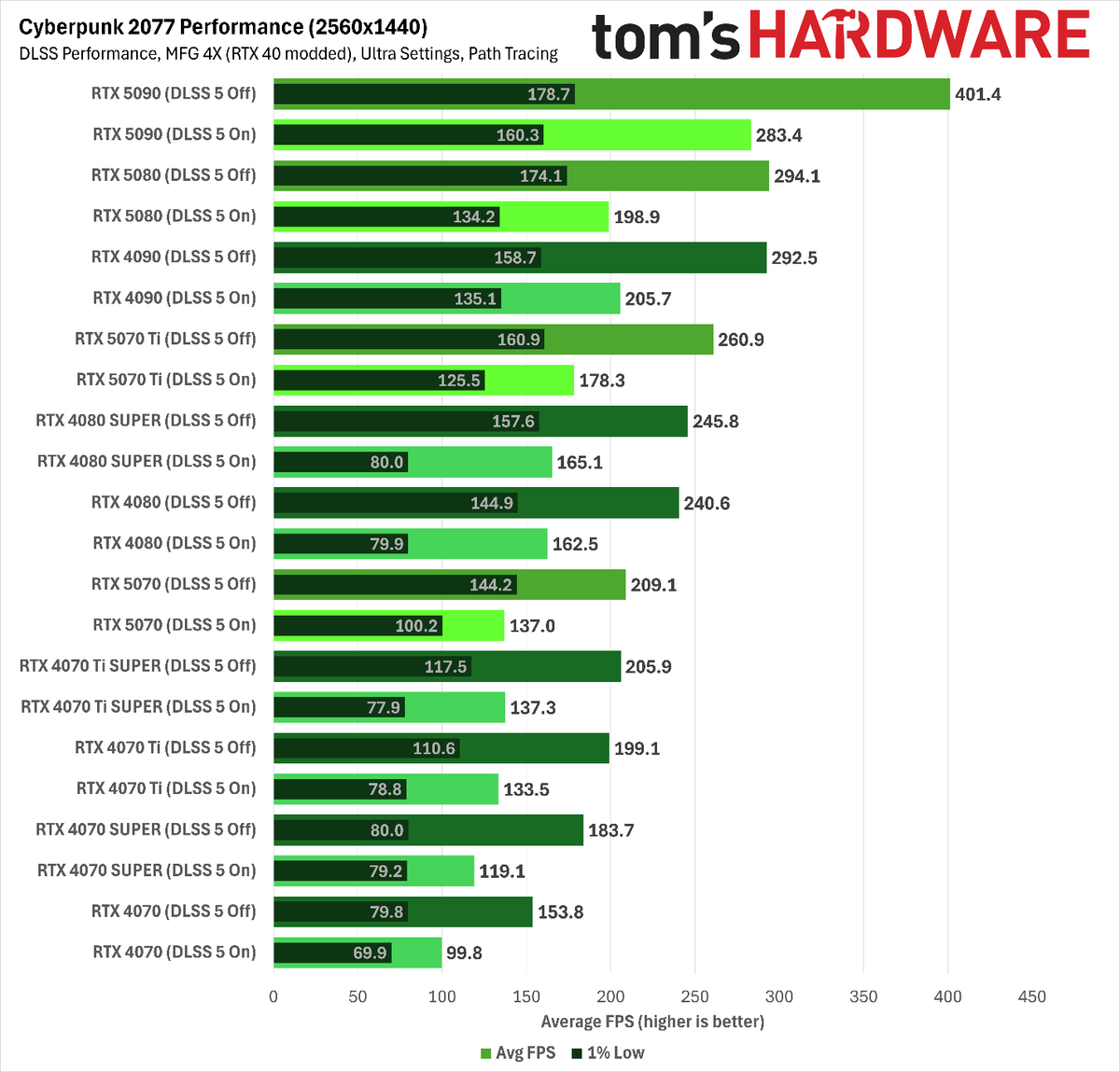
At 2560x1440, generational performance hierarchies remained consistent with 1080p findings. The RTX 4090 fell short of the RTX 5080, and the RTX 4080 variants trailed the RTX 5070 Ti. The DLSS 5 mod again introduced wider variance between average frame rates and 1% lows on additional Ada cards, though MFG smoothing rendered these fluctuations imperceptible on variable-refresh-rate displays.
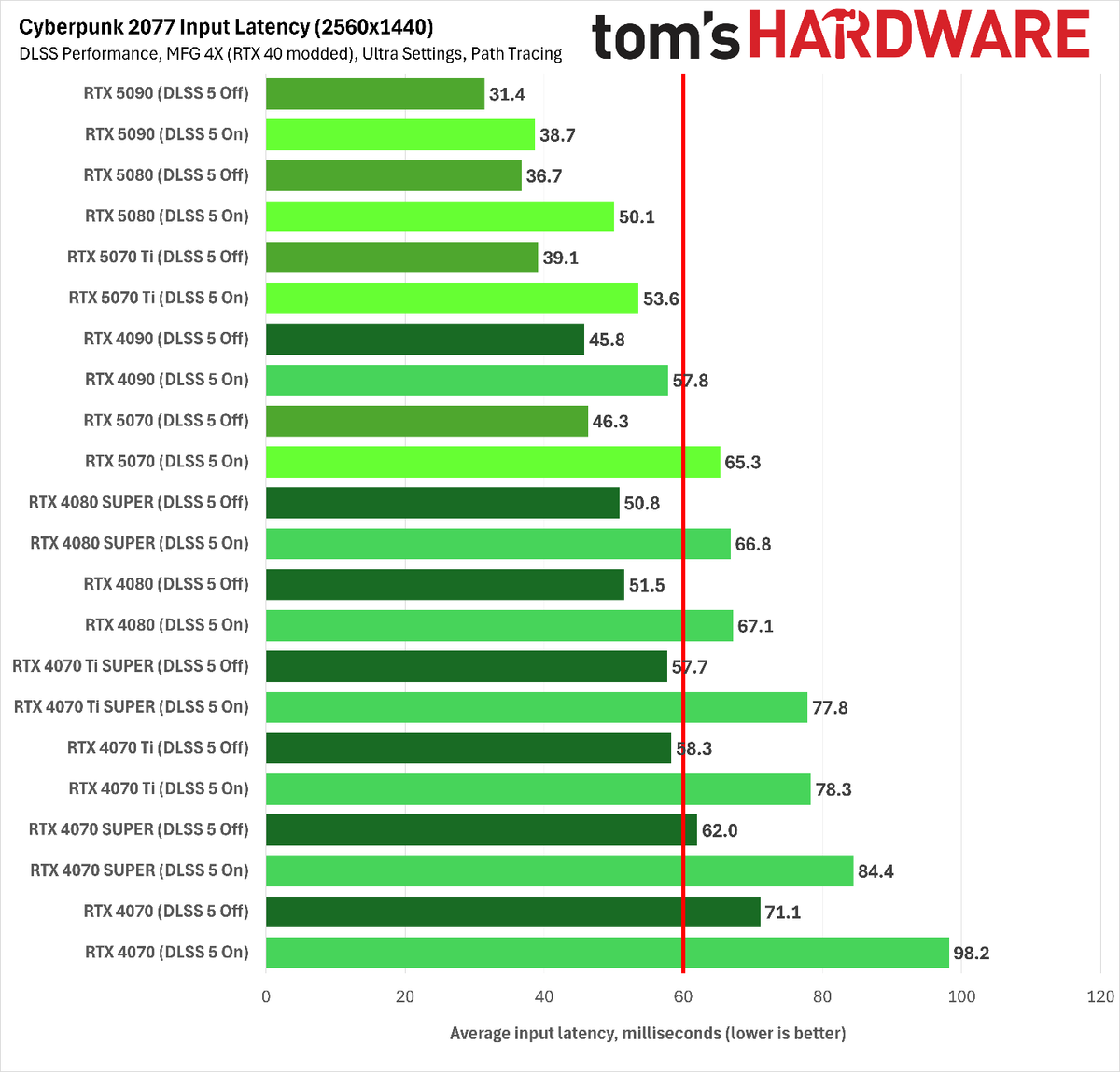
Latency behavior shifted noticeably at this resolution. All Ada cards except the RTX 4070 maintained acceptable latency with MFG 4X alone. Enabling the DLSS 5 mod pushed all Ada cards except the RTX 4090 past the 60ms threshold. The RTX 4080 Super and RTX 4080 remained marginally acceptable, but lower-tier RTX 40-series cards required compromises between DLSS 5 and other visual features like ray tracing intensity.
4K Performance Results
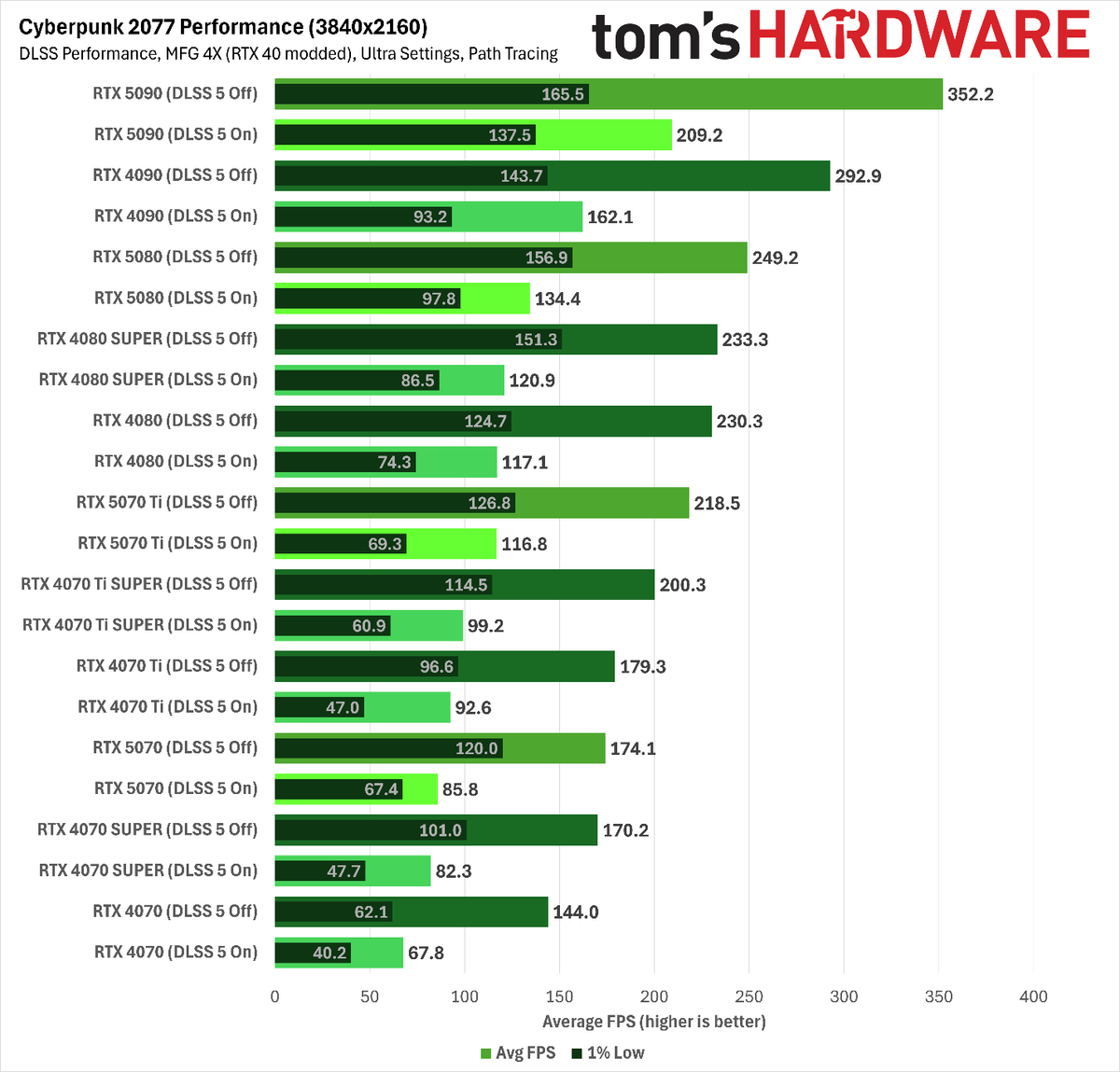
At 4K with DLSS Ultra Performance, output frame rates alone could mislead regarding playability. The RTX 4090 finally surpassed the RTX 5080 in both MFG 4X and DLSS 5 configurations. The RTX 4070 Ti Super's 16GB VRAM appeared advantageous against the RTX 4070 Ti and RTX 5070, while the RTX 4080 variants seemed competitive with the RTX 5070 Ti.
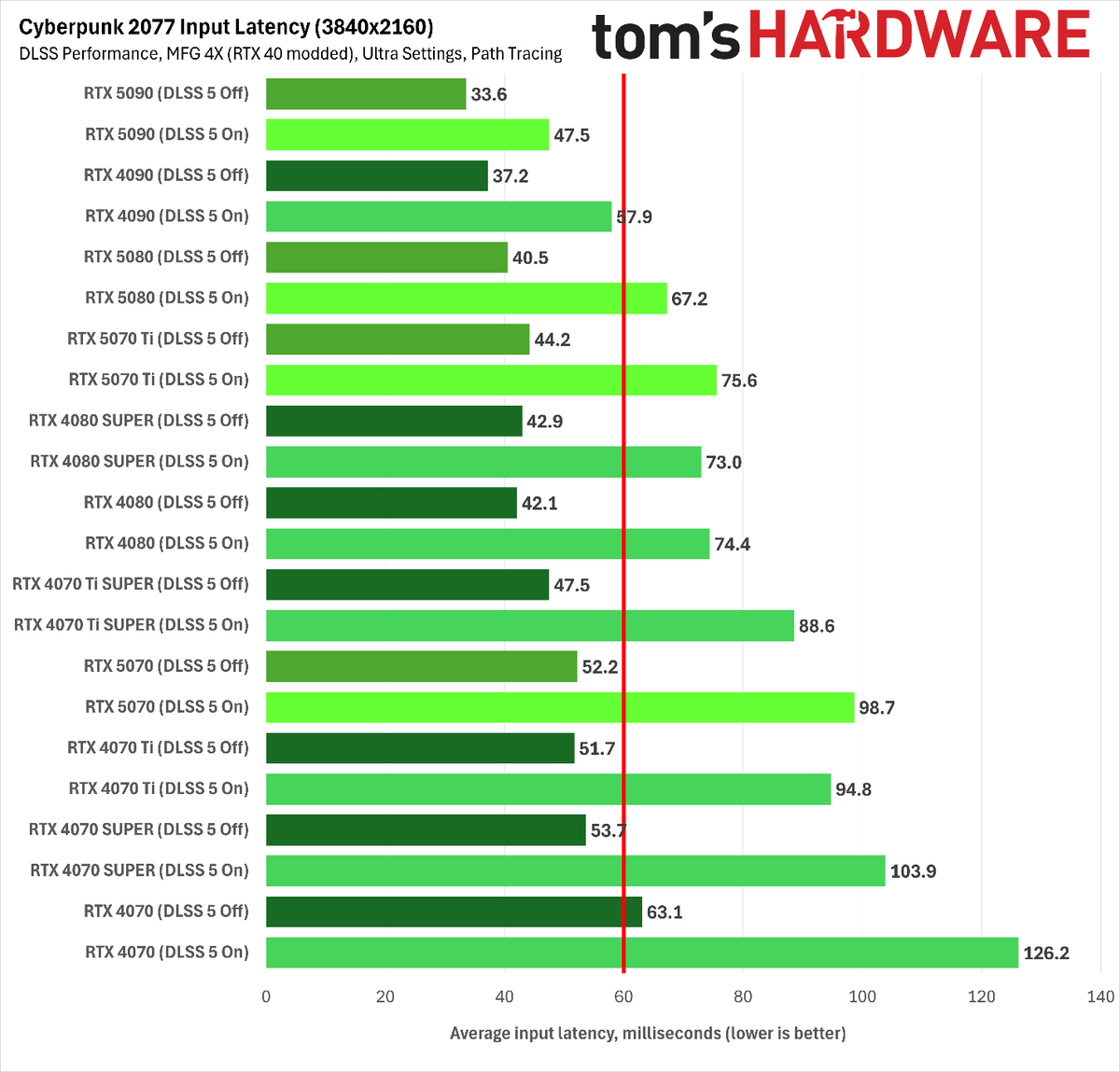
Latency measurements revealed an unexpected pattern: input latencies at 4K with DLSS Ultra Performance were substantially lower than at 2560x1440 with DLSS Performance for most Ada cards, despite identical input resolutions. This anomaly proved reproducible but unexplained. Blackwell cards exhibited the expected linear latency increase with rising output resolutions, suggesting an Ada-specific quirk in the mod's implementation.
The 2560x1440 latency anomaly is particularly problematic given the prevalence of 1440p monitors among PC gamers. Mod maintainers may eventually identify and resolve the root cause, though no guarantees exist.
MFG 4X alone at 4K with DLSS Ultra Performance presented no latency concerns for any tested card, though the RTX 4070 approached acceptable limits. Both Blackwell and Ada hardware delivered on MFG's core promise: smoother output with responsive controls. Adding DLSS 5, however, restricted acceptable performance to the RTX 5090, RTX 4090, and RTX 5080, with even the RTX 5080 pushing boundaries.
Implications and Conclusions
The successful modded implementation of Multi Frame Generation on RTX 40-series hardware undermines Nvidia's positioning of the feature as Blackwell-exclusive. No apparent technical barrier prevents Ada architecture from supporting MFG, raising questions about whether the restriction serves marketing purposes rather than hardware limitations.
Testing demonstrates that MFG generally functions reliably on Ada cards. While input latencies don't match comparable Blackwell hardware, they remain acceptable across demanding workloads combining path tracing, DLSS Super Resolution, DLSS Ray Reconstruction, and MFG 4X in Cyberpunk 2077. For gamers seeking to extend Ada hardware lifespan, the mod offers meaningful performance benefits.
However, the implementation exhibits imperfections. The unusual and reproducible latency behavior at 1440p on RTX 40-series cards exemplifies pitfalls inherent to unofficial feature ports. The mod remains under active development, and stability issues like crashes in newer versions underscore the gap between community modifications and Nvidia's official support.
The robust performance of modded MFG on Ada raises the possibility that Nvidia might eventually provide official support. Given deteriorating graphics card pricing prospects and the AI boom's apparent indefinite continuation, enabling MFG on RTX 40-series could deliver broader and faster relief to gamers than reintroducing legacy hardware like the RTX 3060.

Nvidia is already committing to DLSS 5 support for RTX 40-series GPUs. This mod's success might persuade the company to bundle official MFG support alongside that update, potentially transforming the feature from an experimental workaround into a standard capability for a much larger installed base.