Military robotics startup with Trump family backing misses payroll amid funding crisis
Foundation Future Industries, a humanoid robotics company advised by Eric Trump, has failed to pay employees and faces potential collapse after falling short on funding targets, while facing scrutiny over unsubstantiated claims about Pentagon contracts and battlefield deployments.
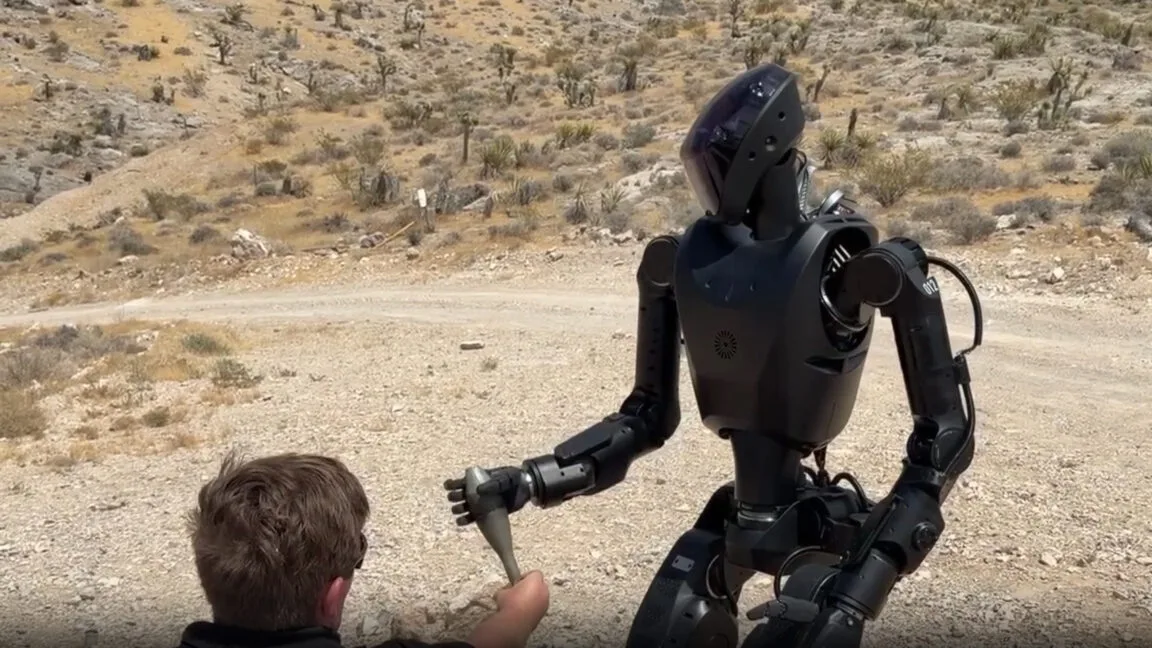
A developer of humanoid robots with backing from Eric Trump has reportedly skipped payroll and teeters on the edge of insolvency due to insufficient capital. The Silicon Valley firm Foundation Future Industries positions itself as building combat-capable machines for military deployment across active conflict zones including Ukraine and Gaza.
Staff members went unpaid for the period concluding October 30, according to sources speaking anonymously to CNBC. Employees are particularly frustrated because co-founder and chief executive Sankaet Pathak allegedly withdrew $4.6 million from company accounts to finance a luxury property with views of San Francisco Bay roughly one year prior.
Leadership continues pursuing capital to support a $3 billion company valuation, contingent on delivering a humanoid robot engineered for combat and equipped to handle multiple weapon systems. The startup has unveiled the Phantom MK-1 and announced plans for the Phantom MK-2. While Foundation has promoted its machines for warehouse and industrial applications, it has generated press attention by emphasizing military battlefield capabilities.
Reporting from CNBC citing "people with direct knowledge of the matter" suggests insiders believe the company risks imminent failure unless it secures additional investment.
Foundation's business claims
Eric Trump maintains an ownership stake and was named chief strategy advisor in March 2026, per the Financial Times. Investment vehicles connected to Eric Trump and Donald Trump Jr. have stakes in multiple defense technology firms that have obtained Pentagon financing and contracts totaling more than $3.2 billion as of July 2026, according to The Washington Post.
During an April appearance on Fox Business, Trump stated that Foundation had "just secured a $24 million contract with the Pentagon." Senator Elizabeth Warren of Massachusetts responded by asking whether the Pentagon has become "just a cash machine from Trump's kids now" in a statement posted online. "This looks like corruption in plain sight," Warren wrote.
Public records, however, do not corroborate Trump's assertion regarding direct Pentagon funding to Foundation. Government procurement databases indicate Foundation carries no publicly disclosed contracts, The San Francisco Standard reported.
Boardwalk Robotics, which Foundation acquired in late 2024, held four contracts valued at $3.22 million. Separately, the Institute for Human & Machine Cognition, a Florida research nonprofit and research collaborator with Boardwalk Robotics, obtained a Navy contract worth $24.8 million in 2025, The San Francisco Standard noted.
Unsubstantiated claims from Foundation's executives and backers have surfaced previously. General Motors refuted Foundation's statements in 2024 that it was preparing to invest in the company, CNBC reported.
Shaky battlefield testing claims
On November 11, 2026, Mike LeBlanc, co-founder and president of Foundation Future Industries, told the Financial Times the company was negotiating with Israeli military officials to furnish humanoid robots for patrol and combat operations within Hamas tunnel networks under Gaza. He also stated he had brought the Phantom MK1 into the tunnels for inspection.
The Israeli defense ministry offered no comment when contacted by the Financial Times.
LeBlanc had previously stated that two Phantom MK-1 units traveled to Ukraine for field evaluation in reconnaissance and supply operations along the front in February 2026.
Craig Smith, an independent journalist and producer of the Eye on AI podcast, accompanied the robot shipment to Ukraine. According to Smith, the machines never entered Ukraine because Polish border authorities halted them. When Smith pressed LeBlanc on the matter, LeBlanc stated only that Foundation had executed a pilot test at an undisclosed site, declining to clarify whether the robots crossed into Ukraine. LeBlanc also retracted an earlier assertion that Foundation had shown its humanoid robots to Brave1, a Ukrainian government entity.
Demonstration videos released by Foundation have not substantiated readiness for battlefield use. A video labeled "mortar demo" posted to the company website in May 2026 depicts an individual handing a mortar round to a humanoid robot, which gradually positions the round over a mortar tube's opening before releasing it.
The real battlefield robots
Regardless of Foundation's trajectory, humanoid robots remain largely experimental and have not realized manufacturer promises about versatility across diverse applications. Testing and deployment of such robots has only recently expanded, and primarily within structured settings like manufacturing plants and distribution centers.
Humanoid robots have yet to see meaningful use in actual combat. Military innovators, notably Ukraine's armed forces, have instead concentrated on building and deploying unmanned ground vehicles (UGVs)—wheeled or tracked robotic platforms.
Throughout its defense against Russian invasion, Ukraine has ramped up deployment of ground robots alongside drone swarms to compensate for personnel shortages relative to Russian forces. Ground robots have typically handled dangerous supply deliveries and casualty evacuation from forward positions, though some have engaged in combat equipped with projectile weapons or explosives as mobile munitions.
Recently, Ukraine has committed armed ground robots directly to combat operations via amphibious assaults and aerial insertions. During 2026, Ukrainian counteroffensive operations that reclaimed Russian-held territory have incorporated airborne robot deployments, with drones dropping military robots behind Russian lines.