Kioxia Exceria Pro G2 2TB: PCIe 5.0 Speed Paired With Enterprise-Grade Reliability
Kioxia's latest high-performance drive combines PCIe 5.0 throughput with firmware tuned for dependability, positioning itself as a solid alternative to consumer-focused competitors despite limited U.S. retail availability.
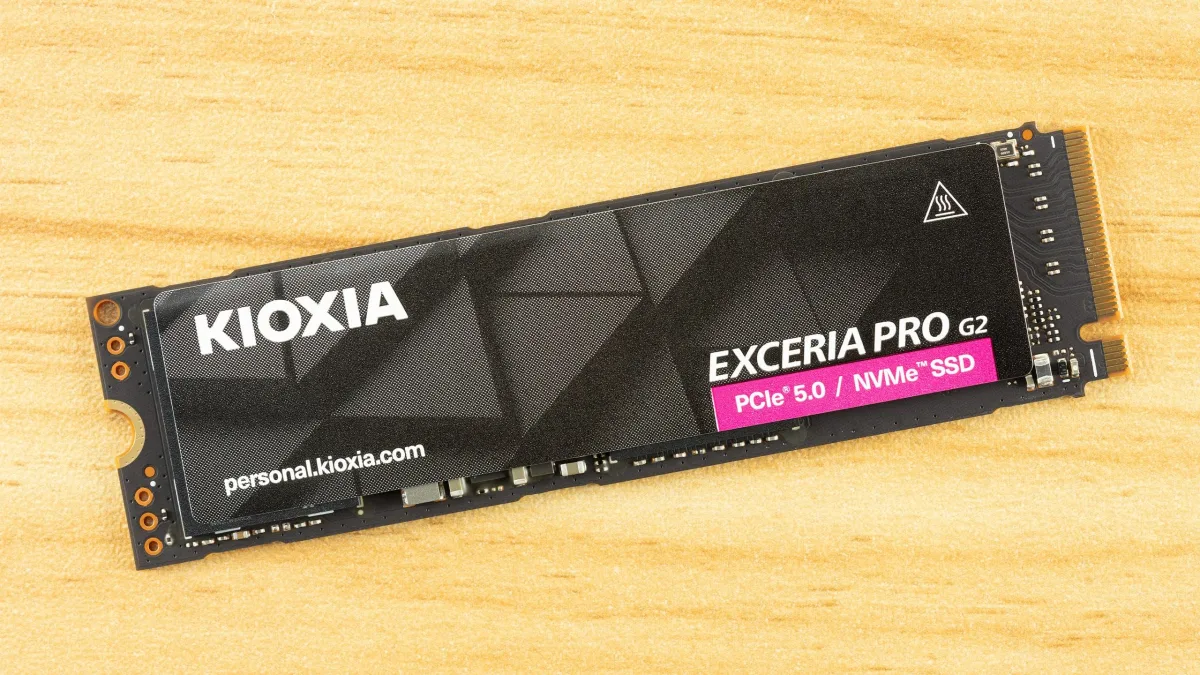
Kioxia storage products have earned a reputation for balancing raw performance against long-term dependability, though finding them through U.S. retailers remains challenging. The Exceria Pro G2 maintains this tradition, introducing performance gains enabled by PCIe 5.0 connectivity and contemporary hardware architecture. The drive resembles a Kingston Fury Renegade G5 optimized for original equipment manufacturers, delivering the throughput expected from drives in this category while prioritizing reliability through its firmware design.
The drive meets the core requirements users demand: rapid performance across sustained write operations, efficient power consumption, and minimal latency on random reads. These characteristics define a storage device that enhances overall system responsiveness. While not the absolute fastest option available, this represents a calculated decision to emphasize reliability—a priority rooted in Kioxia's manufacturing heritage. For buyers in markets where the drive is sold, its pricing remains competitive relative to comparable offerings.
Kioxia Exceria Pro G2 Specifications
The Exceria Pro G2 ships in 1TB, 2TB, and 4TB configurations, representing the most commonly purchased capacities; an 8TB variant remains unavailable due to cost considerations. Peak performance reaches 14,900 MB/s sequential read and 13,700 MB/s sequential write, with random access hitting 2,300K IOPS for reads and 1,950K IOPS for writes at maximum capacity. The 2TB model achieves most of these performance levels and likely represents the optimal capacity choice.
Kioxia includes a standard five-year warranty covering up to 600TB of writes per terabyte of capacity. The company does not explicitly detail encryption capabilities; for this product line, TCG Pyrite compliance and software-based encryption are anticipated. Estimated pricing based on pre-tax European listings stands at approximately $190 for 1TB, $340 for 2TB, and $650 for 4TB. These figures position the 1TB and 2TB models below the WD Black SN8100, with the 4TB priced comparably. Importing to the United States would increase costs. Kioxia's vertical integration—manufacturing its own NAND flash—enables competitive pricing, particularly as competitors like Crucial have exited the market.
Kioxia Exceria Pro G2 Software and Accessories
Kioxia provides SSD Utility Management Software, commonly referred to as SSD Utility, for drive management. The toolbox encompasses system and drive summaries, firmware updates, health status monitoring, secure erasure, password-protected access, and diagnostic resources. For backing up data, MultiDrive for Windows—available in portable and bootable WinPE image formats—or Clonezilla for non-Windows systems are recommended.
Kioxia Exceria Pro G2: A Closer Look
The drive employs a single-sided M.2 2280 form factor. The 1TB and 2TB models follow the 2280-S3-M specification, while the 4TB adheres to 2280-S4-M. All variants are single-sided, though the 4TB measures 2.63mm thick compared to 2.38mm for smaller capacities. This thickness difference stems from the 4TB's use of 16-die NAND packages versus 8-die packages in smaller models, each delivering 2TB per package. The increased height should pose no problems in most systems but warrants consideration for devices with strict dimensional constraints.
The rear label displays the Physical Presence Security ID (PSID), enabling factory-state security resets on unlocked drives. This aligns with expectations of TCG Pyrite 2.01 compliance; the drive reports support for TCG-dependent commands, though Kioxia does not formally advertise hardware-level encryption.
The top surface houses a Silicon Motion SM2508 SSD controller, one DRAM module, and two NAND flash packages. The SM2508 has appeared across numerous flash configurations, with the WD Black SN8100 representing its most recognized implementation. Both the Black SN8100 and Exceria Pro G2 employ 218-Layer BiCS8 TLC flash; however, the WD drive uses Sandisk BiCS while Kioxia uses its own variant.
When the Corsair MP700 Pro XT with Phison's E28 controller was evaluated, the E28 had received both BiCS types at different times. Subtle variations exist between the two—potentially in packaging or other aspects—and Sandisk has consistently highlighted its proprietary flash in marketing materials. The original E28 launch demonstrated faster speeds than early prototypes, likely due to firmware refinement. More precisely, while Sandisk and Kioxia jointly develop and share wafer production, downstream processes—die sorting, binning, package architecture, and I/O speed management—can diverge. WD, Sandisk, and Kioxia each apply distinct firmware optimizations, which typically exert greater influence than flash sourcing alone. Choosing between drives based on flash origin alone would be premature.
The test sample contains 2GB of LPDDR4X memory, though specific configurations vary across production units. While not a primary consideration, LPDDR4/4X is preferred over DDR4 for marginal power advantages. The drive maintains the appropriate 1GB-per-TB DRAM-to-NAND ratio.