Google Expands Android App Verification Globally Starting January 2027
Google is rolling out mandatory developer verification for all Android apps worldwide beginning in January 2027, expanding a system that already blocks unregistered sideloaded apps in several countries.
Despite pushback from developers and users since its announcement last year, Google is proceeding with its Android developer verification initiative. The company started preventing installation of unregistered apps in select nations during the fall and is now preparing to bring the requirement to every region. Beginning in January 2027, Google will initiate the global rollout, urging developers who have not yet registered their applications to complete the process immediately.
While apps obtained through the Play Store already come from verified developers, Google's new system extends this requirement to applications from other sources. When developer verification becomes active in a given region, sideloading apps will be prohibited unless the developer has completed Google's registration process. The company frames this as a security measure, requiring developers to submit government identification and pay a $25 fee to make it more difficult for malicious actors to distribute malware and fraudulent applications.
Google initiated the verification system in Brazil, Indonesia, Singapore, and Thailand during September without incident, prompting the company to accelerate its expansion plans. Although the company had previously indicated a 2027 timeline for global implementation, it is moving forward with a January launch. Google projects that verification will be available across all devices within "several months."
The initiative has already achieved significant adoption, with "millions" of non-Play Store applications now registered. According to Google, these registrations represent more than 99 percent of all global Android app installations. The verifier system service has been deployed to Google-certified devices running Android 8 Oreo and newer, covering virtually all Android devices worldwide except those in China and Russia. Google has also secured cooperation from major third-party app store operators—Galaxy Store, Honor, Oppo, Xiaomi, Transsion, and Vivo—to enforce verification requirements. While the system-level verifier blocks installations, these partner stores will only display verified applications once Google activates the enforcement mechanism.
Feedback accepted
Google has incorporated some developer and user feedback into its verification framework. Hobbyists can now establish a free account to share applications with limited audiences. The company initially capped this at 25 total installations but has since raised the limit to 50. Additionally, Google has introduced an application programming interface to help developers streamline the registration process for new application packages.
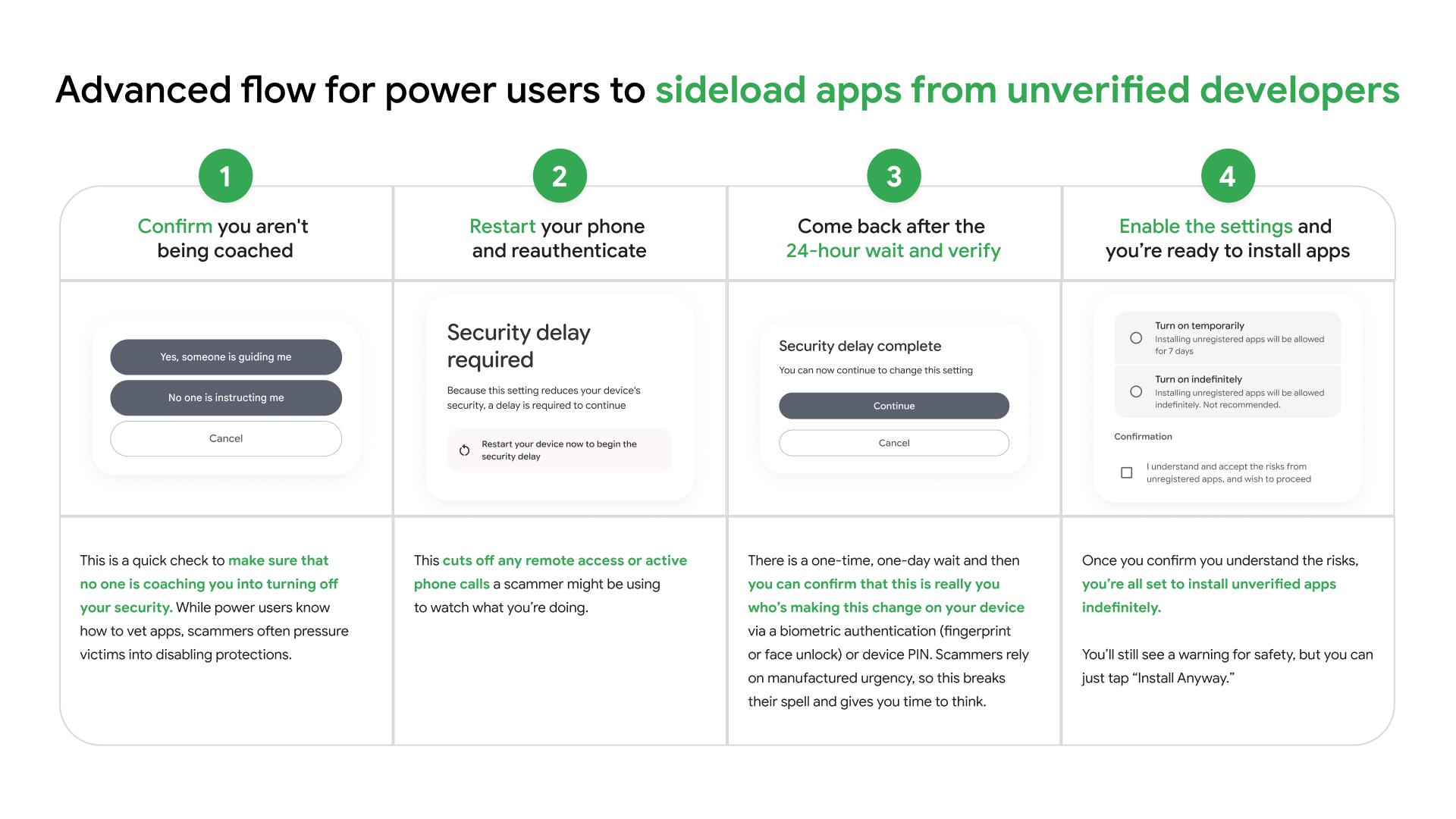
In response to concerns, Google also implemented an opt-out mechanism for users who wish to bypass verification restrictions. The "advanced flow" option permits installation of any application regardless of verification status, though the process is deliberately cumbersome. The setting is positioned inconspicuously within the system, accompanied by prominent warnings about potential risks. Users must also observe a 24-hour waiting period before the feature becomes fully operational. This setting is currently available, allowing users to configure their devices to disregard verification requirements immediately.
Despite these concessions, Google's verification system substantially increases the company's authority over application distribution. Developers located in nations subject to international sanctions will be unable to verify their identities, effectively barring them from distributing applications. Sideloading may also necessitate a connection to Google's servers. Only widely-used application identifiers will be stored locally on devices for verification; other applications will require devices to contact Google before installation can proceed. While these scenarios represent edge cases, they present genuine inconveniences for affected users.
As Google prepares for comprehensive verification enforcement, the company has published documentation for developers and application distributors addressing key implementation details. These resources suggest Google anticipates full verification deployment by March 1, 2027.