Agentic AI Reshapes Cloud Competition: Global Platforms Overtake GPU-Focused Providers
As agentic AI moves from experimental deployments into live production systems, cloud providers are competing less on raw GPU capacity and more on integrated global platforms that enterprises need to build AI-native applications at scale.
The neocloud sector is undergoing a consolidation phase in which worldwide infrastructure availability has become the defining factor separating vendors designed for enterprise artificial intelligence from those simply leasing graphics processing unit capacity.
Agentic AI is transitioning from proof-of-concept trials to operational deployments, prompting enterprise buyers to move beyond focusing on GPU counts alone. Instead, they are seeking comprehensive platforms capable of supporting the full stack required for AI-native applications. This shift is fundamentally altering the competitive dynamics within cloud AI infrastructure. Kevin Cochrane, chief marketing officer at Vultr, explained that enterprises pursuing serious agentic AI initiatives require far more than isolated compute resources. "There are those providers that are trusted platforms, that are global cloud platforms that have the totality of services that are required for real agentic AI deployments," Cochrane said. "We'll continue to see a separation of the pack and there'll be those that are trusted platforms that enterprises can rely on and there'll be those that aren't."
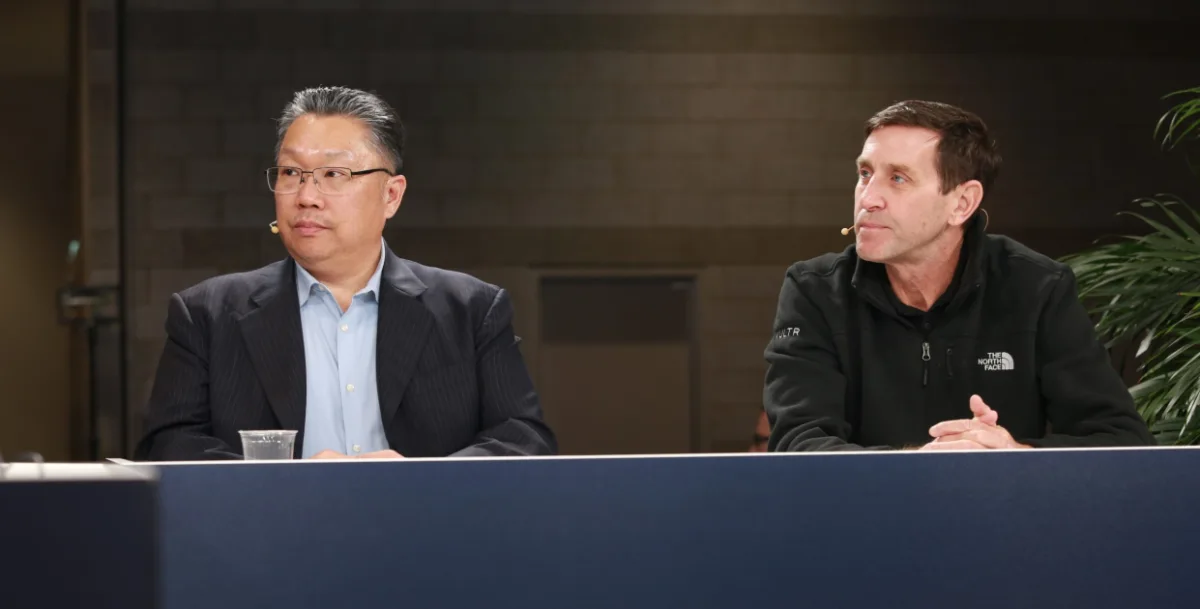
Cochrane and Duncan Ng, vice president of solutions engineering at Vultr, discussed these trends during an exclusive broadcast at SC26 with theCUBE Research's John Furrier and Gemma Allen.
Global cloud availability separates platforms from GPU islands
Building an enterprise-grade cloud platform requires substantially more infrastructure sophistication than simply deploying accelerators. Vultr structures its operations around data center regions, where each region manages multiple facilities connected through a single network and unified application programming interface that developers can integrate into Terraform templates, according to Cochrane. Many competitors, however, rapidly constructed individual sites to fulfill particular customer needs.
"In traditional neoclouds, the data centers are actually islands. They're not connected. It's not one unified global network. It's not one unified global platform," Cochrane said. "These are like individual data centers stood up very quickly for bespoke customer contract. That is not a platform."
Agentic AI is simultaneously transforming the computational architecture within these regions. Contemporary reasoning models enable agents to execute extended sequences of operations, invoke external tools and perform validation checks in real time—activities that depend substantially on central processing units, according to Ng. Vultr operated a cloud infrastructure service for more than a decade prior to the GPU expansion and has relied on AMD processors as its primary CPU infrastructure for multiple years. The company has now deepened this relationship by committing to a $1.2 billion purchase of AMD's Helios rack-scale systems.
"This increased density, this increased usage — these are just new hosting companies," Ng said. "This is just a new application that is 10 times more compute dense than the last that we're trying to sell to."
Enterprises are now advancing these workloads from experimental phases into production environments, Ng noted. A major global systems integrator from the Big Four has deployed Vultr infrastructure to power a risk management platform. Vultr has been introducing infrastructure enhancements specifically designed to support enterprise-scale agentic AI applications.
https://www.youtube.com/embed/cEALveaXMhI?start=34&feature=oembed
"What they're doing is something that used to take consulting hours, people poring through spreadsheets and poring through invoices, poring through declarations," he said. "They now are able to automate significant portions of this to serve a larger number of their customers and do a deeper dive into their risk supply chains."