Goodram PX700 2TB: Budget PCIe 4.0 Drive Punches Above Its Weight
The Goodram PX700 is a budget-friendly PCIe 4.0 SSD that combines solid performance with efficient power consumption in a single-sided design. In testing, this European-assembled drive outperformed expectations for its category.
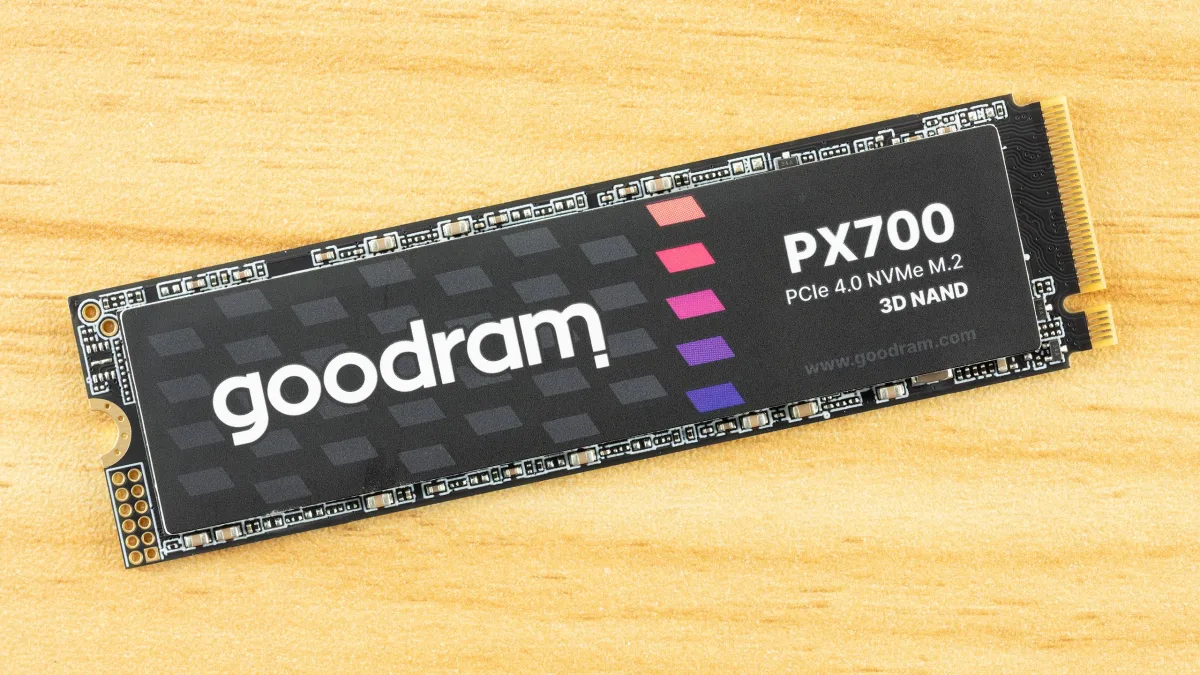
Goodram's PX700 represents a compelling option in the budget PCIe 4.0 segment, offering respectable performance, exceptional power efficiency, and a compact single-sided form factor that keeps temperatures in check. For many users seeking straightforward storage expansion, one drive can satisfy the entire requirement without compromise. While not the first name that springs to mind in this market tier, the PX700 demonstrated capabilities that exceeded what testing typically reveals for drives in this category.
Goodram operates as a memory assembler based in the European Union with substantial operational history, distinguishing it from the proliferation of lesser-known brands appearing on platforms like AliExpress and Amazon. This heritage suggests a reasonable expectation of dependable products and customer support, a confidence reinforced by the drive's TBW rating, which signals this is not an ultra-budget offering cutting corners on longevity.
Performance testing revealed results that surpassed initial expectations—particularly noteworthy given the extensive experience with competing drives featuring identical or nearly identical hardware configurations. While some gains were marginal, the advantages proved consistent wherever performance mattered most. Typically such results come with trade-offs, yet the PX700 maintains impressive power efficiency alongside its performance gains, delivering an overall satisfying storage experience. The main limitations involve sustained write speeds, a concern for most users, and the asking price, which currently appears inflated relative to typical market conditions.
Goodram PX700 Specifications
Goodram offers the PX700 in three capacities: 1TB, 2TB, and 4TB. While smaller capacities appeal for system upgrades and boot drives, modern NAND technology performs optimally at 1TB and above. Larger 8TB configurations serve as comprehensive storage solutions but demand substantial investment. The product line focuses on the 1TB and 2TB variants, which represent the strongest sellers. At review time, pricing stood at $346 for the 1TB model and $418 for the 2TB version. These figures appear elevated, likely reflecting inventory constraints rather than inherent value. The 1TB pricing roughly doubles what it should command, while the 2TB should realistically approach $300. Given ongoing NAND supply disruptions, pricing remains volatile, and prospective buyers should target this price range for the PX700 or comparable alternatives with matching specifications.
The drive operates as a full-featured Gen 4 device, achieving sequential read and write speeds of 7,400 and 6,500 MB/s respectively, with random I/O reaching 1 million IOPS for both read and write operations at the 4TB capacity. The 1TB and 2TB models deliver 820K write IOPS. These figures align with class standards and exceed requirements for everyday computing, gaming, content creation, and professional applications. A standard five-year warranty covers the drive, with endurance rated at 600TB of writes per terabyte of capacity. This TBW specification warrants closer examination, as it suggests potential use of TLC rather than QLC flash memory—TLC offers both superior speed and greater durability compared to QLC. Evidence from testing indicates the sample likely contains QLC, a conclusion we will substantiate through performance analysis. Buyers should avoid making flash-type assumptions based solely on TBW figures.
Goodram PX700 Software and Accessories
Goodram PX700: A Closer Look
The PX700 maintains a single-sided layout across all capacity points, expanding compatibility with a broader range of systems and simplifying thermal management if needed. The drive operates at sufficiently low temperatures that active cooling becomes unnecessary—as detailed in the power consumption and temperature analysis below—though the single-sided design remains a practical advantage. Standard manufacturer information appears on the rear label, with one detail deserving emphasis: the identity of the assembler.
Wilk Elektronik, a Poland-based memory company, manufactures the PX700, making this a European-assembled SSD. Goodram encompasses both mainstream storage products and IRDM-branded enthusiast offerings, though this marks the first SSD from the company to undergo review. While the drive's silicon originates from Asia—standard practice across the SSD industry—describing it as Poland-made refers to assembly, testing, and warranty coverage conducted within Poland under an EU-based corporate structure. For certain purchasers, this European manufacturing footprint may influence buying decisions favorably.
Hardware identification presents both straightforward and complex aspects. The Maxio MAP1602 controller is readily identifiable—a four-channel, DRAM-less design that has established itself as a reliable budget solution for extended periods. The only question involves whether this represents a later revision, typically deployed in higher-capacity configurations.
Flash memory identification proves more difficult. The "512G" designation indicates 512GB NAND packages, which aligns with modern flash specifications where individual dies measure 1Tb or 128GB, yielding four dies per package and sixteen dies total—an ideal configuration for maximizing this controller's performance. The "W2533" marking likely represents manufacture week 33 of 2025, confirming the flash is relatively recent rather than aged inventory. The drive must employ at least 2,400 MT/s flash to achieve its published performance specifications.
TLC flash appears logical for the PX700 given the TBW rating and recent observations of this controller paired with 232-Layer Micron TLC in products like the Biwin Black Opal NV7400. However, Goodram maintains access to YMTC flash options, including QLC variants. YMTC QLC represents a more probable choice than Micron QLC, given the latter's heavy demand in enterprise applications. Standard utilities for flash identification often prove ineffective due to encrypted firmware on this controller, though workarounds exist via leaked MP tools. The most reliable identification method involves analyzing actual performance and comparing results against reference drives—the approach employed throughout this review.