Flipper One Linux Device Launches on Kickstarter at $399, Double the Price of Its Predecessor
Flipper Devices has opened pre-orders for the Flipper One, a pocket-sized Linux computer that moves beyond the offline capabilities of the Flipper Zero to offer networked computing, high-speed connectivity and real on-device processing.
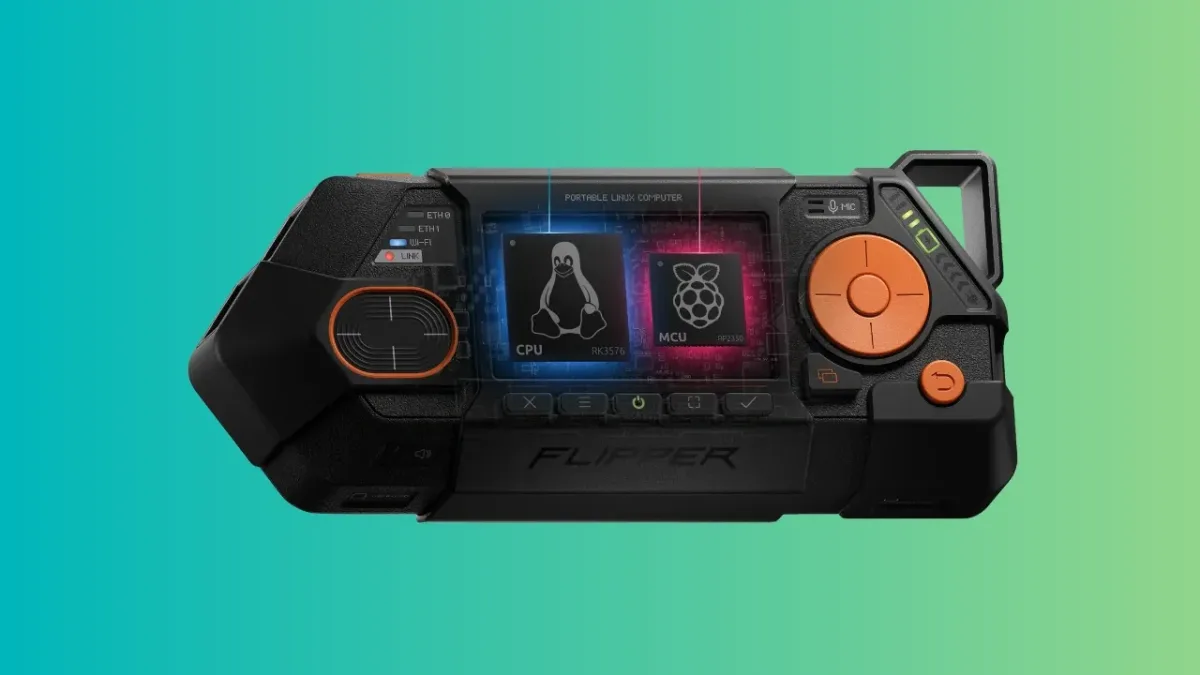
The Flipper One represents a significant departure from its predecessor, the Flipper Zero. While the Zero functions as an offline device for interacting with NFC tags, RFID systems, infrared signals and Sub-GHz radio, the One ascends into networked territory with capabilities centered on data processing and connectivity rather than direct physical interaction.
Flipper Devices launched the Kickstarter campaign on November 17, 2026, with the campaign running through December 17, 2026. The device carries a $399 price tag on the crowdfunding platform, representing a substantial jump from the Flipper Zero's cost. Those who purchased $20 pre-order coupons earlier were guaranteed a discounted price of $379. The estimated delivery window is July 2027.
Hardware and Architecture
The Flipper One employs a dual-processor architecture to balance performance and power consumption. A Rockchip RK3576 octa-core processor manages Linux operations, networking capabilities, USB 3 connectivity and video output. Complementing this is a low-power Raspberry Pi RP2350 co-processor that handles the 256x144 grayscale display, input buttons and power management. This separation ensures the display and controls remain functional independently of the main Linux operating system.
- 8 GB LPDDR5 RAM and 64 GB UFS storage
- Wi-Fi 6E, Gigabit Ethernet and built-in eSIM connectivity
- Expandable via M.2 and GPIO modules for 5G, LoRa and SDR capabilities
- USB-C DisplayPort Alt Mode for monitor connectivity
The device functions as a versatile computing platform. Connected to a monitor via USB-C DisplayPort Alt Mode, it operates as a desktop computer. Attached to a television, it serves as a media box. Its networking capabilities allow it to manage multiple uplinks simultaneously, operate as a hotspot, run VPNs and firewalls, and perform wireless network scanning and traffic analysis. The integrated eSIM includes a Flipper SIM data plan. Battery monitoring functionality tracks both the device's own power consumption and that of connected peripherals.
Software and Kernel Integration
The Flipper One runs Flipper OS, a Debian-based operating system featuring profile-based configuration. Users select from preconfigured profiles—network router, radio lab, desktop or TV media box—at boot time, each with its own kernel settings and application suite. Changes exist in an overlay layer, allowing users to reset any profile to its default state without affecting others, encouraging experimentation.
Flipper Devices has partnered with Collabora to integrate the RK3576 processor into the mainline Linux kernel. The device already runs on mainline Linux, with DisplayPort Alt Mode patches currently under review. The company's objective is delivering an ARM computer free of proprietary binary blobs. Ongoing work includes implementing dynamic memory frequency scaling for improved power efficiency and eliminating remaining closed-source components in the boot sequence. Development details are publicly accessible via the Flipper Developer Portal.
Pricing and Production Strategy
The $399 price point reflects current market conditions in semiconductor memory. Flipper Devices states that RAM and UFS storage comprise more than half of the Flipper One's total hardware costs, driven by global memory supply constraints. Rather than delaying production or increasing prices further, the company is selling the hardware at cost and relying on the Kickstarter campaign to fund the initial manufacturing run.
The company's track record suggests confidence in this approach. The original Flipper Zero Kickstarter campaign raised $4.8 million, achieved its funding goal in eight minutes, and the company has shipped over one million units since 2020.
Expansion Modules and Accessories
Three expansion modules are available through the Kickstarter campaign, each sold separately:
- LoRa module: compatible with Meshtastic, MeshCore and Reticulum mesh networks, functioning as a walkie-talkie
- 5G modem: an M.2 module with four SMA antenna ports, supporting both built-in and external SIM cards
- SDR module: a software-defined radio module with full specifications to be announced
The base package includes the Flipper One device and a USB-C cable. As with any crowdfunding campaign, prospective backers should treat the July 2027 shipping estimate as provisional rather than guaranteed.