Doom Playable on USB Flash Drive Display via File Transfers, Says Hardware Hacker
Aaron Christophel reverse-engineered a MOVESPEED MSSU10 flash drive's LCD controller and ported Doom to its screen, using a Python script that converts keyboard input into timed file transfers.
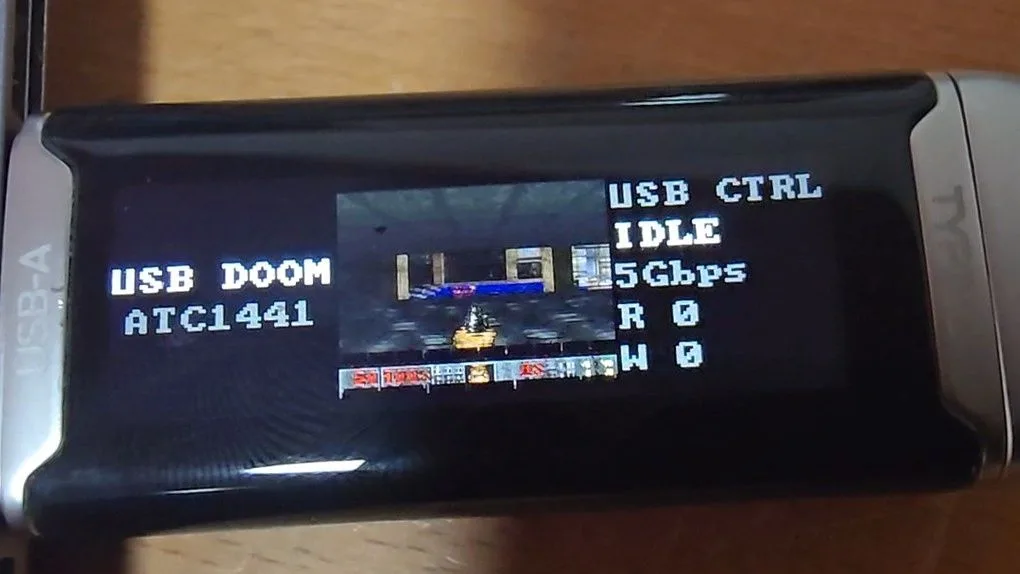
A hardware enthusiast has successfully installed and demonstrated Doom running on the built-in LCD screen of a consumer USB flash drive, with gameplay controlled through a novel method involving file transfers. Aaron Christophel documented the project in a teardown video, showing how he extracted the firmware from the display controller after discovering an accessible debug port, then leveraged artificial intelligence to reverse-engineer the hardware and adapt the game to run on the device's screen.
The MOVESPEED MSSU10, a dual-connector drive with both USB-A and USB-C ports, normally displays operational metrics on its 428 x 142 color LCD, including transfer speeds, storage capacity usage, and temperature readings. Christophel purchased the 128GB model—the entry-level capacity option—for approximately 50 euros.
Hardware Architecture
The drive's core storage management relies on a Silicon Motion SM2320G flash controller, the same component found in portable solid-state drives from Kingston (XS2000) and Lexar (SL660 Blaze). A separate C*Core CCM4101 microcontroller, equipped with 2MB of flash memory and limited RAM, manages the LCD display independently. The NAND storage carries SanDisk branding, representing fairly conventional portable SSD architecture with the exception of the integrated display.
The drive's construction features a metal chassis with heavily adhesive-bonded plastic end caps. The display assembly disconnects first, followed by the main circuit board after removing the USB-C connector housing. The display controller's identifying markings had been deliberately removed, likely through laser ablation, but Christophel gained immediate access through debug pads connected to ground and a 3.3V power line. The bootloader returned a firmware version string dated 2023, which proved instrumental in identifying the chip's specifications.
The microcontroller is marketed primarily for security applications such as fingerprint readers and access control systems, though no such features were activated on this particular drive. Christophel also noted a discrepancy between the documented operating frequency of 200 MHz and his measured clock speed of 40.2 MHz, a variance he could not explain.
Control Mechanism
A fundamental design challenge emerged immediately: the drive lacks physical buttons for gameplay input. The display controller has no direct USB connection and receives information only from the storage controller's activity, which it monitors to calculate transfer speeds. The primary storage controller maintains read and write counters that the display chip polls every 50 milliseconds via I2C communication.
Christophel's solution involved creating doomctl.py, a Python script that translates keyboard input into precisely timed file transfers in both directions. The control scheme encodes commands as transfer rates across five levels per direction, with each read-write pair corresponding to specific button combinations. Movement and rotation use arrow keys, while the Space or Ctrl keys handle firing and door operation, with M toggling the menu. While unscripted file copying still permits basic steering, the dedicated control software provides substantially improved responsiveness.
Performance and Limitations
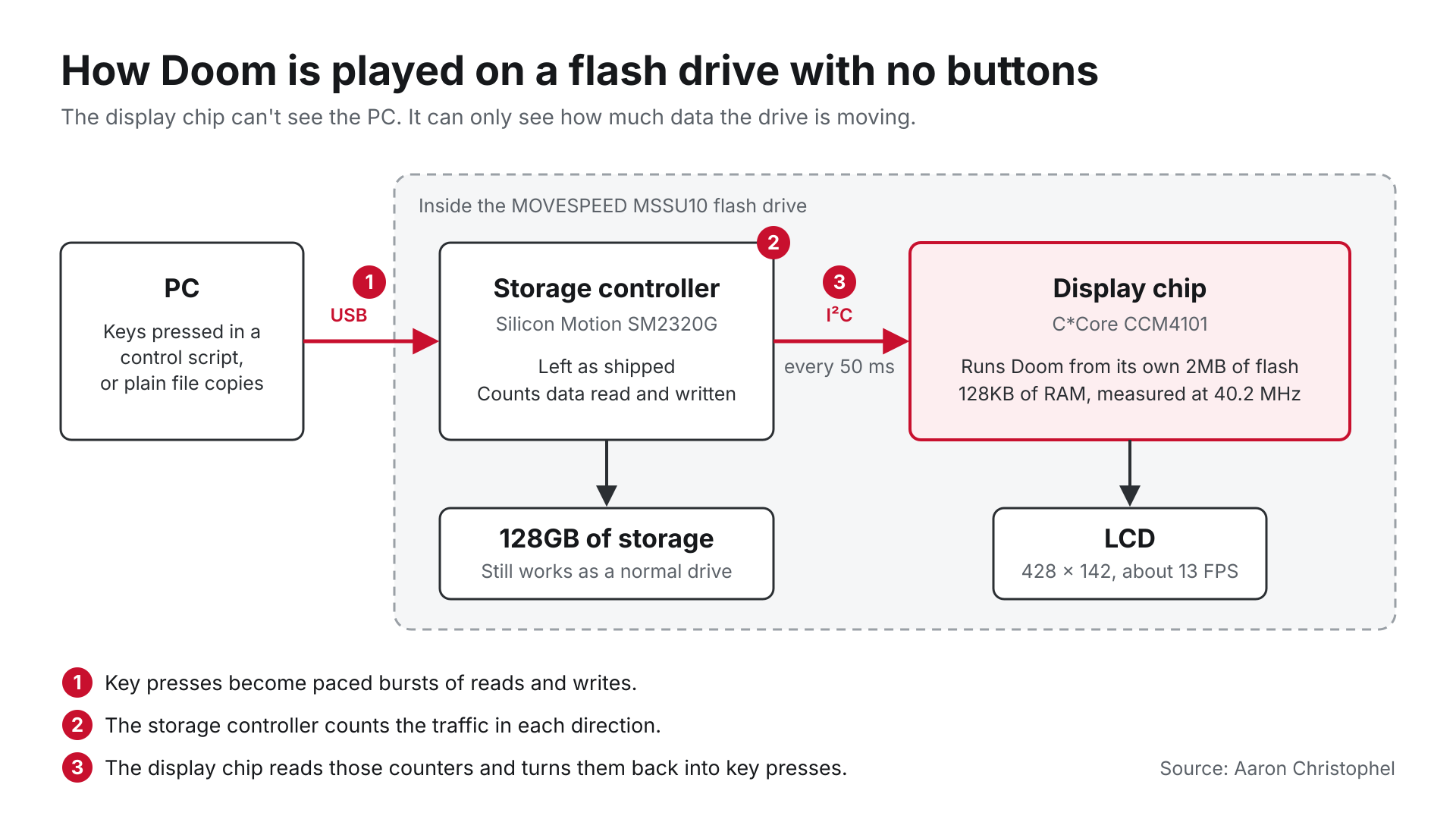
The implementation achieves approximately 13 frames per second, rendering the experience marginally playable despite the game logic executing at Doom's standard 35 ticks per second. Christophel identified the microcontroller's clock frequency as the primary bottleneck for performance improvement. The game port derives from DMC100-DOOM, Artur Bieniek's adaptation designed for extremely resource-constrained microcontrollers. Only the first campaign map, E1M1, fits within the chip's flash memory constraints, and audio output remains absent due to the drive's lack of a speaker.
Christophel completed a full playthrough of the level despite the low display resolution, acknowledging the technical constraints. He noted that artificial intelligence performed the critical work: "I would not be able to do such a thing in a few hours." The reverse-engineering process and the port adaptation both relied substantially on AI assistance.
Open-Source Release and Future Implications
The project has been released as open-source software with both source code and compiled firmware made publicly available, likely to inspire similar modifications. The technical barrier to entry remains relatively low, requiring primarily a debug probe and basic familiarity with firmware extraction. Christophel recommends preserving a backup of the original firmware before attempting modifications. He reassembled his test unit to function as a standard storage device while retaining the ability to launch Doom on demand.