DEEPX Melts Butter With Thermal Demo, But Questions Linger About AI Chip Efficiency Claims
A South Korean startup showcased its DX-M1 processor staying solid while competitor chips melted butter in a theatrical thermal test, claiming a 25 to 40 degree Celsius advantage—though the demonstration glosses over performance trade-offs.
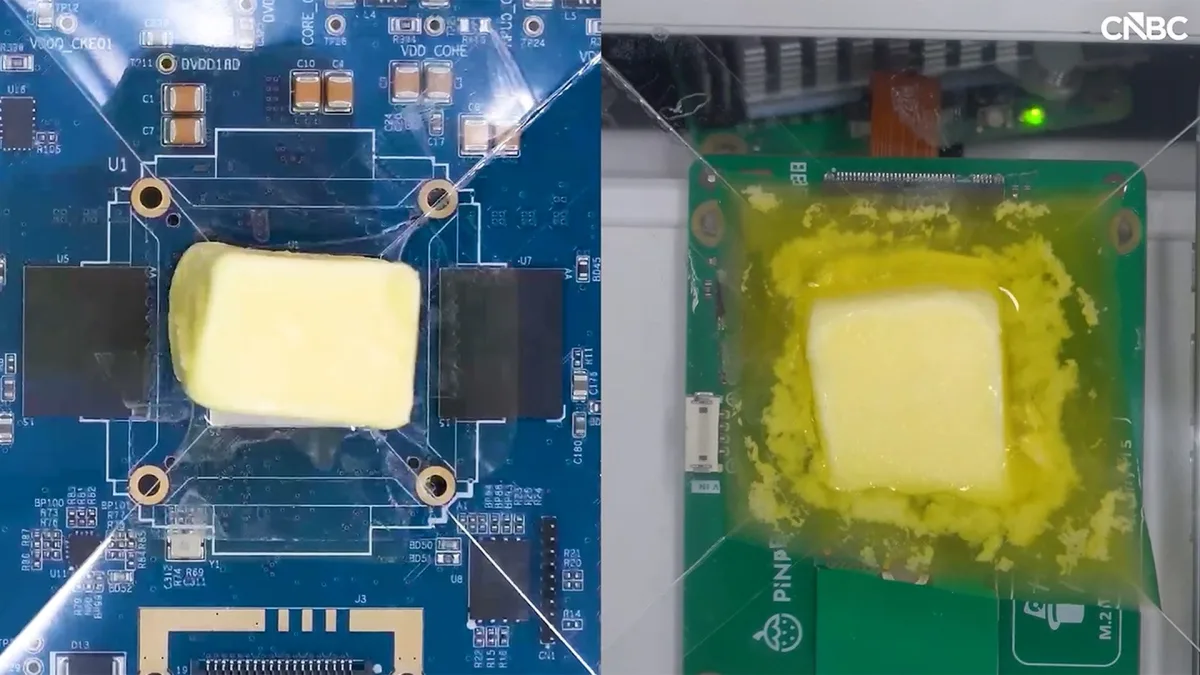
Heat dissipation has become a defining constraint in modern data center architecture, affecting operational expenses, infrastructure demands, and energy consumption. Yet the landscape could shift dramatically if artificial intelligence accelerators consumed less power and generated less thermal output. DEEPX, a startup based in South Korea that recently gained attention through CNBC coverage, contends that its processor designs offer a path forward. The company unveiled its DX-M1 chip using an unconventional thermal demonstration: while competing processors caused butter placed atop them to melt rapidly, the same butter remained unmelted on the DEEPX device.
The expansion of AI data centers has sparked mounting apprehension across multiple regions. These trends are influencing corporate strategy, environmental policy, and public discourse. The intensity of public concern has driven some activists to face legal consequences while opposing new data center construction. CNBC's reporting examines the underlying reasons for this resistance, tracing much of the problem to the thermal output of contemporary processors and the substantial power infrastructure and cooling systems required to manage them.
DEEPX's proposed solution centers on engineering processors that inherently dissipate less heat. The CNBC video presentation demonstrates the DX-M1 neural processing unit alongside unidentified competing chips, visibly showing the temperature differential. According to DEEPX CEO Kim Nok-won, "the side-by-side chips processed the same AI workload… and every chip melted the butter except the last chip [DX-M1]." The executive claims a thermal margin of 25 to more than 40 degrees Celsius relative to other solutions.
The butter-based thermal test, while attention-grabbing, reveals significant omissions in the comparison methodology. The most glaring absence involves performance metrics—specifically, how quickly each processor completed the test workload. Reducing thermal output becomes trivial when a chip operates at lower power levels or reduced clock speeds. This principle is well-established among PC enthusiasts, who routinely undervolt or underclock graphics processors to achieve cooler operation, lower power draw, and quieter cooling fans.
Samsung's 5nm process node has been manufacturing the DX-M1 NPU since August 2025, according to reporting from The Elec. The chip has generated approximately $13.3 million in customer orders to date. DEEPX is advancing development of the DX-M2, its successor, which will utilize Samsung's 2nm technology, with volume production targeted for the second half of 2027.
These neural processing units are positioned for edge computing and robotic systems, placing them in a fundamentally different market segment than the data center accelerators highlighted in CNBC's feature—specifically Nvidia's Blackwell and Ruben GPUs, which consume substantial power and rely on sophisticated liquid cooling infrastructure. A future scenario in which thousands of power-intensive Nvidia GPUs are displaced by more efficient custom accelerators could potentially ease public opposition to AI data center expansion. Yet DEEPX's current and near-term offerings do not operate in that competitive arena, rendering the butter demonstration somewhat misleading as a broader statement about data center thermal challenges.
CNBC's coverage also examines SK hynix's development of iHBM, a memory technology designed to reduce power consumption and operating temperature. According to a company representative quoted in the report, the 'i' designation signifies 'Integrated Cooling Element.' CoolIT Systems is pursuing a comparable strategy, integrating water cooling mechanisms closer to the heat sources within the silicon itself.