Pentagon Seeks Contractors for Military Satellite Network Around the Moon
The US military has issued a Request for Information seeking industry proposals for a constellation of military satellites to operate in cislunar space, signaling a shift toward sustained military operations near the Moon.

A procurement announcement from the Pentagon reveals plans to develop what officials are calling a "proliferated cislunar constellation"—a fleet of military satellites intended to operate in the region surrounding the Moon. The Department of the Air Force released the Request for Information on November 2, asking contractors to propose solutions for deploying spacecraft in cislunar space to support undisclosed military objectives.
The move reflects a broader strategic shift within military leadership. Maj. Gen. Stephen Purdy, the Space Force's acquisitions chief for advanced programs, has spent recent months advocating for expanded military capabilities beyond Earth orbit. Speaking at Space Systems Command's Industry Days event in October, Purdy stated: "I've got the Secretary of War and the Chairman of the Joint Chiefs full on stating in public: 'This is a warfighting domain,' and so, I would ask you all, please jump on my cislunar bandwagon because I need some more friends here, along with our deep, passionate crew that have been working on this for years."
The Pentagon's interest in lunar operations follows an executive order signed by President Donald Trump in December that outlined the administration's space policy, including provisions for detecting and countering threats to US space interests from low-Earth orbit through cislunar space. The Space Force's current most distant satellites operate in geostationary orbit, approximately 22,000 miles above the equator.
Protecting US Interests at the Moon
Military officials have framed the cislunar initiative as a defensive measure. Gen. Chance Saltzman, who served as the Space Force's top general until his retirement in August, explained the rationale: "We have a role to play, but we're not the lead. I just don't want to get caught flat-footed when we start to have to protect US interests out there, so we're along for the ride."
The emphasis on protection reflects growing competition between the United States and China in lunar exploration. Both nations are conducting robotic missions with plans for crewed landings within the next few years. Military strategists have identified potential competition over landing zones and access to water ice deposits at the Moon's south pole, where only a limited number of safe landing sites exist.
Initial Constellation and Future Expansion
The RFI describes an initial phase involving up to five spacecraft, each equipped with government-provided payloads, intended to be operational by late 2029. The Pentagon plans to award up to five preliminary design study contracts based on responses to the procurement request, with submissions due by November 24.
The language in the RFI suggests broader ambitions. Officials stated that the first five satellites "may serve as seed vehicles that will inform the acquisition strategy for a potential future proliferated cislunar constellation." The document provides limited detail about specific military objectives, though it emphasizes the need for "rapid" and "low-risk" solutions.
Timeline considerations suggest the Pentagon may pursue formal contracts around 2027 to meet the 2029 deployment goal, accounting for typical commercial satellite development cycles of two to three years. The RFI does not commit the military to proceeding with full-scale deployment.
Possible Military Functions
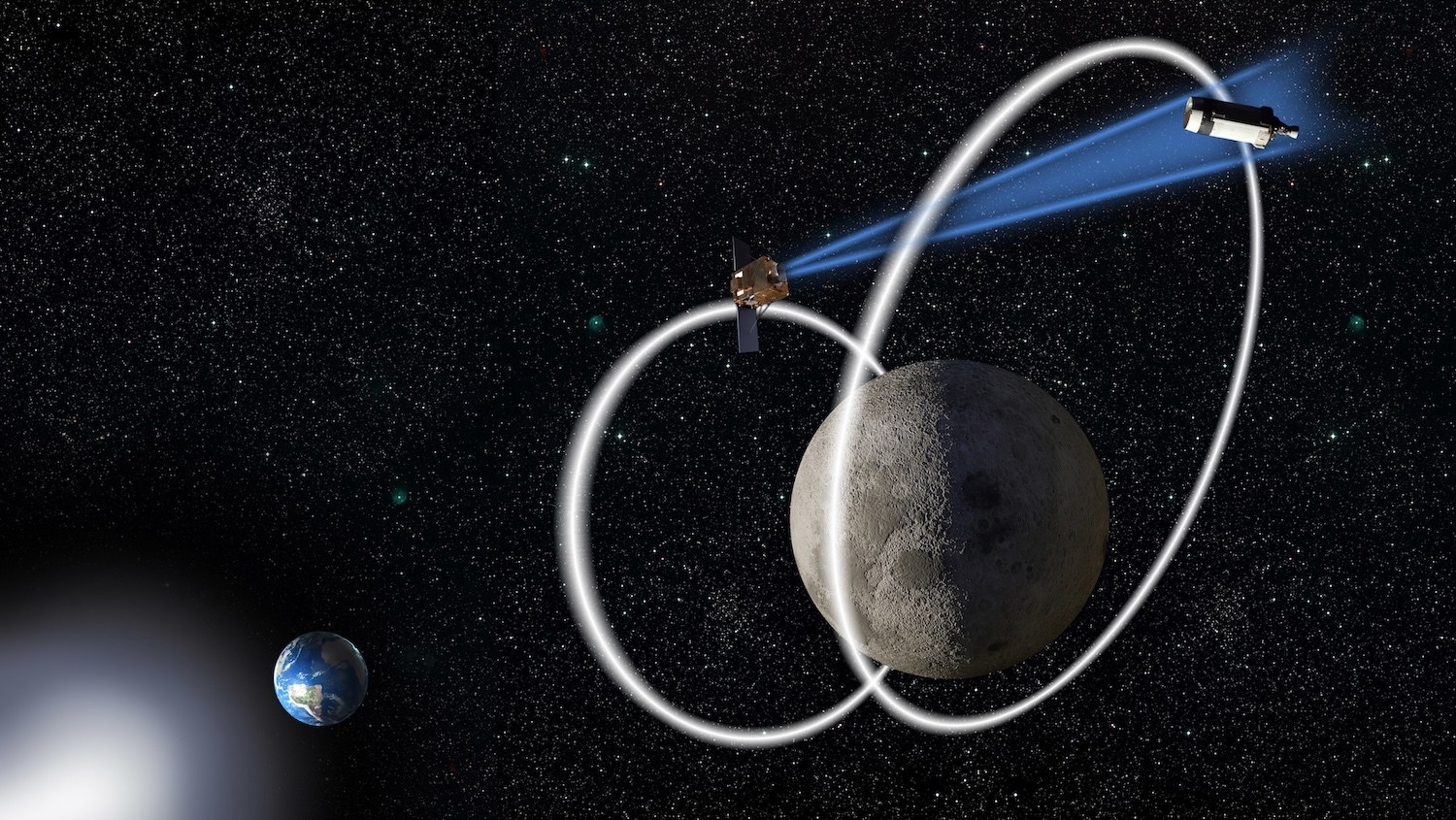
While the Air Force announced in September that the military has placed unspecified weapons in orbit, officials have not indicated plans to deploy weapons systems to the Moon. Instead, military satellites in cislunar space would likely perform functions similar to those of Earth-orbiting systems: tracking and characterizing objects in cislunar space, providing navigation and communications support, and conducting surveillance operations.
The Defense Department has maintained a presence at the Moon for decades. The Clementine spacecraft, a joint NASA-DOD mission, made the first discoveries of water ice signatures in permanently shadowed craters at the lunar south pole.
Existing and Planned Military Missions
Two Oracle missions are already in development. The Oracle-Mobility mission, also known as Oracle-M and formerly called the Defense Deep Space Sentinel, is scheduled to launch in mid-2027. Led by the Air Force Research Laboratory, the $75 million spacecraft will be "highly mobile and will transit throughout cislunar space and experiment with techniques to maintain custody of objects in this region," according to AFRL. The agency states the mission will "allow AFRL to assess strengths and weaknesses of navigation techniques needed for future operational systems."
A second mission, Oracle-Prime, is planned for launch by the end of 2027. This spacecraft will be positioned near Earth-Moon Lagrange Point 1, a gravitationally stable location roughly three-quarters of the way to the Moon, where it will detect and track satellites and debris.
Unlike the Oracle missions, which each involve a single spacecraft, the new RFI signals the Pentagon's intention to establish a more sustained and distributed military presence in cislunar space.