IBM Positions Hybrid Cloud and Governance as Enterprise AI's Missing Piece
As organizations struggle to move AI from pilot to production, IBM is leveraging its mainframe heritage and governance strengths to build an enterprise AI operating model that prioritizes trust and control over raw model capability.
A widening chasm separates enterprise AI ambitions from actual execution. According to Deloitte research, 54% of organizations intend to move at least 40% of their AI initiatives into production within six months, yet only 25% have achieved this milestone today. IBM is wagering that its established strengths—mainframe infrastructure, hybrid computing platforms and deep governance expertise—will prove decisive in closing this gap.
Dave Vellante of theCUBE Research sees IBM's strategy as distinctly differentiated. "In our opinion, IBM has found a differentiated path in enterprise AI by productizing workflow-level outcomes across a stack that, while sometimes confusing, customers generally trust," he said. "Client Zero proof, a workload-first hybrid design, durable platforms reimagined for agents and a pragmatic quantum roadmap create a credible basis for sustained advantage."
Building toward an enterprise AI operating model
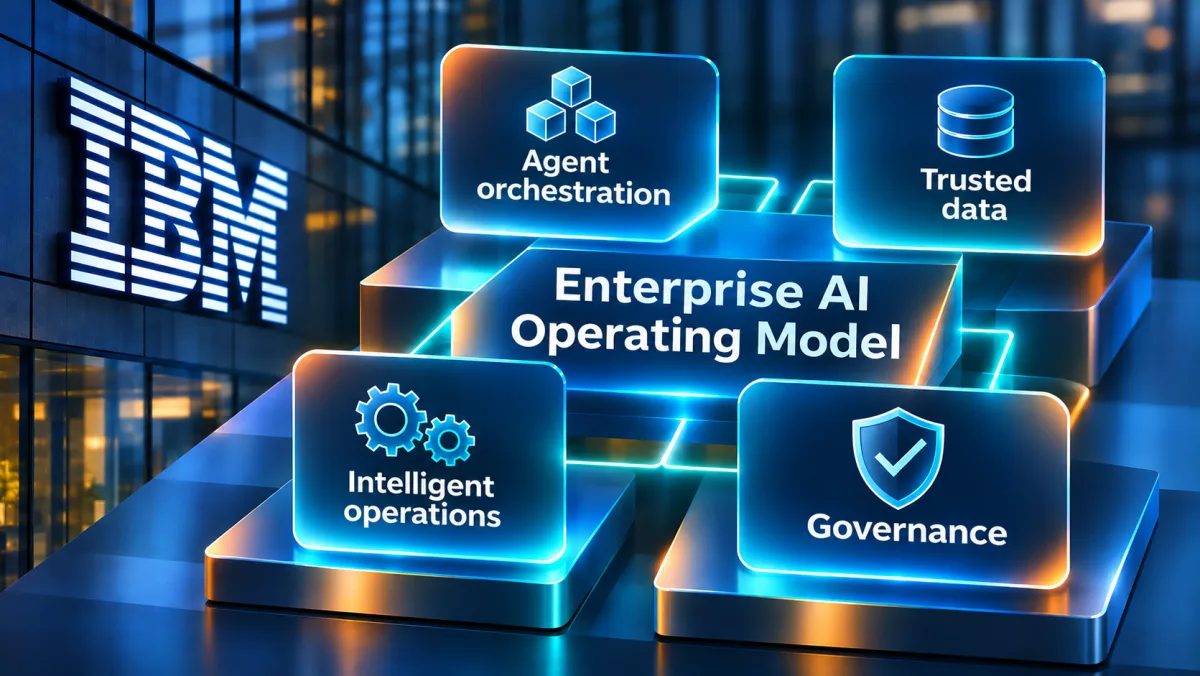
IBM's AI business has grown substantially, with AI-related software sales and consulting work reaching more than $12.5 billion in Q4 2025, compared to $9.5 billion the previous quarter. The company is assembling capabilities across four pillars: agent orchestration, trusted data, intelligent operations and governance.
A series of strategic moves has accelerated this buildout. In February, IBM partnered with Deepgram Inc. to add voice functionality to watsonx Orchestrate, its platform for constructing, launching and managing agents. IBM Bob, an AI-assisted development tool for planning, writing, testing, modernizing and deploying code, became globally available in April. May 2026 saw IBM finalize its acquisition of Confluent, the data streaming platform, to strengthen watsonx.data by incorporating real-time data capabilities that keep AI agents supplied with current context.
At Think 2026, IBM transformed Concert from a standalone product into an agentic IT operations platform designed to unify observability, optimization, security and automation across hybrid environments. The IBM Sovereign Core platform, also unveiled at Think 2026, addresses governance by enabling enterprises to construct and operate AI-ready sovereign environments with governance, compliance and operational control embedded in the infrastructure itself.
Additional announcements followed in June: IBM joined OpenAI's Daybreak Cyber Partner Program to identify AI-driven cybersecurity threats, and partnered with Google Cloud to help IBM consultants architect, construct and govern enterprise-grade agents on Google Cloud infrastructure.
John Furrier of theCUBE Research frames IBM's direction as a deliberate pivot away from the frontier model race. "While others chase frontier models, IBM is betting on something harder: trusted AI in production," he told theCUBE. "The question coming out of Think is simple — are they becoming the system of record for enterprise AI or just another layer in the stack?"
IBM's legacy infrastructure finds new relevance in the AI era
IBM Chief Executive Arvind Krishna emphasized that more than 70% of enterprise data remains confined to on-premises systems, making hybrid cloud essential for organizations seeking to harness corporate data for AI without discarding existing infrastructure. Recent financial results validate this positioning: Red Hat Inc., whose OpenShift Kubernetes platform anchors IBM's hybrid cloud software offerings, achieved 13% year-over-year revenue growth. IBM Z, the company's mainframe line, posted 51% year-over-year revenue growth, underscoring mainframes' continued strategic importance.
IBM is embedding AI directly into IBM Z mainframes to handle demanding AI workloads. According to Ric Lewis, senior vice president of the Infrastructure Division at IBM, this approach has driven 20%-30% program-to-program growth for nearly a decade. Z mainframes appeal to enterprises balancing AI deployment with data sovereignty and system control, forming a cornerstone of IBM's sovereignty strategy.
"Sovereignty is our home court. We do 70% of the world's financial transactions," Lewis told theCUBE. "The most important data that travels around the world is in our Z systems. Those are sovereign systems. They're on-prem, they're in environments, they're in banks, they're in financial institutions, they're in insurance. Sovereign is our home court, and we know this space extremely well."
Sovereignty becomes a prerequisite for enterprise AI
IBM's sovereignty vision centers on customer control: preserving critical data and AI workloads within environments that customers own and oversee, rather than outsourcing entirely to third-party cloud providers. Javier Olaizola, global managing partner for hybrid cloud and data at IBM Consulting, notes that sovereignty has moved from a late-stage discussion to a priority conversation. "Sovereignty and exposure was coming in on slide 40 in a PowerPoint pitch," he told theCUBE. "Now it's coming up front: 'How much is my exposure?' That is coming up with a new set of conversations that we are having with clients."
Sovereign Core addresses these emerging concerns by helping enterprises maintain operational consistency amid shifting AI regulations and geopolitical pressures, while managing the sprawl of AI agents now proliferating across organizations. Sripriya Srinivasan, general manager for Core and ALM software products at IBM, explained the governance challenge. "The proliferation of agents is real in enterprises. Everybody is starting to build agents," Srinivasan told theCUBE. "How do you, as a [chief information officer], make sure that there's a level of standardization, consistency, governance, orchestration? All of these are internal fears, not necessarily coming, just based on regulations."
Putting the enterprise AI operating model to work
Krishna articulated IBM's vision for enterprise AI success at Think 2026: "The enterprises pulling ahead are not deploying more AI; they're redesigning how their business operates." IBM treats itself as Client Zero, demonstrating its own enterprise AI strategy in practice. James Kavanaugh, senior vice president and chief financial officer of IBM, described the integration: "AI is now embedded across our business, from how we deliver services to our software portfolio to the capabilities we are adding to our infrastructure platforms and how we drive our own productivity."
IBM reports that more than 80,000 employees use IBM Bob, with users experiencing more than a 45 percent productivity increase. IBM Consulting has deployed more than 4,000 digital workers across 450 active projects, drawing agents from watsonx, Anthropic PBC and OpenAI Group PBC.
Managing this digital workforce requires treating AI agents like human workers, a philosophy that emerged from a conversation between Krishna and Mohamad Ali, senior vice president and head of IBM Consulting. "Arvind called me, and we had a conversation about three years ago, and he said, 'I want you to come over, and I want you to be a consulting business,'" Ali recalled. "'What is digital labor? It's a whole bunch of bits of software. I need you to come in, and I need you to build this set of software and do it in a way that it could be managed. You could think of this as HR management … but now you have to HR manage human workers and digital workers.'"
IBM customers are adopting elements of this operating model. Global bank BNP Paribas SA operates nearly 1,000 AI use cases across its business, employing a group-level governance framework distributed across business units and functions. Jean-Michel Garcia, group chief technology officer at BNP Paribas, articulated the bank's philosophy: "The strategy is to use AI, not to become AI — to use AI to better serve our customers and to give more value to them. But also internally, for employees, to give them more capabilities to focus on the right set of tasks and to make them more efficient and more focused on what they do."