China's LineShine Holds Top Supercomputer Spot as AI Factories Absorb Computing Resources
The latest Top500 ranking shows the fewest new supercomputers ever added to the list, as the industry redirects massive computing investments toward artificial intelligence data centers instead of traditional high-performance systems.
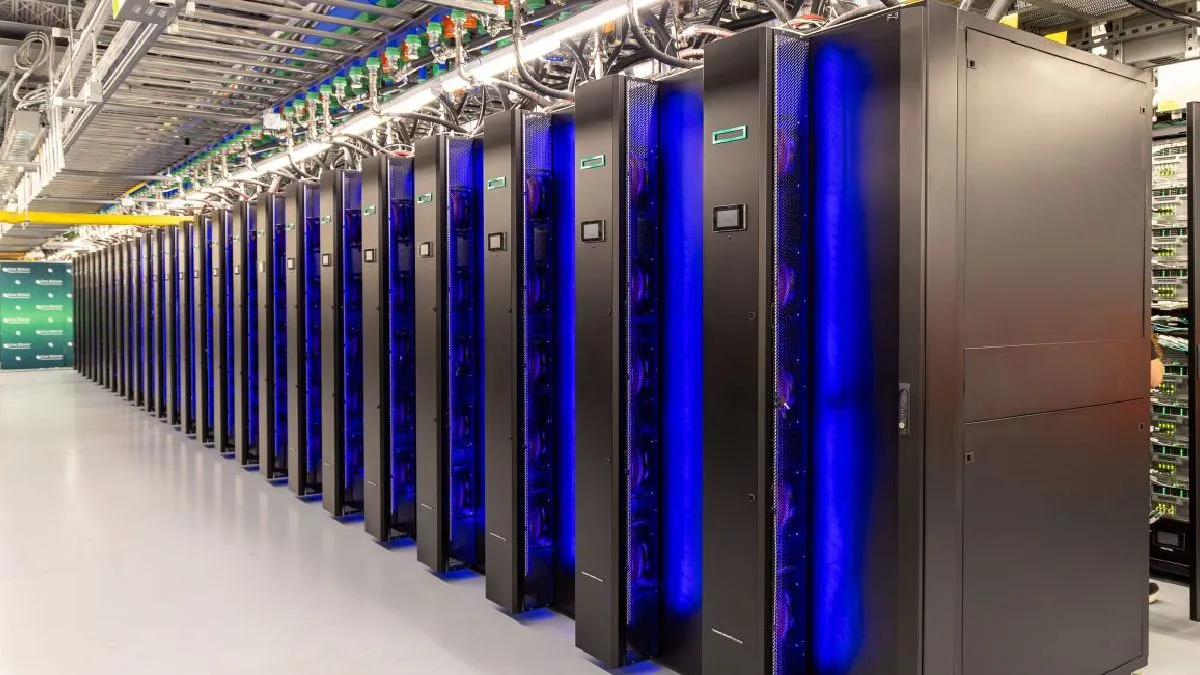
China's LineShine maintains its position as the world's leading supercomputer in the 68th edition of the Top500 list, unveiled at SC26 in Chicago on Monday. The ranking reveals a striking shift in how the computing industry allocates resources: despite soaring demand for high-performance hardware, traditional supercomputers are being eclipsed by the construction of massive AI data centers, resulting in historically low numbers of new systems entering the prestigious list.
Top 10 supercomputers unchanged
Housed at the National Supercomputer Center in Shenzhen, LineShine delivers 2.198 FP64 ExaFLOPS sustained performance on the High Performance Linpack benchmark while consuming 42.22 MW of power. The system architecture centers on the domestically developed LingKun platform, which incorporates 304-core Armx9-based LX2 processors running at 1.55 GHz—totaling 13,789,440 cores—paired with the proprietary LingQi interconnect. Notably, LineShine achieves its ranking through CPU-only processing without compute accelerators, a distinction that limits its mixed-precision performance gains to 3.6X compared to systems leveraging low-precision accelerators.
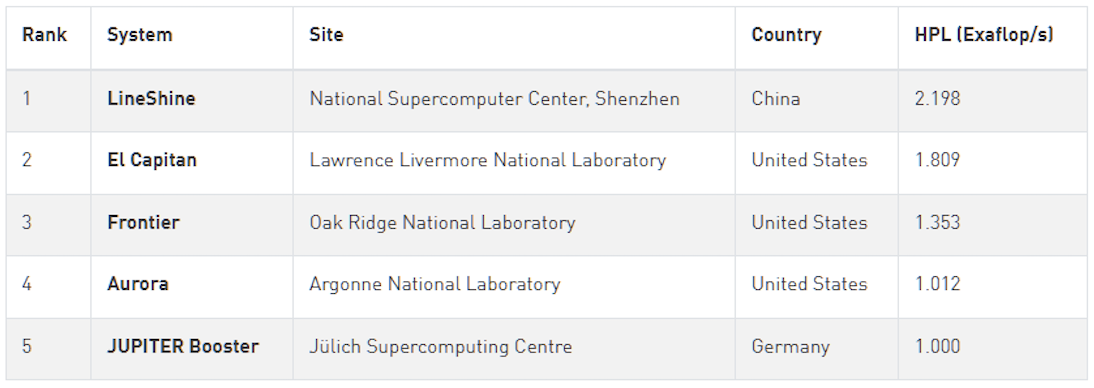
The United States operates three exascale-class systems that round out the top tier. Lawrence Livermore National Laboratory's El Capitan harnesses AMD's Instinct MI300A accelerated processing units on an HPE Cray EX255a platform, reaching 1.809 FP64 ExaFLOPS at 29.69 MW—demonstrating superior energy efficiency relative to LineShine. Oak Ridge National Laboratory's Frontier combines AMD's 3rd Generation EPYC processors with Instinct MI250X compute GPUs to achieve 1.353 FP64 ExaFLOPS at 24.61 MW. Argonne National Laboratory's Aurora pairs Intel's Xeon CPU Max 9470 processors with Data Center GPU Max accelerators, delivering 1.012 FP64 ExaFLOPS at 38.70 MW. All three American systems employ HPE's Cray EX platforms and Slingshot-11 interconnect technology.
Germany's Jupiter Booster at the Jülich Supercomputing Center rounds out the exascale tier, utilizing Nvidia's GH200 Grace Hopper Superchips on a BullSequana XH3000 platform with Nvidia's quad-rail InfiniBand NDR200 interconnect. This configuration produces 1.0 FP64 ExaFLOPS at just 15.79 MW, making it the most energy-efficient exascale supercomputer currently ranked.
A significant development emerged from this ranking cycle: the top 10 highest-performing supercomputers and the top 10 most energy-efficient machines have remained completely static since the June edition.
Only 27 new supercomputers in Top 500
The November Top500 list welcomed merely 27 new supercomputers, representing just 5.4% of all machines on the roster—the lowest number since the project's inception in 1993. South Korea's Hanggang, installed at the KISTI Supercomputing Center, emerged as the most powerful newcomer, claiming the 12th position with 342.6 FP64 PFLOPS. The system leverages Nvidia's GH200 Grace Hopper Superchips integrated with HPE's Cray EX254n platform and ranks eighth globally in the HPCG benchmark with 4.29 HPCG PFLOPS.
Overall performance metrics show modest growth across the global supercomputing landscape. The combined HPL performance of the top 500 systems increased 4.4% over six months to 19.57 FP64 ExaFLOPS. Entry into the Top500 now requires 2.857 PFLOPS of sustained FP64 performance, up 7.3% from June's 2.662 PFLOPS threshold. Systems ranked 50th and 100th saw performance rises from 49.85 PFLOPS to 55.81 PFLOPS (a 12% jump) and from 21.85 PFLOPS to 22.74 PFLOPS, respectively. The count of machines delivering at least 100 PFLOPS of FP64 performance climbed from 25 to 27, while supercomputers equipped with compute accelerators increased from 275 to 291, now representing 58.2% of the list.
Everything goes to AI data centers
The scarcity of new Top500 entrants stands in stark contrast to unprecedented capital deployment in advanced computing infrastructure. According to Epoch AI data cited by Top500 researchers, global quarterly additions to AI compute capacity have grown 2.5X annually. This reflects a fundamental reorientation: the industry has largely abandoned the pursuit of machines designed to tackle extraordinarily complex scientific challenges in favor of deploying vast computational clusters for commercial artificial intelligence applications.
The scale of this shift becomes apparent when examining installed AI compute capacity. Epoch AI estimates the world's total AI compute capacity now surpasses the equivalent of 15 million Nvidia H100 GPUs. By the fourth quarter of 2025, five major American hyperscalers controlled approximately 71% of global AI compute resources, predominantly organized into enormous clusters. While demand for cutting-edge computing hardware has reached record levels, the overwhelming majority of newly deployed systems bypass the Top500 ranking entirely, destined instead for proprietary AI infrastructure.