Apple's A20 Pro Chip Dominates Geekbench 7, Outpacing Desktop Processors by Up to 32%
The 2nm smartphone processor sets a new single-core benchmark record, surpassing flagship desktop CPUs from Intel and AMD while matching the performance of some laptop processors.
Architectural refinements and substantially elevated clock frequencies allow Apple's A20 Pro application processor to achieve remarkable single-thread performance in Geekbench 7, establishing a new benchmark record and eclipsing leading desktop processors from both AMD and Intel by margins reaching 32%. The chip, which powers Apple's newest iPhones, delivers a significant leap over its predecessor while maintaining competitive multi-threaded capabilities against mainstream laptop processors, though high-end desktop CPUs retain advantages in heavily parallel workloads.
Fastest smartphone SoC
Apple's A20 Pro system-on-chip achieves 4,006 points in single-thread and 11,460 points in multi-thread Geekbench 7 testing, representing gains of 23.3% and 27.1% respectively compared to the A19 Pro, based on early benchmark submissions that may not reflect final product performance. This generational improvement marks the largest performance jump Apple's mobile processors have achieved in years and establishes the A20 Pro as the highest-performing mobile application processor available.
The processor surpasses AMD's 16-core Ryzen 9 9950X3D by 26% and Intel's Core i9-14900KS by 32% in single-thread benchmarks. Against competing smartphone processors, the A20 Pro demonstrates commanding advantages: it outperforms Qualcomm's Snapdragon 8 Elite Gen5 (SM8850) and Xiaomi's XRing O3 by 31.5% to 33.7% in single-thread performance, with both rivals performing at levels comparable to Apple's two-year-old A18 Pro.
Compared to other flagship mobile processors, the A20 Pro's lead widens considerably. It delivers 76% faster single-thread and 48% faster multi-thread performance than MediaTek's eight-core Dimensity 9400. Google's eight-core Tensor G5 falls even further behind, with the A20 Pro achieving 99% faster single-thread and 96% faster multi-thread results. The most dramatic disparity emerges against Huawei's Kirin 9050 Pro, where Apple's processor demonstrates 290% faster single-thread and 139% faster multi-thread performance in Geekbench 7.
A great laptop CPU
Despite maintaining the six-core configuration used in many previous generations, the A20 Pro incorporates two desktop-class general-purpose cores operating at frequencies up to 4.93 GHz, alongside four efficiency cores, and a memory interface delivering 50% greater bandwidth than its predecessor, reportedly utilizing a 96-bit memory I/O configuration.
The combination of advanced CPU cores running near 5 GHz and an enhanced memory subsystem enables both substantial single-thread performance gains and multi-thread capabilities approaching those of laptop processors. The A20 Pro surpasses Apple's M5 by 7%, M4 by 20%, and M3 by 43% in single-thread benchmarks. In multi-thread workloads, its six-core design trails the 10-core M5 by 39% and the 10-core M4 by 27%, though it remains only 5% behind the eight-core M3.
Against Intel's Panther Lake lineup, the A20 Pro demonstrates 48.7% faster single-thread performance than the flagship Core Ultra X9 388H, though the 16-core Panther Lake processor achieves 63% faster multi-thread results. When facing lower-tier Panther Lake variants, the A20 Pro extends its single-thread advantage to 74% to 88%, and even surpasses the Core Ultra 5 325 and Ultra 5 332 by 3% and 64% respectively in multi-thread performance.
First 2nm smartphone SoC
Apple's prior transition to TSMC's N3B process with the A17 Pro in 2023 yielded modest improvements of 9.8% in single-thread and 6.8% in multi-thread performance over the A16 Bionic. The shift to TSMC's N2 node for the A20 Pro produces substantially larger gains, delivering a dramatic performance increase compared to the A19 Pro manufactured on N3P.
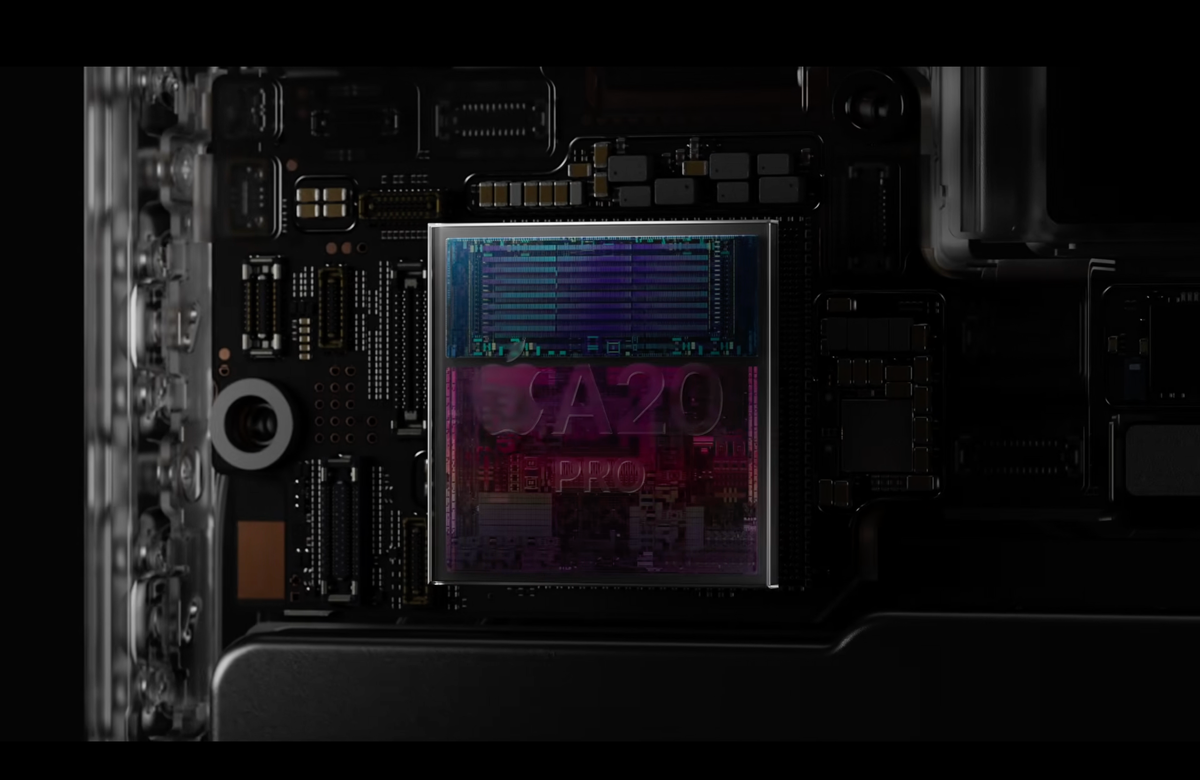
The A19 Pro incorporates two desktop-class super cores whose architecture is "driven in part by increased front-end bandwidth, a new cache hierarchy, and enhanced branch prediction," characteristics Apple previously described when introducing similar super cores in the M5 processor earlier this year. These architectural enhancements significantly boost single-thread performance while increasing die size, transistor count, and power consumption. The N2 process apparently enabled Apple's engineers to integrate two desktop-grade CPU cores into a smartphone application processor.
The A20 Pro delivers 7.1% higher single-thread performance than the M5 while operating at clock speeds 7.1% higher than M5, suggesting that the A19 Pro employs the same super core design as the M5 processor.
Although incorporating PC-grade general-purpose cores in a smartphone chip might seem excessive, Apple has consistently integrated PC technologies into its mobile processors, including NVMe, PCIe, DisplayPort-over-USB-C, and hardware virtualization. Given that Apple deploys A-series processors in iPads and budget laptops, incorporating these technologies into smartphone application processors proves strategically valuable. The desktop-grade cores in the A20 Pro expand potential use cases while reinforcing Apple's position in traditional computing segments it will address in coming quarters.

Apple's transition to TSMC's N2 commences with substantial general-purpose performance improvements driven by powerful super cores and a memory subsystem offering 50% additional bandwidth relative to the A19 Pro. In the coming weeks, details will emerge regarding upgrades to the GPU, NPU, and other A20 Pro components, revealing whether these enhancements match the CPU's impressive gains or represent more incremental improvements. Based on current evidence, the A20 Pro demonstrates exceptional capabilities.