Agility's Digit 5 Humanoid Robot Adds Safety Systems to Work Alongside Humans
Agility Robotics has unveiled Digit 5, a humanoid robot designed to operate safely in shared workspaces by detecting nearby workers and taking autonomous precautions like squatting or moving aside. The robot will reach early customers in the first half of 2027.
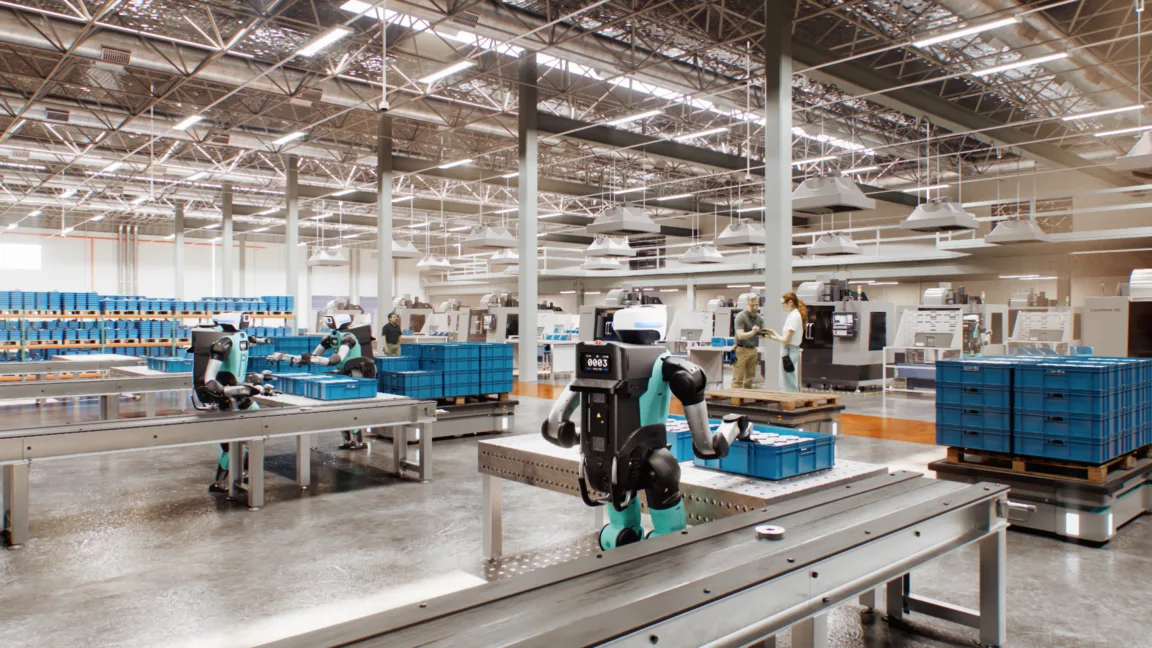
Agility Robotics introduced its latest humanoid robot, engineered to function safely in environments where human workers are present, eliminating the need for isolated work areas or protective barriers. The Digit 5 can detect approaching personnel and respond by repositioning itself, halting movement, or lowering into a squat position to minimize collision risk.
"The robot was designed with a complex safe motion system that can take a variety of different mitigations depending on exactly what sort of human presence is detected," said Pras Velagapudi, chief technology officer at Agility.
The Salem, Oregon-based company plans to make Digit 5 available to select customers during the first half of 2027, with broader availability expected by year's end. Agility is retrofitting its RoboFab manufacturing facility in Salem to produce the new model.
Safety has remained central to Agility's strategy since becoming the first company to deploy humanoid robots in commercial warehouse operations at a GXO facility in Atlanta during 2024. Earlier Digit iterations have logged more than 65,000 hours across North American warehouses and manufacturing plants, with deployments at GXO, Schaeffler, Amazon, and Toyota Motor Manufacturing Canada. Jonathan Hurst, Agility cofounder and robotics researcher at Oregon State University, previously noted that safety concerns have been a "blocker for everybody" in the industry's race to scale humanoid robot production.
The robotic safety hardware and software
Digit 5's approach to safety represents a more "granular" alternative to simply powering robots on and off, Velagapudi explained. The system integrates with external workplace safety infrastructure that customers already operate.
The robot combines artificial intelligence algorithms with onboard multimodal sensors to identify personnel in nearby areas. While Velagapudi declined to specify exact sensor types, he characterized the detection system as incorporating "a few different types of vision-based sensors."
Digit 5 runs on Nvidia's Thor IGX hardware for robotic artificial intelligence processing and incorporates Nvidia Halos for Robotics, a software framework designed for robotic safety applications. "Digit is equipped with this Thor IGX, and we're one of the first adopters to be taking that through to a functionally safe application using that technology," Velagapudi stated. "It's really core to the compute of our product, and it's part of the safety case that we've been putting together."
Agility developed Digit 5's safety capabilities while contributing to an international working group establishing safety standards for industrial mobile robots. The resulting standard, ISO 25785-1, is currently under committee review and will eventually face a vote from the International Organization for Standardization's 89 member nations.
Unleashing the upgraded robot
Beyond its safety enhancements, Digit 5 incorporates an improved leg structure allowing it to repeatedly handle loads up to 50 pounds. This capability aligns with single-person lifting thresholds established by the U.S. Occupational Safety and Health Administration.
The robot features a 90-minute battery that recharges in nine minutes, enabling more than 20 hours of daily operation by minimizing charging downtime. Standing 5 feet 11 inches tall with a maximum reach of 7.2 feet—compared to Digit 4's 5.5-foot reach—Digit 5 can access shelves at heights typical human workers reach.
Digit 5 includes interchangeable gripper systems that allow rapid installation of different end-effectors for varied tasks. Combined with updated artificial intelligence capabilities, this modularity enables the robot to perform diverse warehouse and factory operations beyond simple item transport.
The robot's capacity to work safely alongside people opens possibilities for tasks like pallet stacking and packaging while workers swap pallets, or traversing aisles shared with human staff. "In those scenarios, it's not really practical to constrain the robot within a physical safety cage," Velagapudi noted. This "cooperative safety" approach allows productive robotic work in shared spaces while maintaining safe distances. Successful commercial deployments could eventually enable "collaborative safety," where humanoids work in direct proximity to human colleagues, Velagapudi added.