Two Competing Efforts Push MATE Desktop Toward Wayland Support
As major Linux desktop environments complete their transition away from X11, two independent projects are now working to bring MATE to Wayland through different technical approaches.
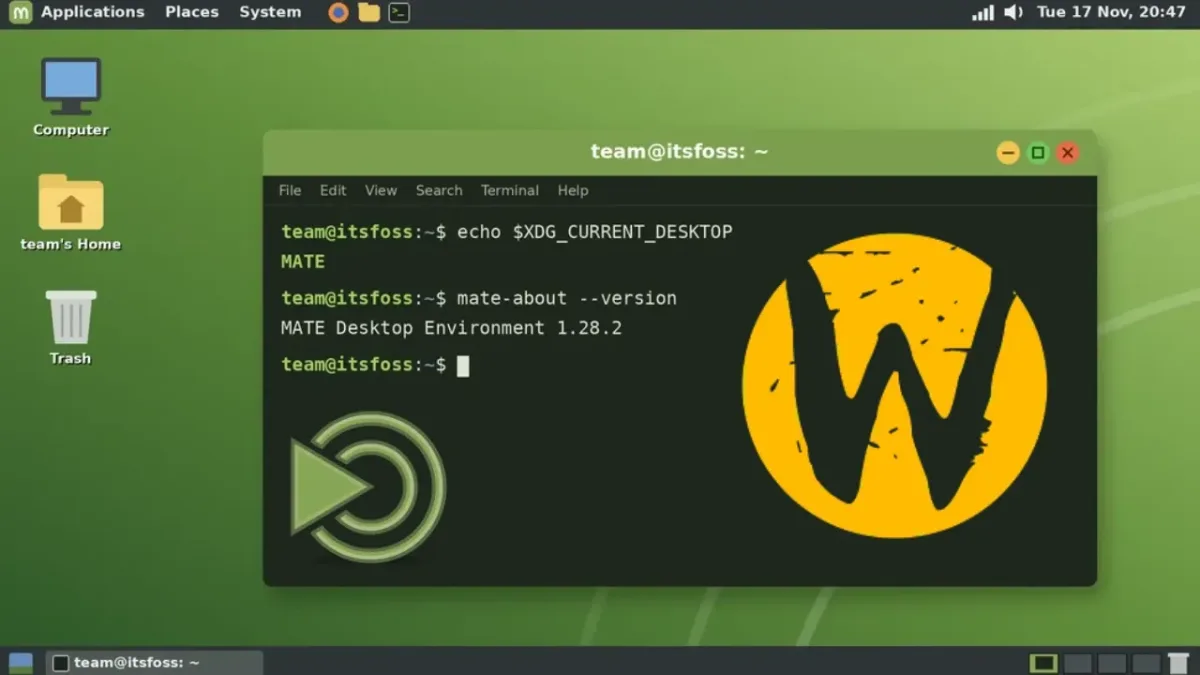
The shift to Wayland among major Linux desktop environments is accelerating. GNOME removed X11 support from its login manager in March, while KDE Plasma discontinued X11 session startup capabilities last month. Cinnamon lags slightly behind but plans to include a production-ready Wayland session in Linux Mint 27, arriving around Christmas, though X11 will remain the default option.
Smaller desktop projects are progressing at varied speeds along the same path. LXQt eliminated the experimental designation from its Wayland session with version 2.3.0, and Ubuntu Budgie 26.04 switched entirely to Wayland using labwc.
MATE has taken a more gradual approach, rolling out Wayland compatibility incrementally. Beginning with MATE 1.26, individual applications including Atril, System Monitor, Pluma, and Terminal gained Wayland support, while the official mate-wayland-session provides a basic experimental environment built on Wayfire.
The critical gap remains the absence of a Wayland-native window manager for MATE. Marco, MATE's standard window manager, lacks Wayland capabilities. Two new initiatives, Polo and MATE Wayland Desktop, now seek to address this limitation through distinct strategies.
Polo
Developer Kerem Söke created Polo as a compositor, window manager, and session manager designed to preserve MATE's current look and behavior when running on Wayland.
Built using Vala and C atop libweston 16, Polo implements Marco's window management approach while maintaining existing MATE settings, themes, and keyboard shortcuts. Legacy X11 applications receive their own window manager through XWayland.
Polo manages sessions via the D-Bus interface of mate-session-manager, allowing the panel, Caja file manager, and screensaver to interact as they would under X11. The first stable version launched on 12 November, featuring tiling support, workspaces, screen sharing via xdg-desktop-portal, and layer shell compatibility for mate-panel.
A DRM backend manages multiple displays and preserves screen configurations. The project also includes visual effects such as wobbly windows and a desktop cube.
Building Polo from source is supported on Fedora 44 or 45, Debian 14, and Ubuntu 26.04 or 26.10. After installation, a "MATE (Polo)" option appears in LightDM. Söke indicated he might establish his own .deb repository if the Debian and Ubuntu MATE teams do not provide Wayland-enabled packages.
MATE Wayland Desktop
Rather than developing a new compositor, MATE Wayland Desktop leverages an existing one. It replaces Marco with labwc and distributes as an installable ISO based on Ubuntu 26.04 LTS, incorporating Linux 7.0 and MATE 1.29 as core components.
Eight MATE packages are recompiled from updated upstream sources, including mate-panel 1.29.2 with Wayland support enabled. X11-only applications function through XWayland.
Calamares handles installation and provides optional LUKS2 full-disk encryption.
The project acknowledges several limitations. The keyboard, mouse, and keyboard shortcuts panels in Control Center crash when running natively, so MATE Wayland Desktop routes them through XWayland instead. MATE's Displays dialog does not function on Wayland; the launcher's "Displays" entry opens wdisplays as a workaround.
Secure Boot must remain disabled during installation and use. The ISO ships with the open source Nouveau GPU driver, though NVIDIA's proprietary driver can be installed afterward using ubuntu-drivers.
Given its nascent status, testing on a separate system before committing to full installation is strongly advised. The ISO for x86_64 systems is available through the official download portal.