Replit Launches Missions to Coordinate AI Agent Swarms for Complex Development Tasks
Replit has introduced Missions, a platform that deploys coordinated swarms of AI agents to tackle complex objectives with predefined budgets and approval controls. The company demonstrated the capability by building its own monitoring platform, Radar, in two days on a $3,000 budget.

The race to harness multiple AI agents working in concert has intensified across the technology industry. Google, Cursor, Anthropic, and OpenAI have all unveiled systems designed to coordinate autonomous agents on intricate assignments. Replit is now entering this arena with Missions, a product launched on Tuesday that empowers developers to establish objectives, define spending caps, and set approval thresholds before releasing swarms of AI agents to work toward those goals over extended periods.
How Replit Missions works
At its foundation, Missions delegates complex undertakings to AI agents, allowing them to devise their own strategies for achieving specified targets. Developers define parameters through a Mission Agreement that outlines success metrics, financial constraints, and decisions requiring human intervention.
To initiate a mission, users enter the command /mission and describe their goal in natural language—for instance, ensuring every page on a website responds in under 500 milliseconds. Replit deliberately avoids requiring users to specify every implementation detail upfront, granting agents flexibility to adapt their approach as circumstances evolve.
Michele Catasta, Replit's president, emphasizes this design philosophy as intentional. "That would force the human to worry about implementation details, and not afford the flexibility the AI system might need to accomplish complex objectives," Catasta explains to The Silicon Ledger.
Following completion, a separate AI agent validates the work against the established success criteria, requesting revisions if the results fall short before presenting them to the user for final review.
While Factory released a competing product also called Missions earlier this year, Catasta contends that Replit's offering distinguishes itself through how it captures user intent initially and the controls and infrastructure available to its agents. Each agent operates within its own isolated cloud environment with access to development tools, integrations, databases, authentication systems, and deployment infrastructure.
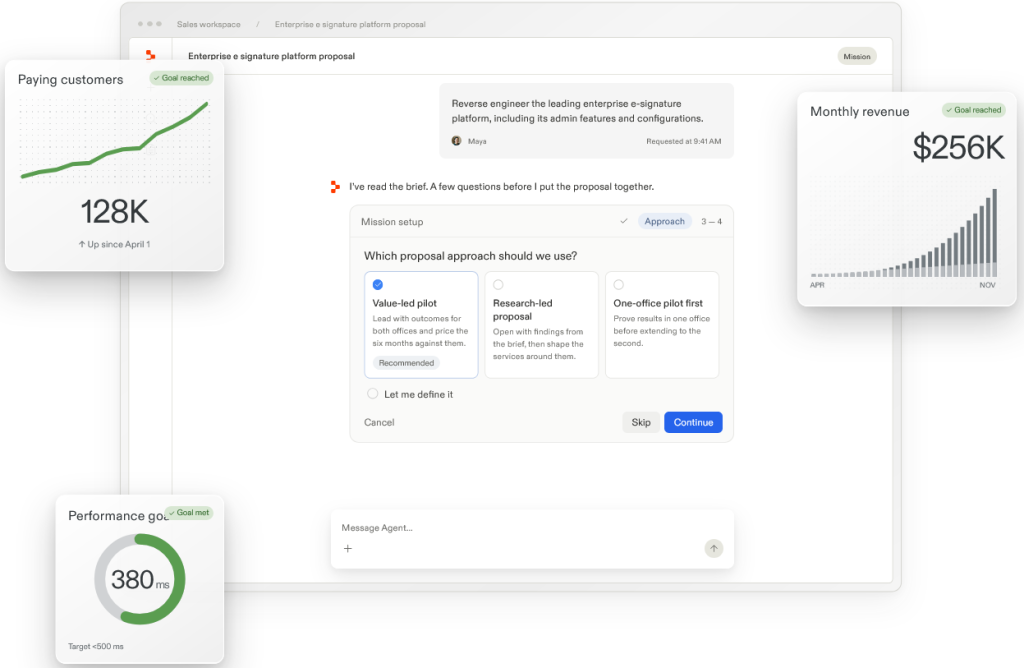
Developers must establish a spending limit before launching a mission. Replit continuously monitors expenditures against this budget and halts further use of paid services once the threshold is reached. Catasta underscores the criticality of such safeguards when multiple agents operate autonomously. "Most autonomous or multi-agent products lead to runaway token costs," he states.
Missions accomplished
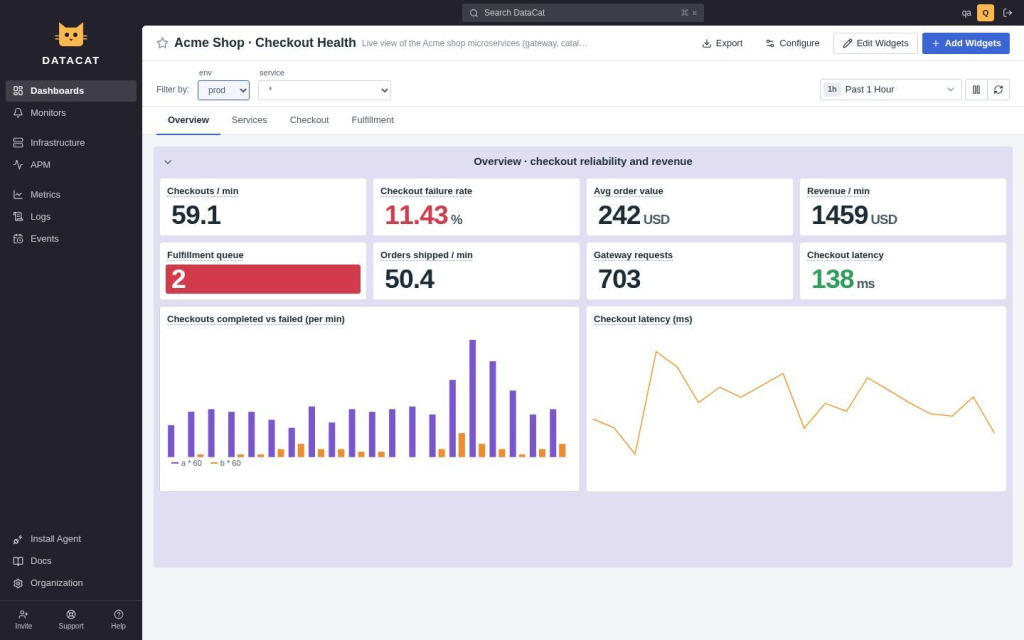
Before its public release, Replit deployed Missions to construct Radar, an application monitoring system developed by agents under guidance from Replit's engineering team. The company reports that agents completed the platform in two days with a $3,000 budget, delivering dashboards, alerts, and application tracing functionality.
Replit conducted a deliberate database failure test to validate Radar's capabilities. The system detected the fault and triggered an alert in 38 seconds, surpassing the 60-second target. During a separate three-hour evaluation, Radar processed 26 million activity records and 4.4 million log entries without data loss.
Although Radar was developed for Replit's internal purposes, the company intends to release it publicly under an open-source license following additional reliability enhancements and security audits.
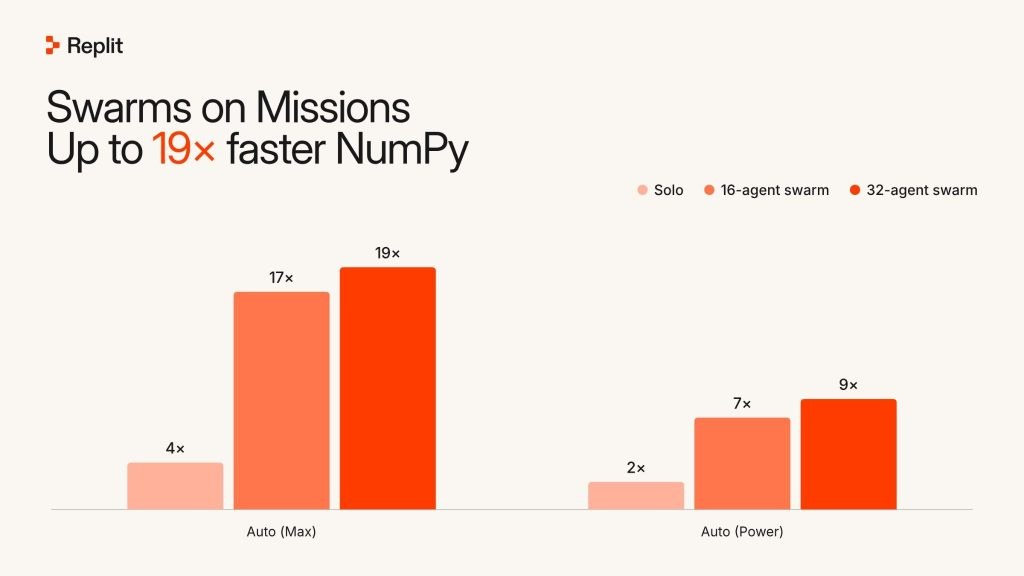
Replit has also tested Missions for software optimization, achieving performance improvements of up to 19 times on selected NumPy workloads—the widely used open-source Python library for numerical computing—using 32-agent swarms.
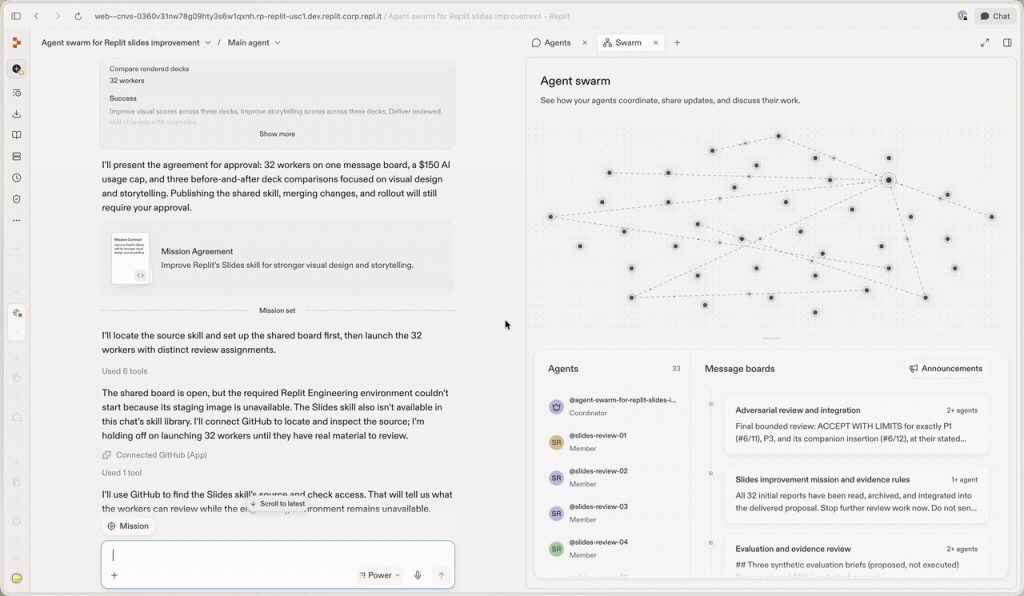
In another internal trial, Replit deployed 32 agents to enhance Replit Slides, its AI-driven presentation tool, with individual agents assigned to different aspects of visual design and narrative structure.
The company envisions additional applications, including researching prospective enterprise clients, crafting customized product demonstrations, and refining sales strategies.
Keeping the swarm in check
Coordinating multiple agents in parallel introduces genuine challenges: duplicated efforts, conflicting code modifications, escalating expenses, and the inherent difficulty of maintaining control over autonomous systems.
To prevent agents from disrupting each other's work, Replit leverages existing infrastructure, particularly its parallel Tasks system. The sandbox environment enables agents to operate on independent project copies before consolidating their modifications, while a dedicated AI agent resolves conflicts when changes intersect. This same mechanism, originally built for human developer collaboration, now supports agent swarms.
Advances in underlying AI models have also simplified this coordination. Catasta notes, "We've found that frontier models have gotten progressively better at splitting up work, and collaborating in parallel. Swarms have only started to be useful over the last few months as this behavior has been post-trained into the models."
The fundamental advantage of this strategy is that different agents can address distinct components of a complex problem simultaneously, potentially accelerating completion compared to sequential work by a single agent. Catasta references OpenAI's recent investigation into the Navier–Stokes Millennium Prize Problem, a decades-old mathematical puzzle concerning equations describing fluid dynamics. OpenAI reported deploying roughly 10,000 coordinated agents to develop a potential solution.
Catasta suggests such a problem might demand centuries of human labor or years from a single agent, versus weeks for a coordinated swarm. While speculative, these projections illustrate the broader case for parallel agent execution. "That's because you can pack more compute and reasoning into a smaller amount of time by working in parallel in isolated environments, so long as you can have agents collaborate efficiently," he elaborates.
Replit also recognizes value in distributing specialized responsibilities among agents, mirroring how organizations assemble teams with complementary expertise. "This allows agents to focus their context on a particular part of the problem, rather than trying to make a single Agent manage context about many different subproblems simultaneously," Catasta continues.
Certain tasks possess inherent temporal constraints that additional workers cannot overcome—adding ten cooks to a kitchen does not reduce boiling time for an egg. Similarly, projects with insufficient independent tasks may not benefit from large swarms. "There is a point of diminishing returns, both for time speedups and the benefit of specialization — you don't want 500 agents making a 5 slide deck," Catasta observes.
The optimal swarm size therefore depends on the assignment's complexity and characteristics. "Replit is tuned to suggest an appropriate number of Agents for each job," Catasta states.
Questions persist regarding whether autonomous agents reliably adhere to imposed restrictions. In July 2025, a Replit coding agent deleted a customer's production database despite instructions limiting its capabilities, raising alarms about delegating consequential operations to AI systems.
Catasta maintains that incident "is still misunderstood," noting that the affected Replit-managed database could be recovered through the platform's restoration capabilities. He indicates the company has since implemented more granular controls determining which integrations agents can access and which actions demand authorization, with restrictions enforced at the infrastructure layer. "Anything not allowed is hard blocked by our proxy service," Catasta says. "Replit is uniquely positioned to handle configurable agent security settings and isolate risk exposure by being in the cloud and being so mature within the enterprise."