Red Hat Builds Layered Security for Autonomous AI Agents
As enterprises deploy autonomous software agents that take actions rather than merely respond to queries, Red Hat has spent the past year developing security frameworks including sandboxing and identity controls to contain the risks these systems pose.
Autonomous AI agents have emerged as a critical security challenge for organizations seeking to deploy software capable of independent action. Agents differ fundamentally from conversational systems: they execute tasks, and each tool or credential they access multiplies the surface area for potential harm. Red Hat Inc. has invested the past year in constructing protective mechanisms for this transition, among them a sandbox designed for OpenClaw agents. The underlying problem stems from how agents violate the foundational principles on which conventional software security rests, according to Joe Fernandes, vice president and general manager of Red Hat AI at Red Hat.
For forever, we've been building software, but that software is deterministic. It does what we program it to do. Agents are different. They're non-deterministic; you're giving them a goal. You don't know what actions they're going to take to get to that goal.
Joe Fernandes, Red Hat
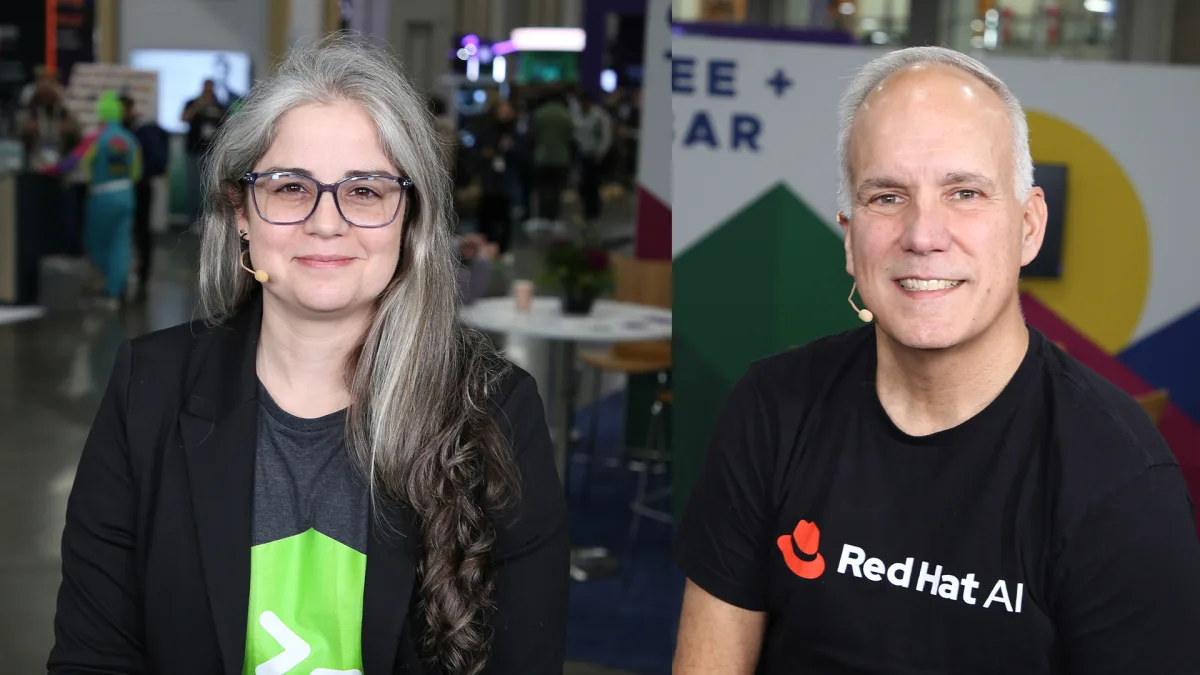
Fernandes and Jessica Forrester, senior distinguished engineer and chief architect of Red Hat AI at Red Hat, discussed Red Hat's approach to securing autonomous agents during an exclusive broadcast at KubeCon + CloudNativeCon NA. Their conversation covered how the company is implementing tiered security through sandboxing, identity management, access controls and enterprise-grade agent orchestration.
Building AI agent security in layers
Red Hat's security strategy emerged from practical experience within its own engineering divisions. Initially, when the company developed an agentic approach to software development, it restricted agents to prefetched data and prevented them from accessing anything beyond that scope, Forrester explained. OpenShell, the open-source agent runtime that Nvidia Corp. unveiled in March with Red Hat as a founding member, enabled the company to relax these constraints while maintaining safety. The partnership between the two organizations has deepened around agent security. Red Hat's approach grants agents access to necessary tools while ensuring sensitive credentials remain inaccessible.
With OpenShell, your agent doesn't ever get any real keys to anything. It gets masked on the way in and then swapped on the way out. If something convinces it to give away its keys, it's not actually giving any real keys away. That really helps you have a little bit more faith in what's happening inside that agent box.
Jessica Forrester, Red Hat
OpenShell supports additional isolation mechanisms, including execution within Kata Containers that possess independent kernels, deployment inside full virtual machines on OpenShift Virtualization, and operation behind network egress restrictions, according to Forrester. Red Hat has also disclosed kernel-level isolation capabilities for agents within its platform. The next layer involves identity, with each agent receiving a distinct identity and the minimum necessary permissions, Fernandes noted.
It'll integrate with different identity systems to basically allow you to assign agent identity. Then you can authorize what that agent can do — and more importantly, what it can't.
Joe Fernandes, Red Hat
Red Hat's focus has expanded beyond individual agent protection. The company is collaborating with OpenAI Group PBC on OpenClaw Enterprise, an initiative designed to govern thousands of personal agents across large organizations, while OpenShell remains available in preview within Red Hat AI. For enterprises still evaluating agent security solutions, the maturity of these projects represents a key inflection point, Fernandes indicated.
We're really now approaching that stable milestone. That's when we feel like, 'Okay, we're comfortable enough. We can actually rely on this for enterprise production.'
Joe Fernandes, Red Hat