Percona CEO warns AI industry is blurring the meaning of 'open source'
Peter Farkas argues that releasing model weights is not the same as open source software, and that the AI industry risks weakening the definition for all of technology.
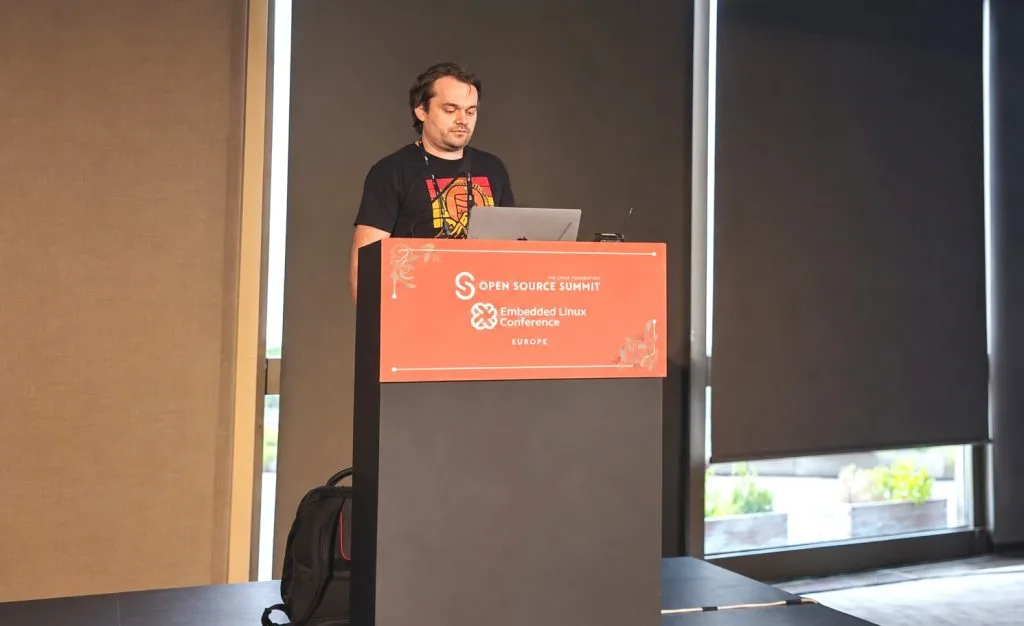
The artificial intelligence sector has adopted the vocabulary of open source while delivering something fundamentally different to developers. At Open Source Summit Europe in Prague, Peter Farkas, CEO of database services firm Percona and co-creator of the MongoDB alternative FerretDB, made a direct appeal: "Don't use 'open weight' and 'open source' interchangeably."
Farkas is concerned about what he calls "open washing"—the practice of labeling products as open when they lack the freedoms that open source traditionally guarantees. He worries this trend could damage the definition of open source across the entire software industry, not just in AI.
'Open source' is only going to remain 'open source' as long as we preserve the actual meaning and the freedoms that are behind open source, and open weights are not providing that.
Peter Farkas, CEO of Percona
The gap between weights and source
An AI model's weights represent the numerical parameters learned during training—the patterns encoded in the system. When developers gain access to weights, they can download and operate a model on their own servers, even without understanding how it was built or what data trained it.
This distinction matters because open-weight models now dominate production AI systems. In August, they represented 56% of tokens processed through Vercel's AI Gateway and 60 percent of token consumption originating from the United States on OpenRouter, with Chinese-developed models making up the bulk of that share.
Farkas frames the problem plainly: "You don't have the source code, you don't have the training data, you only have the output of these two. So why would we call this open source in the first place?"
James Landay, director of Stanford's Institute for Human-Centered AI, has articulated a similar concern. In an August article, Landay drew a sharp distinction between what open weights and open source actually deliver to the development community.
Open weights answer 'can I run this?' Open source answers 'can I trust this, improve it, and build the next thing on top of it?'
James Landay, Stanford Institute for Human-Centered AI
According to Landay, the major AI laboratories are primarily answering the first question while falling significantly short on the second.
Degrees of transparency
Some companies have begun moving beyond simply releasing weights. Xiaomi recently unveiled its MiMo-V2.6 models, broadcasting nearly a week of reinforcement-learning training through a public dashboard. The company also made available more than 7,000 reinforcement-learning task environments alongside its RL training code and technical documentation, providing greater insight into the fine-tuning process.
Whether such efforts qualify as genuinely open source AI remains debatable. Xiaomi's approach does illustrate the spectrum Farkas describes: different "open" releases can expose vastly different amounts of information about how a model was constructed.
Farkas points to China's DeepSeek as an example of the terminology problem. Its models have been widely labeled as open source in public discussion, even though the company released only the weights rather than everything necessary to reconstruct the models from the beginning.
Nevertheless, Farkas acknowledges the genuine value of open weights on their own terms.
Are open weights a bad thing? No, open weights are great. You can run your models in your own environment, you can experiment with them, and if you understand the risks, you can also use it in production. The problem is when open weights are positioned as, 'hey, this is as good as open source'.
Peter Farkas, CEO of Percona
The real danger, Farkas contends, emerges when the distinction collapses. Without a clear boundary between the two concepts, he warns, "open washing wins." More troubling still is his concern that accepting a diluted definition of open source in the AI space could ultimately weaken the concept for software development as a whole.
Farkas illustrates the risk with a concrete example: "Companies are going to get away with calling something Apache 2.0 that [for example] you can't use in the European Union. Open source AI is one thing, but if we talk about open source, and we let this happen to the core definition itself, that is going to go way beyond AI."
The Open Source Initiative responds
The Open Source Initiative released its first Open Source AI Definition in 2024, laying out criteria centered on freedoms to use, study, modify and share AI systems. However, the definition remains contested, particularly regarding what information about training data should be mandatory for an AI system to be considered open source.
Duane O'Brien, who took over as OSI's executive director in April, responded directly to Farkas's concerns from the audience, signaling that the organization is prepared to revisit its original framework.
We did have a conversation two years ago — it was an important conversation, and two years is a long time in this space. We are in the process of reopening and having another set of conversations.
Duane O'Brien, OSI executive director
The OSI has launched an Open Source AI Fellowship, naming Gabriel Toscano as its inaugural fellow to help forge consensus on what open source AI should mean. The two-year initiative will examine potential updates to the definition while the organization plans a series of community forums, termed "open source salons," across the coming two years.
O'Brien invited Farkas and others to participate in these discussions while acknowledging the legitimate objections raised against the initial definition.
The criticisms that have been lodged against open source AI definition 'one' are valid. We have to continue that conversation.
Duane O'Brien, OSI executive director