Anthropic Rolls Out Claude Ship, an AI System for Automating Code Review and Approvals
Anthropic introduced Claude Ship on Monday, a trio of AI agents designed to streamline the pull request workflow by reviewing code, fixing issues, and granting approval when team policies permit.
Anthropic unveiled Claude Ship this week, comprising three distinct agents built to handle pull requests at different stages. The Code Review agent, which reached general availability in October, screens PRs for issues. Two additional agents—PR Steward and Claude Approvals—launched in beta alongside it.
PR Steward addresses failing continuous integration checks, merge conflicts, and reviewer comments by pushing corrections. Claude Approvals examines policies stored in a team's GitHub repository to decide if a PR requires human sign-off before merging.
Anthropic contends that while Claude handles the bulk of code generation for Claude Code, the actual bottleneck emerges once developers submit their work for review. By the time feedback arrives, engineers have often shifted focus elsewhere. A seemingly simple change then demands interrupting other tasks, waiting for automated tests to complete, and securing approval from a reviewer. Though few organizations operate at Anthropic's velocity, the code review bottleneck represents a widespread productivity constraint across the industry.
Who has to sign off?
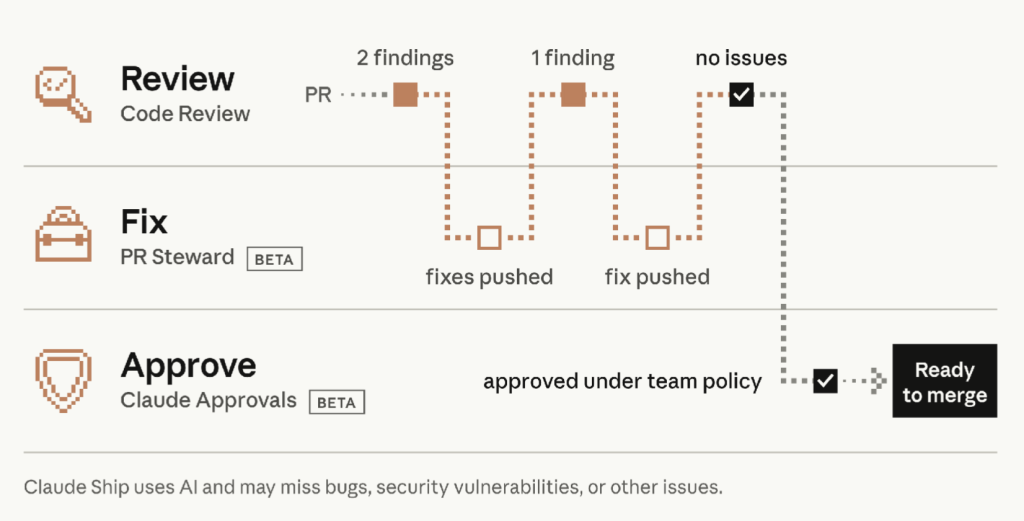
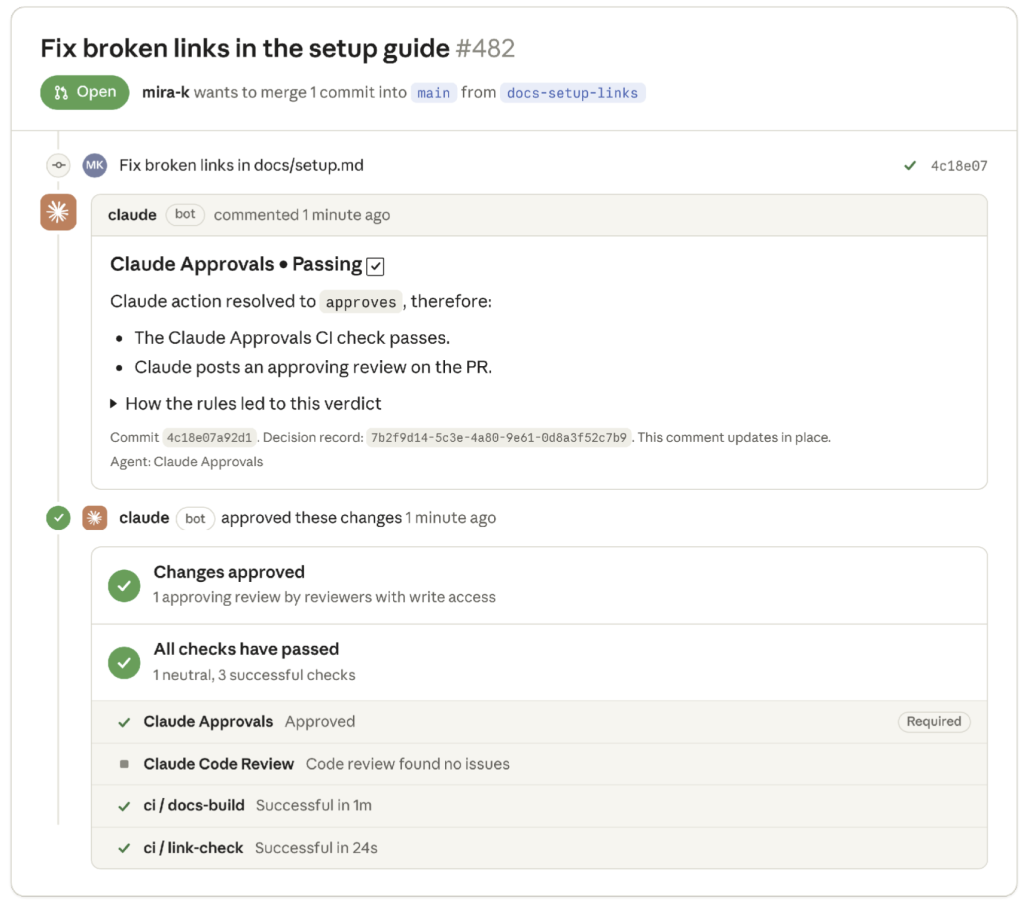
Most organizations remain hesitant to grant AI complete authority over code reviews, yet as Anthropic suggests, perhaps not every change warrants multiple human reviewers. A change affecting a critical billing system might still demand two reviewers beyond the author, including someone from the payments group. For routine modifications, Claude's approval could reduce required human sign-offs to a single reviewer. Documentation-only changes could potentially receive Claude's sign-off without human intervention.
Teams establish these rules within .claude/approvals.yml, where they can also define custom classifiers using plain language. Anthropic suggests initially running the policy in observe-only mode to preview which PRs Claude would approve before making its authorization a mandatory check.
PR Steward operates before a PR reaches the approval stage. It responds to feedback from humans and other review systems, though it cannot approve or merge changes itself. Following each update, it posts a comment detailing what changed and how to revert it.
Administrators can activate Claude Ship across an entire repository. Developers can also invoke /ship within Claude Code to commit a change, initiate a PR, and manage feedback and test failures. The command executes locally for up to seven days, requiring the session and computer to remain active.
How GitHub, Cursor, and CodeRabbit handle approvals
Other vendors in the coding tools space are addressing the same workflow constraint. GitHub rolled out approvals for Copilot code review on September 1 and made the feature generally available on October 28. Repository administrators can limit which file paths Copilot is permitted to approve.
Cursor's PR Routing & Approval agent applies a team's risk threshold and examines the APPROVAL_POLICY.md file nearest to modified code. CodeRabbit enables teams to configure separate thresholds for merge risk and security risk in .coderabbit.yaml.
GitHub's Max review level, currently in public preview, leverages models from multiple providers and synthesizes their assessments. Claude Ship, by contrast, relies exclusively on Claude for all three agents.
How Anthropic uses Claude Ship
Anthropic reports deploying Claude Ship across numerous PRs within its own Claude Code team. When a customer identified an imprecise statement in the Analytics API documentation, a product manager consulted Tag, the company's Slack agent, about the issue. Tag generated a PR, Code Review cleared it, and a documentation reviewer approved it. The correction shipped that same evening.
Between June and September, the team increased its merged PR volume by more than half while reducing the revert rate by over 40 percent, according to Anthropic.
It bears noting that Claude Ship addresses only a portion of the complete workflow. Anthropic's engineering post from October also references a distinct security review process capable of blocking merges.
TELUS Digital and Carvana rank among the early adopters. Vatsal Bhatt, director of engineering at TELUS Digital, stated in a comment provided by Anthropic, "We keep a human in the loop." He noted that PR Steward has enabled contributors to resolve issues flagged by Code Review before human review occurs.
Carvana's pilot program leverages PR Steward to process review feedback, according to Alex Devkar, senior vice president of engineering and analytics. Neither customer has disclosed using Claude to independently approve PRs.
Pricing and availability
Team and Enterprise tier customers can activate Claude Ship for GitHub repositories, provided they do not employ Zero Data Retention, Anthropic's HIPAA-compliant configuration, or customer-managed encryption keys.
Anthropic charges based on token consumption. When Code Review launched in March, the company estimated an average cost of $15 to $25 per review—not inexpensive, though potentially less costly than deploying faulty code.
Invoking /ship counts as standard Claude Code usage. Claude Approvals carries no separate base fee, but classifiers incur billable token charges identical to other model operations. Policies requiring Code Review trigger a paid review, even when running in observe-only mode.
A limited promotional window exists for qualifying Enterprise customers. Through January 15, 2027, eligible organizations can claim "at least" $10,000 in Claude Ship credits, though they must consume these within 30 days of claiming them.