openSUSE Merges Leap Micro Into Main Leap Distribution With New Immutable Mode
openSUSE is consolidating its Linux lineup by folding the immutable Leap Micro into Leap 16.1, offering users an "Immutable" installation mode alongside the traditional "Standard" option.
The openSUSE project maintains four primary Linux distributions: Leap, a stable fixed-release built from the same codebase as SUSE Linux Enterprise (SLES); Tumbleweed, a rolling-release variant; MicroOS, an immutable rolling-release that follows Tumbleweed; and Leap Micro, an immutable fixed-release counterpart to Leap designed for container hosts, edge devices, and virtual machine workloads. That product lineup is now changing.
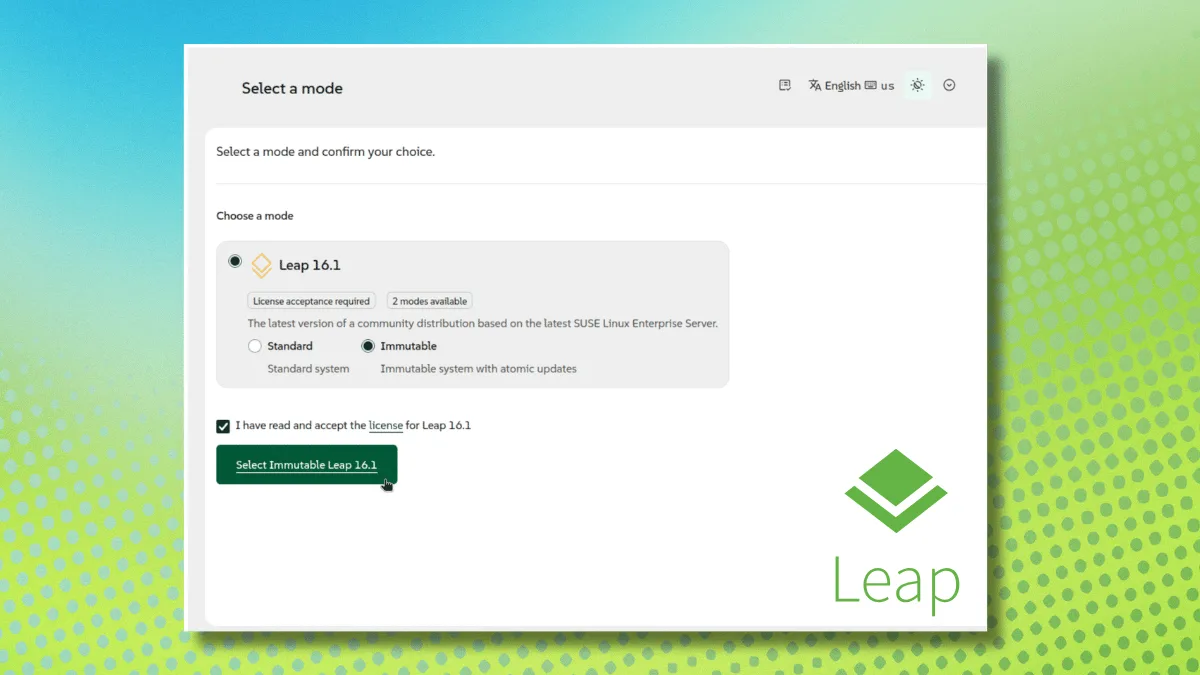
The project has decided to discontinue Leap Micro as a standalone product and instead integrate immutable capabilities directly into the main Leap distribution. Rather than maintaining separate installation paths, Leap 16.1 introduces an "Immutable" mode option within the Agama installer that users can select during setup.
Immutability as an installation option
Selecting the "Immutable" mode during Leap 16.1 installation configures the system with a read-only root filesystem, transactional updates, and snapshot-based rollback capabilities. The underlying technical architecture mirrors what Leap Micro previously delivered; the shift is architectural rather than functional, moving immutability from a separate product into a configuration choice within Leap.
System maintenance occurs through transactional-update, which stages changes in a new snapshot before reboot, enabling rollback if an update causes problems. New software installation relies on Podman and Distrobox for container workloads, while Flatpak manages desktop applications. Users preferring conventional system behavior can select the "Standard" mode instead.
The project has confirmed there will be no Leap Micro 6.3 or 7.0 releases. Leap Immutable now serves as the designated path forward for users running container workloads, edge deployments, or systems requiring atomic updates. Existing Leap Micro 6.2 users can migrate using the experimental openSUSE Migration Tool.
Additional improvements in Leap 16.1
Beyond the immutability consolidation, Leap 16.1 brings a collection of component upgrades. KDE Plasma 6.6 arrives with OCR functionality in Spectacle and enhanced accessibility features. GNOME 48 introduces HDR support and a new default audio player, though this represents the same version shipped with Leap 16.0 with an added gnome-shell bug fix. The openSUSE development team is rolling out GNOME updates incrementally across multiple releases rather than performing major version jumps simultaneously.
The stable release of Leap 16.1 is scheduled to arrive on the same date as SLES 16.1.
Release candidate availability
Currently, only the release candidate (RC) is available. The project commits to publishing one RC build weekly until reaching Gold Master Candidate (GMC) status. RC images are accessible from the Leap website for x86_64, aarch64, ppc64le, and s390x architectures.