New Software Sharpens Webb Telescope's View of Distant Exoplanets
Researchers have developed a machine-learning approach that optimizes the James Webb Space Telescope's hardware model to filter out noise and reveal fainter exoplanets in imaging data.
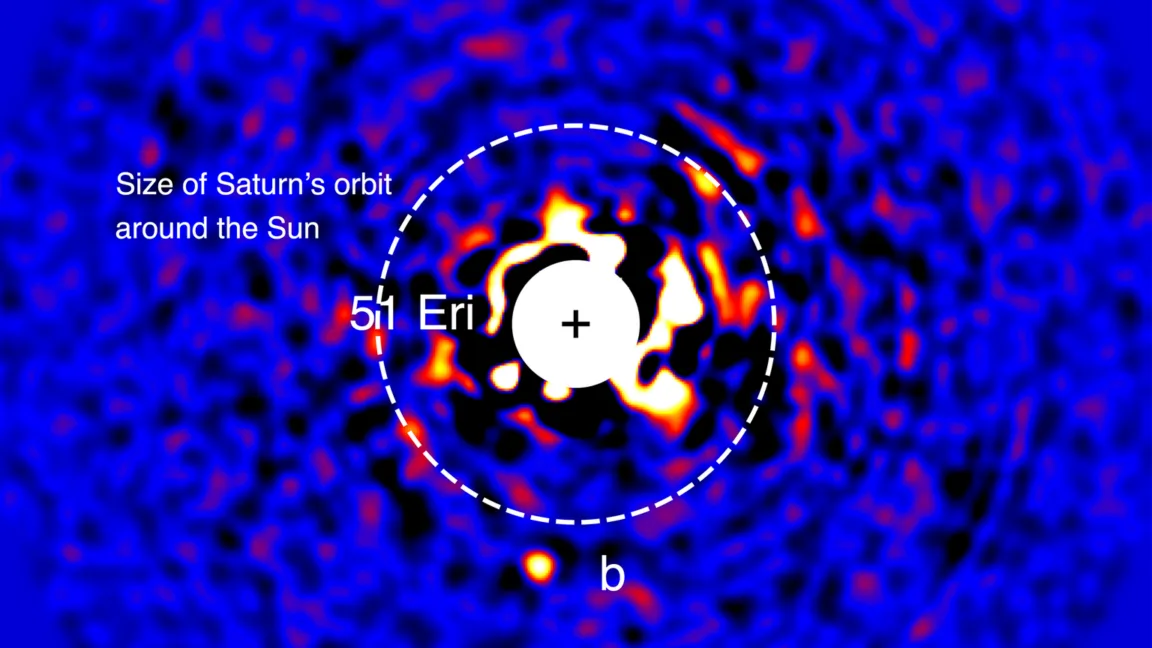
Astronomers studying exoplanets face a fundamental obstacle: planets are vastly dimmer than their host stars. Researchers want to image these distant worlds directly or analyze starlight filtered through their atmospheres to understand their conditions. Coronagraphs can suppress much of a star's overwhelming brightness, but they cannot eliminate all interference caused by minute fluctuations in the telescope's alignment and hardware between observations.
A team has now created a software solution that builds a precise physical model of the telescope and uses artificial intelligence techniques to account for these variations. The approach yields cleaner images of exoplanets by reducing the noise that typically obscures faint signals.
Point spreads
The foundation of this work rests on understanding the point spread function—a mathematical representation of how a telescope distorts a single point of light. When a telescope observes a point source, the image appears blurred and dispersed rather than sharp, a consequence of hardware imperfections and the challenge of maintaining precise pointing during long exposures.
Astronomers typically determine the point spread function through one of two methods. The first involves observing a known target and deriving a mathematical description from those observations. While effective at reducing noise, this approach has drawbacks: telescope hardware behavior shifts over time, and the point spread function can differ across wavelengths.
The second method attempts to model the hardware's behavior directly to calculate the point spread function. However, modern telescopes are extraordinarily complex instruments with countless variables influencing performance, many of which remain difficult to quantify even with complete engineering documentation. This complexity introduces so many parameters requiring adjustment that the computational burden becomes impractical.
Recent advances in artificial intelligence offer a path forward. Neural networks have demonstrated remarkable success at optimizing billions of parameters using a mathematical technique called gradient descent. Moreover, substantial engineering effort has gone into accelerating gradient descent calculations on GPUs, making the approach computationally feasible.
Researchers developed FLIP (Physics-based Learning for Imaging Planets), a process that combines a physical model of the James Webb Space Telescope's NIRCam instrument—containing 106 adjustable parameters—with software optimization. The system begins with a simulated point spread function, then applies gradient descent to refine performance against data from an actual star. On current GPU hardware, this optimization completes in just over thirty minutes.
The optimized parameters are then adjusted further using the specific scientific image under analysis. This fine-tuning step proves essential because certain variables shift between different observations.
Good results
The team validated FLIP using Webb observations of three stars: HIP 65426 and 51 Eridani, both hosting known exoplanets, and TYC 5899, which has no confirmed planets but exhibits significant variability between observations. These are young stellar systems; two host massive planets still radiating heat from their formation, enabling previous detection.
Applying FLIP to Webb data improved the signal-to-noise ratio by factors ranging from 1.5 to 2 across different observations. At wavelengths sensitive to carbon dioxide, the technique enabled the first detection of one planet in Webb data. For TYC 5899, the method enhanced observational sensitivity by a factor of 15.
The researchers emphasize that FLIP's utility extends beyond refining images of already-known planets. By suppressing noise, the technique should enable detection of fainter objects—older or lower-mass planets that previously remained invisible. The team also plans to modify FLIP to identify where it makes the largest adjustments to the model, potentially revealing insights into the telescope's hardware performance.
Nature, 2026. DOI: 10.1038/s41586-026-11213-z