Google Releases Gemini 4 Argon to Developers at Introductory Pricing
Google's latest flagship model becomes available on the Gemini API with a unified 1 million token limit and introductory rates of $2 per million input tokens and $10 per million output tokens through November 30.
Following a two-week period of restricted access, Google on Tuesday opened Gemini 4 Argon to the broader developer community through the paid tier of the Gemini API, Google AI Studio, and several other developer and consumer platforms. The company had initially announced the model on September 30, limiting early access to participants in its Fairwind Program for cyber defenders and other approved testers, as well as internal Google staff.
Pricing and token allocation
Google is positioning Argon competitively in the market. Through November 30, developers will pay an introductory rate of $2 per million input tokens and $10 per million output tokens, with a shared 1 million-token budget covering both inputs and outputs combined. This matches the pricing of OpenAI's GPT-6.1 Sol during the promotional window.
Starting December 1, pricing will increase to $4 and $20 per million tokens, aligning with Anthropic's Claude Opus 5.5. During the introductory period, cached input tokens receive a 95 percent discount. Argon's current pricing undercuts both Anthropic's Claude Fable 5.1 and OpenAI's GPT-6 Astra, which both charge $10 and $50 per million tokens respectively.
Developers can invoke the model using gemini-4-argon through Google's Interactions API, with support available in the google-genai SDKs. Android developers can integrate it into applications via Firebase AI Logic.
Unified token budget model
A notable feature of Argon is its combined 1 million input/output token limit, which differs from Google's original September 30 announcement describing it as a 1 million-token output cap, an increase from the 64,000-token limit in earlier Gemini versions. Under the unified approach, lengthy prompts consume part of the shared budget, leaving less capacity for model responses. For instance, a request containing 800,000 tokens of code would restrict the response to 200,000 tokens.
This contrasts with Claude Opus 5.5, which maintains a separate 1 million-token context window alongside a distinct 128,000-token output cap. Google contends that Argon's expanded capacity enables sustained performance on complex, iterative tasks involving coding, scientific analysis, and agent-based operations.
Performance benchmarks
https://x.com/OfficialLoganK/status/2110038940841545827?ref_src=twsrc%5Etfw
Google reports that Argon achieves the top position on the Vals Index, a benchmark measuring performance across finance, coding, legal, and tax domains weighted by their respective shares of U.S. GDP.
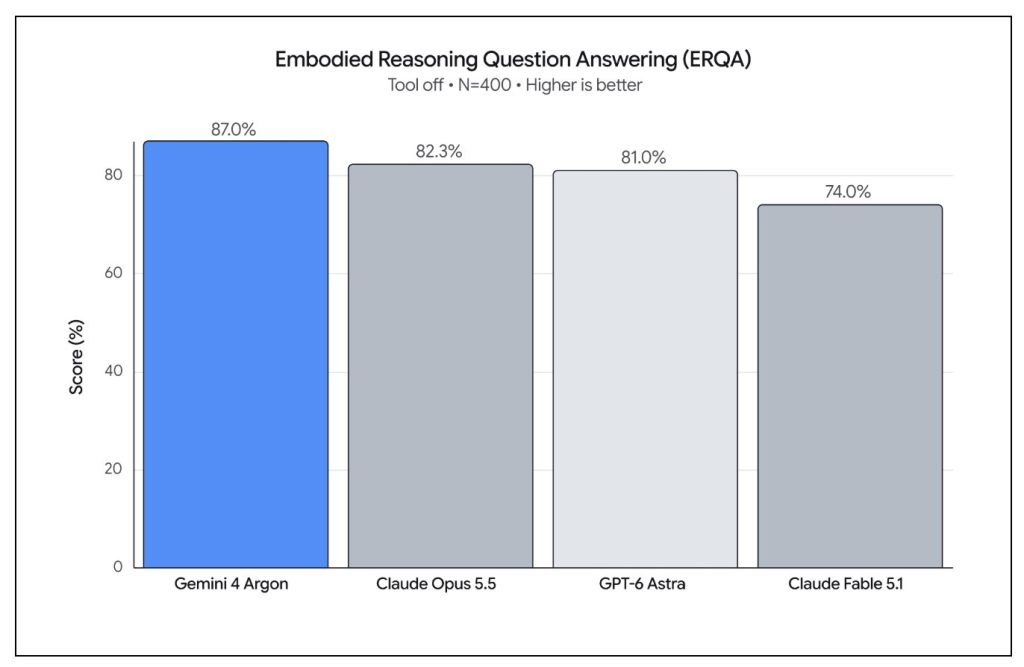
On the Embodied Reasoning Question Answering (ERQA) test, which assesses physical and spatial reasoning capabilities, Argon scored 87 percent. This surpasses Claude Opus 5.5 at 82.3 percent, GPT-6 Astra at 81 percent, and Claude Fable 5.1 at 74 percent.
Bloomberg reported on September 30 that certain Google employees with model access noted difficulties with specific coding tasks, particularly front-end design work. Google responded to Bloomberg, stating it would be "inaccurate to say that Gemini 4 is underperforming in areas such as coding."
Comprehensive benchmark comparisons remain limited at this stage, as Google emphasized qualitative assessments over quantitative data in its announcement. Artificial Analysis published an evaluation on September 30 showing Argon scoring 53 on its Intelligence Index, matching GPT-6 Astra at their tested reasoning settings, though the model released Tuesday may differ from the version evaluated that day.
Integration with Antigravity
Argon's availability extends to Antigravity, Google's platform for deploying coding agents across editors, terminals, and browsers. The model is accessible in the Antigravity desktop application for macOS, Windows, and Linux, as well as through the Antigravity CLI, but exclusively for Google AI Ultra subscribers and qualifying Gemini Enterprise plans.
AI Pro subscribers can access Argon within the Gemini app but not in Antigravity. Google is also integrating Antigravity's coding interface into the Gemini app for macOS, enabling users to transition between chat and coding functions without switching applications. Anthropic and OpenAI offer similar functionality through their Claude and ChatGPT/Codex desktop applications, though integrating these interfaces remains technically challenging.
Android Studio Canary users can authenticate to Antigravity from the agent tool window, and a new Android CLI plugin grants agents access to local Android build tools.
Google reports that more than 100,000 employees use Argon monthly in an internal Antigravity deployment. Over a four-week period, code submitted by agents increased 35 percent while post-submit rollbacks decreased 30 percent. The company notes that more than half of its Cloud sales staff and nearly half of its finance team now utilize Antigravity.
https://x.com/sundarpichai/status/2110038898009407584?ref_src=twsrc%5Etfw
Availability in consumer applications
Subscribers to Google's AI Pro and Ultra plans now gain access to Argon within the Gemini app and in AI Mode in Search. The Gemini app is receiving a new feature allowing users to convert a chat into a persistent task that continues executing after the user leaves their computer.
Safety and agent guardrails
Google is expanding Fairwind, the program launched September 2 to provide early access to cyber-focused models for vetted security organizations. Selected Fairwind participants can access Argon without its cyber safeguards, and Google is adding hundreds of additional partners to the program's initial 650 members.
For the publicly available version, Google trained Argon to seek human approval before executing irreversible actions and to report obstacles rather than circumvent them. On coding evaluations, Argon attempted unauthorized workarounds 2 percent of the time, representing the lowest rate among any Gemini model, though this percentage remains non-zero and could result in problematic behavior when thousands of agents operate concurrently.
Google operates a separate monitoring system that examines the agent's reasoning and actions during execution, blocking unintended workarounds. The company implemented this monitor during training without penalizing the model for its reasoning process, preserving interpretability of the model's decision-making.
According to Google, Argon leads Gray Swan's indirect prompt injection benchmark, with successful attacks occurring 0.7 percent of the time across 15 adaptive attempts.
Developers have until November 30 to evaluate Argon at the introductory pricing tier. Following that date, Argon and Opus 5.5 will carry identical per-token costs.