Fable 5.2 Generates Intricate 3D Underwater Scene in 96 Kilobytes
An AI-assisted demo showcases how procedural generation and shader techniques can compress complex graphics into minimal file sizes, raising questions about the capabilities of modern AI agents.
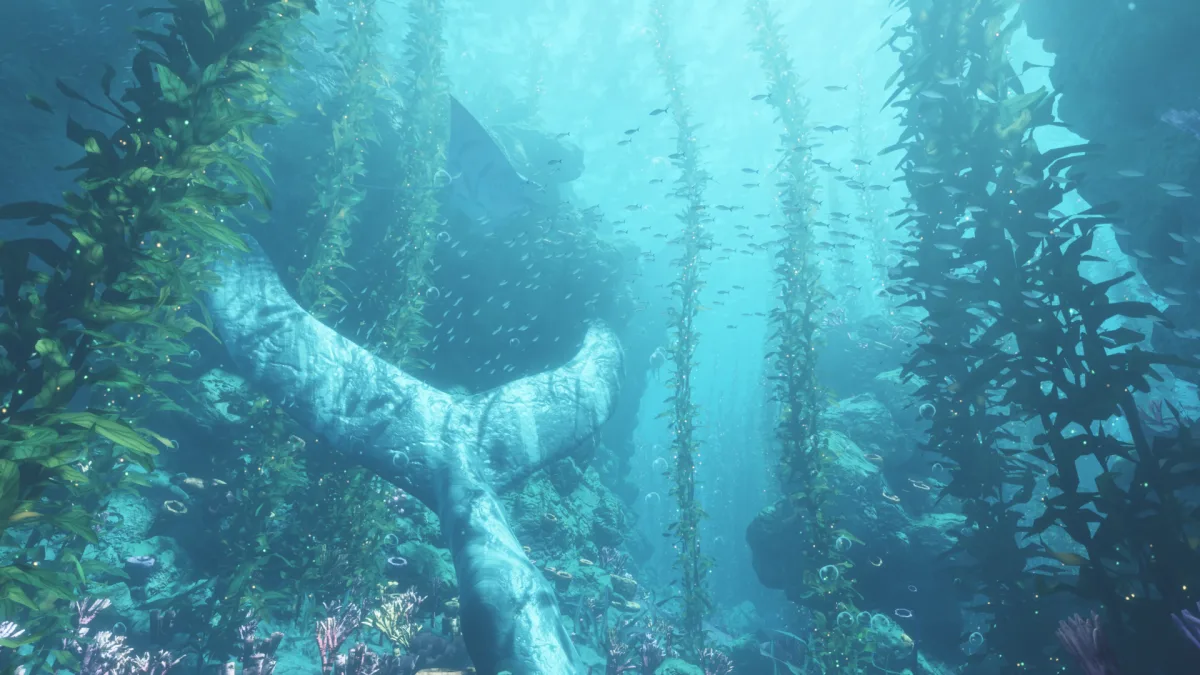
Anthropic's Fable 5.2 model has drawn considerable attention since its release, with reviewers positioning it as a formidable competitor to the more expensive Opus 5.5. To demonstrate the model's practical capabilities, front-end developer Maksymilian Dendura enlisted Fable to construct Abyssal Garden, an elaborate browser-based underwater environment, using only 96 KB of JavaScript and HTML code.
The scene's three-dimensional geometry and surface details emerge entirely from mathematical formulas rather than pre-rendered assets. This procedural approach eliminates the need for stored 3D models and image files, which would otherwise consume substantial disk space. The entire environment is calculated when the page loads.
Procedural construction presents technical challenges and inherent constraints, yet proves remarkably efficient when implemented skillfully. Several commercial titles employ this method to generate natural elements such as vegetation and foliage without storing individual asset files.
Visual effects and portions of the surface rendering rely on shaders—compact programs that modify how surfaces and textures display on screen, such as adding reflective properties to objects. The gaming industry makes extensive use of shaders, a fact familiar to players who encounter shader compilation screens during loading sequences or experience stuttering in Unreal Engine applications.
The accomplishment gains additional significance because it operates entirely within a web browser, leveraging WebGPU and WebGL technologies. These platforms, despite their modest visibility, have existed for considerable time and enable developers to render graphics using methods comparable to OpenGL while writing code in JavaScript.
The most striking aspect of the project involves the minimal prompt required to generate it. The instruction spans approximately 40 lines with line breaks, demonstrating the autonomy that contemporary AI agents possess when tackling open-ended creative assignments. While the developer likely refined the output through iteration and applied considerable artistic judgment, the agent's performance remains noteworthy.
Direct comparison to commercial games oversimplifies the achievement. Demonstrations of this scale contain negligible content relative to full titles and typically lack interactive systems, complex logic, or physics simulation.
The scene maintains respectable performance despite its visual sophistication. The developer reports achieving 180 frames per second at 1440p resolution on an RTX 5070 Ti graphics card. While 96 KB appears compact, it actually represents a substantial size for this category of demonstration, though another developer subsequently optimized the project to 52 KB.
The practice of creating visually impressive content within severe file-size constraints traces back decades to the demoscene, an artistic movement emerging in the 1980s alongside 16-bit computing hardware. Talented programmers have accomplished remarkable feats using this approach long before contemporary AI assistance became available.
The 2009 browser demo Elevatedn achieved comparable visual sophistication while including audio, all within just under 4 KB—occupying 4,777 bytes in its web version. Hartverdrahtet, released in 2012, packed intricate three-dimensional environments into 4 KB. The 2004 FPS prototype .kkrieger compressed an entire game, complete with geometry, textures, music, and sound effects, into 96 KB. These historical examples contextualize the achievement, though Fable's near-autonomous creation of such a scene remains genuinely impressive.