F-Droid 2.0 Arrives With Kotlin Rewrite and Material Design Overhaul
The open-source Android app repository has completed a major redesign after more than a year of development, replacing its Java foundation with Kotlin and modernizing its interface as it faces pressure from Google's 2027 developer registration mandate.
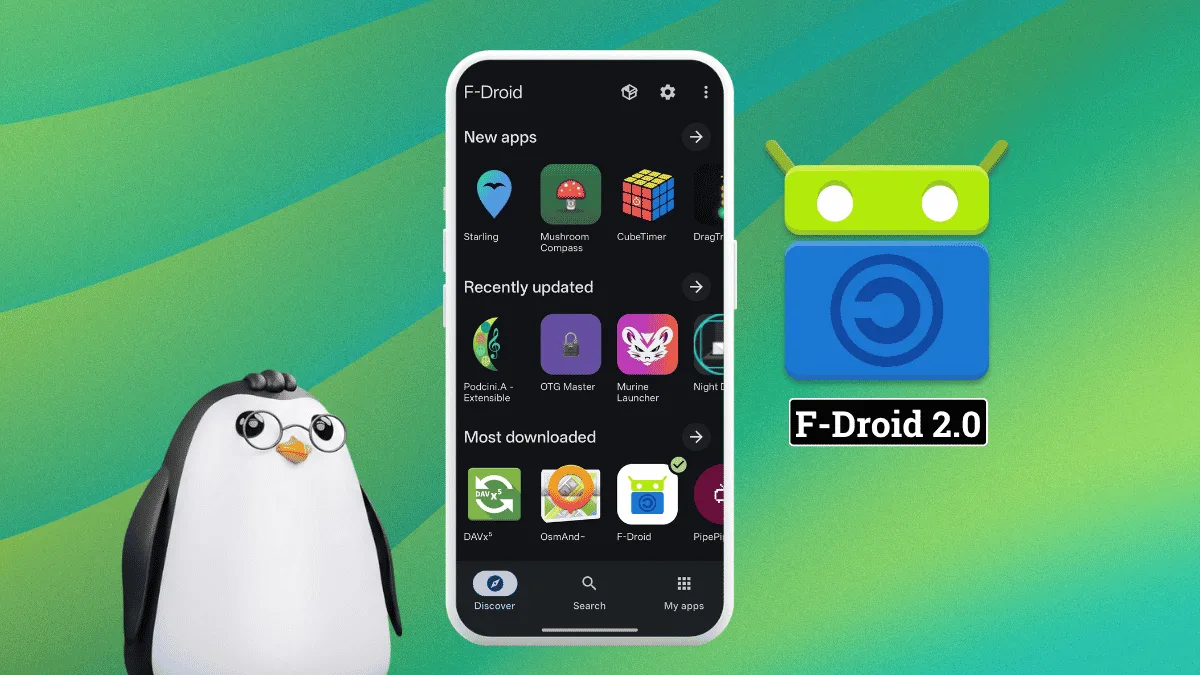
For over a decade, F-Droid has served as the primary distribution channel for free and open-source applications on Android. The platform's client application, which users interact with directly, has undergone incremental improvements throughout its history. Now the project has undertaken a substantial reconstruction effort, the product of eighteen months of engineering work and multiple pre-release iterations.
A comprehensive redesign
The rewrite migrates the codebase from Java to Kotlin, while the user interface has been reconstructed using Jetpack Compose. The resulting application adheres to Material Design principles throughout, presenting an interface consistent with contemporary Android standards.
The navigation structure now organizes functionality into three primary sections at the bottom of the screen: Discover enables browsing through available applications, Search provides query capabilities and direct access to category filters, and My Apps manages installed software, pending updates, and any associated problems.
The Settings interface has been repositioned to the upper-right corner, where it shares space with a newly introduced Repositories menu.
The Discover section has been configured to surface newly introduced applications, recently modified entries, and the most frequently downloaded items from the repository. Related application categories are now grouped together, streamlining navigation through the full collection without requiring users to scroll through exhaustive lists.
The search functionality now extends beyond application names to encompass categories, application descriptions, and localized content. Queries in Chinese, Japanese, and Korean languages have received particular attention for improved accuracy. The system preserves previous search queries for convenient access during future sessions.
The filtering system has undergone substantial revision, allowing users to simultaneously narrow results by anti-features, device compatibility requirements, and application category.
What else's changed?
Background update checking is now enabled by default, eliminating the pull-to-refresh interaction previously required to scan repositories. Users retain the ability to manually initiate update checks through the three-dot menu on the My Apps page.
The application concealment feature, which previously allowed users to disguise F-Droid's icon as a calculator application, has been relocated to the Settings menu under the "App Icon" option. The Nearby app sharing capability has been temporarily disabled.
In their announcement, F-Droid stated that:
F-Droid 2.0 represents a major milestone, but it is not the end of the story. Rebuilding the app has given us a stronger foundation, yet there is still plenty of work ahead. As the rollout reaches more users, we expect to learn a great deal from real-world usage. Community feedback has shaped F-Droid 2.0 from its earliest design discussions through many alpha and RC releases, and it will continue to guide future improvements.
F-Droid
A looming threat
Google announced in August of the previous year that beginning in 2027, all Android application developers must complete registration with the company, submitting government-issued identification, cryptographic key documentation, and a registration fee. Applications developed by unregistered parties would face restrictions on certified Android devices.
F-Droid responded proactively; Marc Prud'hommeaux, a member of F-Droid's board, established the Keep Android Open campaign in response. The initiative has assembled more than 70 organizations spanning over 20 countries.
Notable signatories include the Electronic Frontier Foundation, the Free Software Foundation, KDE, Proton, Codeberg, VideoLAN, LineageOS, CryptPad and the Tor Project.
With fewer than 90 days remaining before the registration requirement takes effect, F-Droid's introduction of this substantial update demonstrates the organization's commitment to resisting Google's coercive measures.
Get F-Droid 2.0
The update is being distributed gradually across the coming weeks, so existing installations may not immediately receive version 2.0. Fresh installations will follow a similar timeline, as the current stable release remains v1.23.2.
Those unwilling to wait for the gradual rollout can obtain the latest 2.0 beta build from the packages portal.