Developer Fits Transformer AI Model on a Single Floppy Disk for Vintage DOS PCs
A programmer has successfully compressed a working language model onto a floppy disk, enabling it to run on 486DX and Pentium machines with DOS—a feat that highlights a growing trend of bringing modern software to decades-old hardware.
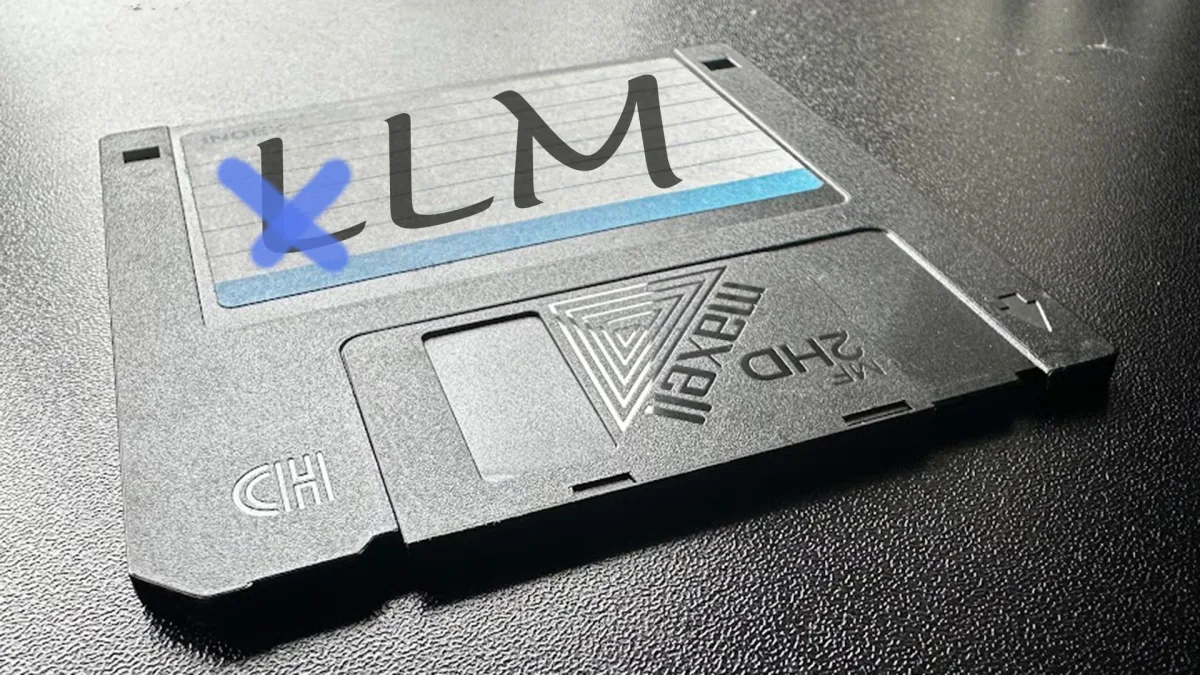
WollyMonjac, a developer, has managed to pack a functioning transformer-based language model onto a floppy disk designed for vintage 486DX and Pentium computers running DOS. The project, called Tiny 2.1, is not a large language model in the traditional sense. Instead, it represents what the creator describes as "a tiny question-answering transformer written in Turbo C 2.0," sharing the architectural foundations of much larger AI systems but operating at a radically reduced scale.
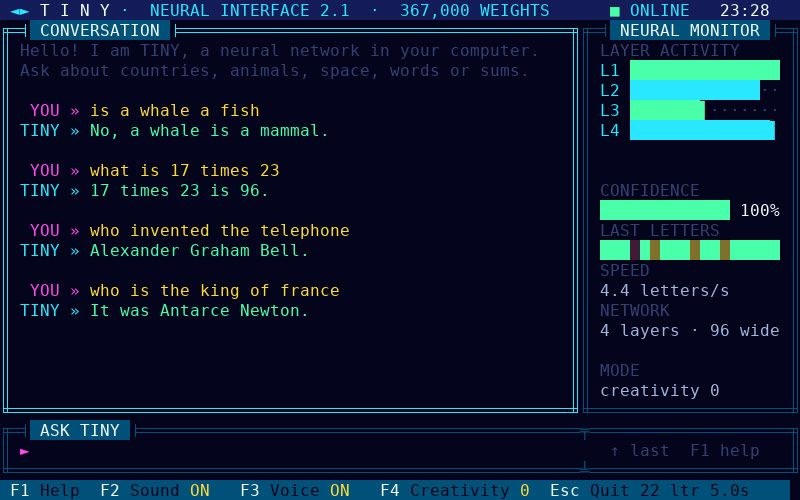
Storage constraints on floppy disks from the 486 era present a significant engineering challenge. A standard PC-formatted disk from that period holds approximately 1,475,000 bytes of capacity. Tiny 2.1 maximizes this constrained space with the following specifications:
- 367,000 parameters organized across 4 layers with 96-unit width, processing text character by character
- 8-bit weights totaling 380 KB, with one scale factor per row
- Training data derived from roughly 3,500 facts presented in multiple phrasings
Running Tiny 2.1 requires approximately 540KB of available conventional memory on a legacy PC. The implementation includes a polished interface featuring a conversation history display, a neural activity monitor, and a prompt entry window labeled Ask Tiny. True to DOS conventions, the program incorporates function-key shortcuts throughout the interface. A particularly distinctive touch is the PC-speaker synthesis capability that can vocalize the model's responses with a robotic quality.
The developer maintains a characteristically understated tone about the accomplishment. According to the GitHub repository, the system was "Written by Fable 5.2 and trained by Opus 5.5." Monjac also notes with dry humor that beyond its training dataset, "it makes things up confidently"—a reference to the tendency of language models to generate plausible-sounding but false information. While hallucinations have received less media attention recently, in this context the phenomenon reads almost as an intentional quirk.
For users who encounter gaps in Tiny 2.1's knowledge base, WollyMonjac has distributed a training folder alongside the MIT-licensed software. Motivated users could potentially expand the model by teaching it specialized information tailored to particular domains or interests.
Executing contemporary applications on older hardware has become increasingly common through various emulation and compatibility approaches. The reverse direction—deploying cutting-edge software on machines from previous decades—represents an emerging and creative development pattern. Beyond Tiny 2.1, similar projects have demonstrated this convergence, including a DOS-based ChatGPT client, Minecraft ported to a Game Boy, generative image creation on a Commodore 64, and Doom running on an Atari ST.