Cloud-native infrastructure struggles to keep pace with AI agent workloads
At KubeCon, CNCF leadership acknowledged that systems designed for human-speed operations face fundamental scalability challenges when handling AI agents, even as new projects aim to address security and resource constraints.
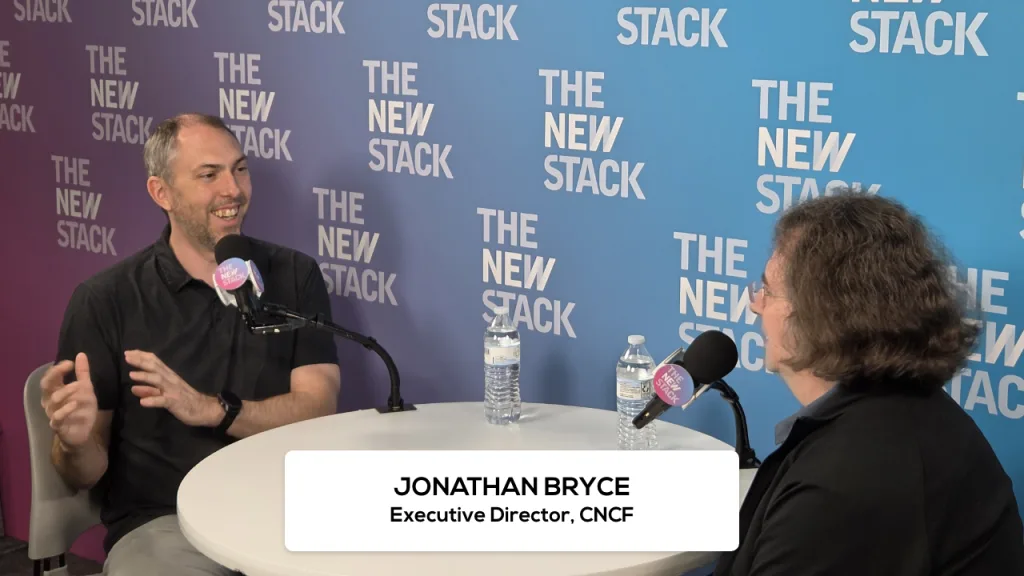
Artificial intelligence agents are pushing existing infrastructure to its limits, testing platforms that were engineered around human operational patterns. Jonathan Bryce, executive director of the Cloud Native Computing Foundation, sat down with The Silicon Ledger at KubeCon + CloudNativeCon North America in Salt Lake City to discuss how the foundation is adapting to this shift and which new projects are joining its ranks.
According to Bryce, "A lot of the existing systems in our world were built for human speed, and agent speed is a completely different type of usage pattern and scenario, and so these systems are just not scalable and resilient enough to handle the kind of workloads that agents are generating." The cloud-native community already has experience running training and inference workloads on Kubernetes, but Bryce contends that financial services, healthcare, and transportation systems interacting with agents will require the elasticity and observability capabilities that cloud-native technologies deliver.
New sandbox projects target agent infrastructure gaps
Nvidia announced its contribution of OpenShell to the CNCF at the conference, while Google had previously announced the donation of Agent Substrate. Both projects entered the foundation as Sandbox initiatives, representing the entry-level classification within the CNCF's project hierarchy.
OpenShell's primary function involves enforcing policies that determine which files, networks, credentials, and model endpoints an agent can reach. Agent Substrate addresses a complementary challenge by furnishing isolated execution environments for agents running on Kubernetes, including capabilities such as session suspension for idle agents and subsequent resumption when required.
Bryce stated, "We can make AI systems that have security and control architected into them from the infrastructure side." He frames this work as an obligation for the broader community, given the security and resource consumption concerns surrounding artificial intelligence. Transitioning OpenShell into neutral governance structures also enables broader corporate participation in its development, Bryce noted.
Optimizing compute utilization for intermittent workloads
Agent workloads exhibit different distribution characteristics compared to conventional enterprise applications. Bryce explained, "Your agent, even if it's always waiting around to be at your beck and call, it's not necessarily doing work 24/7. How do you spin it down and spin it up where it feels like it's ready for you at any time? That's going to be the user experience that people demand. How do you do that without just having it sit there and burn CPU cycles on nothing?"
Agent Substrate addresses this challenge by preserving the agent's operational state and releasing the computational resources it occupied, then restoring the session onto an available worker node when needed. Bryce also pointed to llm-d, a distributed inference framework, as demonstrating how software innovations can extract greater performance from existing hardware. Given that hardware remains costly, energy-intensive, and currently constrained in availability, software represents an immediate avenue for developer progress.
Security vulnerability reporting reaches new scale
Security concerns featured more prominently at this year's KubeCon than in previous iterations. Bryce observed that as more organizations deploy AI tools to identify and report vulnerabilities, open source maintainers face an overwhelming volume of duplicate and unverified reports that nonetheless demand serious attention. While the rate of increase may have stabilized compared to earlier in the year, Bryce expressed uncertainty about what 2027 will bring as models continue improving.
He offered a historical comparison: "Y2K didn't end up being that big of a deal. This is really a moment that could be a big deal if we don't actually just all get together and work as quickly as we can."
Agent deployment remains limited outside software development
Despite the prominence of agent discussions throughout the conference, Bryce's evaluation of current adoption levels remains cautious. He stated, "Beyond software development, adoption is still quite low." Production implementations exist in customer service and similar domains where historical knowledge bases are well-established and clearly defined.
Bryce characterized the current moment as extremely nascent: "We're very, very, very early in the path to billions of agents that are taking action on our behalf on a constant basis." Enterprise organizations continue exercising restraint regarding agent deployment, concerned about failure scenarios when agents operate with elevated access levels. Bryce views this caution favorably, as it may provide the community sufficient runway to strengthen projects like OpenShell and Agent Substrate before enterprises accelerate agent adoption at scale.