AWS Releases Strands Decider v2, Five Open Models for AI Decision-Making
Amazon Web Services unveiled a new family of decision models ranging from 2 billion to 31 billion parameters, built on Google's Gemma 4 and designed to help AI agents make choices rather than generate text.

AWS introduced Strands Decider v2 on Monday, a collection of five open decision models for artificial intelligence agents. The announcement arrives just seven weeks after Strands Labs—the experimental division within AWS's open source Strands Agents SDK—unveiled the original Strands Decider model, which was a 2-billion-parameter system constructed using Alibaba's Qwen3.5.
The updated version relies on Google's Gemma 4 and offers multiple sizes from the start, ranging from 2 billion parameters up to a 31-billion-parameter dense variant, with intermediate options including a 4B model and a 26B-A4B mixture-of-experts configuration. All variants are distributed under the Apache 2.0 license.
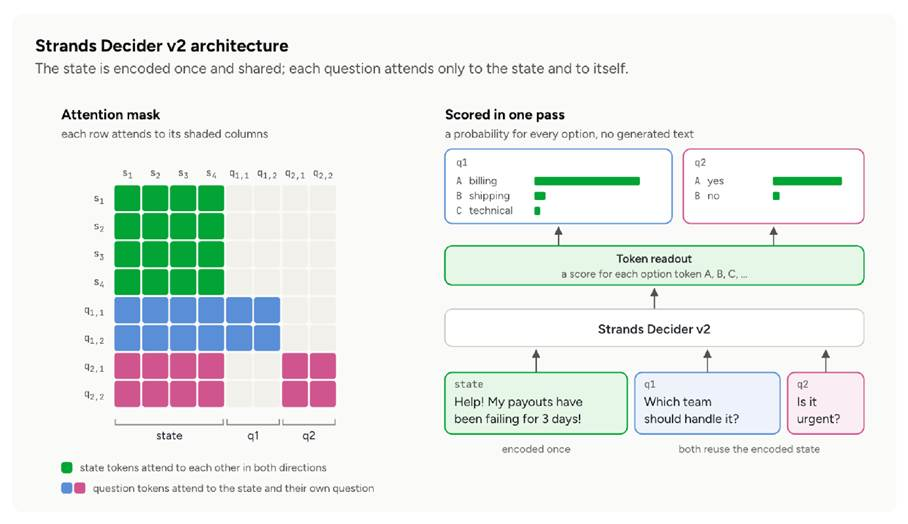
Unlike text-generating language models, Strands Decider operates differently. It accepts an input state—such as a support ticket or agent trace—along with a question and a predetermined collection of possible responses, then outputs a probability score for each option.
Marc Brooker, AWS Vice President and Distinguished Engineer who initiated the project, explained to The Silicon Ledger, "We chose better training data or larger training sets, the usual kind of ML model generation journey, and came out with a set of models with significantly better accuracy and significantly better calibration, which are the things that really matter to customers in this space."
Benchmarks
The v2 models demonstrate clear improvements over their predecessors. According to AWS, the 31B model achieves an average score of 82.1 across six public text benchmarks, surpassing all tested competitors, including Google's Gemini Decision 1, which scored 79.4. However, the model underperforms rivals on three of the six individual benchmarks, and Gemini maintains a lower calibration error.
On JevBench—the benchmark created around TypeSafe's Jev—the 31B v2 model reaches 93.1, exceeding Gemini's 92.2. The model falls behind Perplexity Decider v1.3 on PubMedQA and When2Call, and trails vLLM Semantic Router's open d3-ultra on a test based on New Yorker cartoon captions.
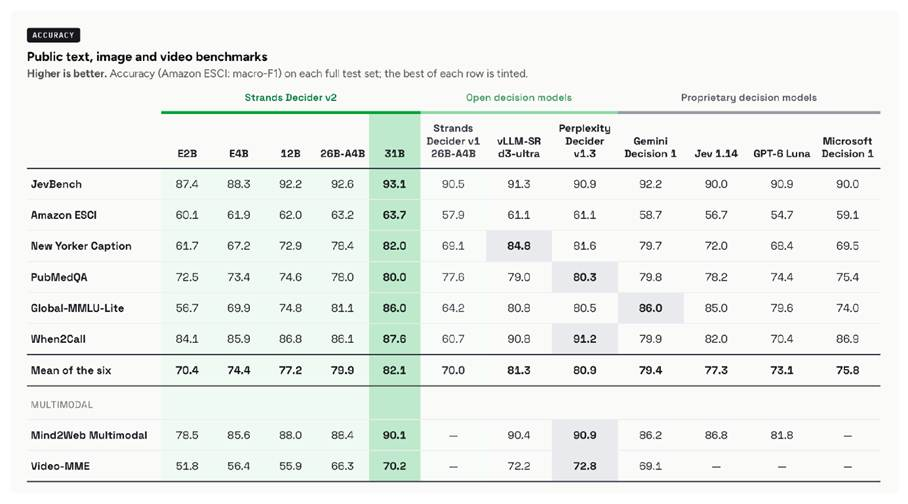
Smaller variants also perform competitively. The 26B-A4B mixture-of-experts model averages 79.9, slightly ahead of Gemini Decision 1, while the 4B model improves from 62.7 in v1 to 74.4. For image and video tasks—not reported for v1—the 31B model scores 90.1 on Mind2Web Multimodal and 70.2 on Video-MME, marginally trailing Perplexity's offering on both measures.
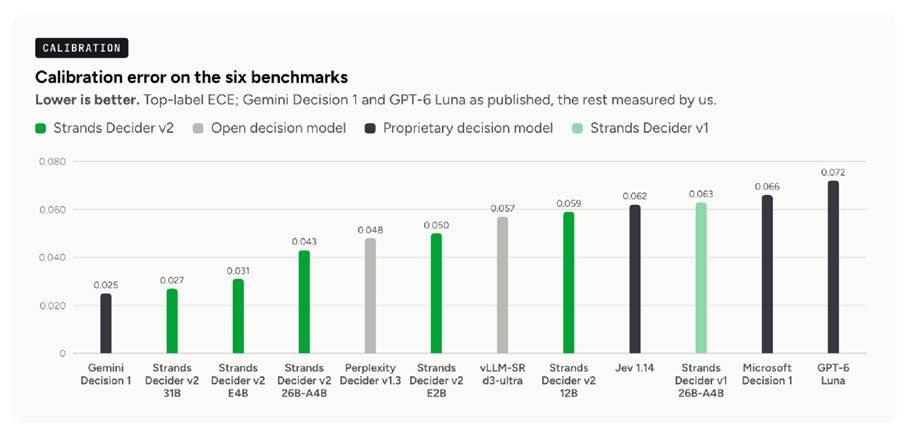
Calibration error, which reflects how well a model's confidence aligns with actual accuracy, drops to 0.027 for the new 31B model, down from 0.062 in v1. Only Gemini Decision 1 performs better at 0.025, while Jev 1.14 and Microsoft-Decision-1 register 0.062 and 0.066 respectively.
"I think with V1 we were benchmark leading for about eight hours," Brooker remarked. He believes benchmarks are becoming "a little bit saturated" and primarily assist customers in determining whether a 4B model suffices for their particular use case.
Gemma 4 and bidirectional attention
AWS selected a distinct architectural approach for Strands Decider 2. Most contemporary large language models employ causal attention, restricting each token to viewing only preceding tokens. This design is essential for text generation, but since decision models never produce text, the Strands team enabled every token in the state to attend to the entire state bidirectionally. This architecture allows questions to reuse the encoded state, making the cost of asking 20 questions about a single agent trace barely higher than asking one.
Regarding the mechanism behind this improvement, Brooker stated, "I have some theories, but I would say that I'm not entirely sure." The team evaluated both approaches across varied datasets, and "one outperformed the other, and I think that is the shape of the majority of ML research."
Brooker suggested that Gemma's relatively conventional architecture may have played a role in the enhanced performance.
Using Strands Decider at Amazon
Within Amazon's operations, engineers managing an internal ticketing platform replaced Claude Sonnet 4.6 with the v1 4B model for ticket labeling. The average processing time per call decreased from 4,215 milliseconds to 897 milliseconds, and AWS estimates costs fell from approximately $22,200 to roughly $500 per million tickets using list pricing. AWS has not disclosed accuracy measurements for this deployment.
Additionally, AWS reports that v2 reduced expenses by distributing requests between Claude Haiku 5.5 and Sonnet 5.5, shifting expenditure away from Anthropic models that AWS provides via Amazon Bedrock.
Brooker expressed particular enthusiasm for hybrid workflows. "What's really nice about these kinds of models is they're just a cool tool for us to build workflows that are mostly deterministic and then have a decider model step, or mostly agentic, but on the easy routes, we can use decider models to drive down cost and latency," he stated.
Notably, Strands Decider remains unavailable on AWS's Bedrock inference service at present. However, AWS's annual re:Invent conference begins in one week, and additional details about Bedrock integration are expected to emerge there.