Alibaba's Qwen4-Max Stays Proprietary as Company Retreats From Open-Weight Commitment
Alibaba has launched Qwen4-Max, its most capable model yet, but is keeping it behind a commercial API rather than releasing the weights—marking a reversal from the company's August pledge to open-source its flagship systems.

Alibaba unveiled Qwen4-Max, the flagship entry in its next-generation Qwen4 lineup, positioning the model for demanding professional work and autonomous AI agent applications. The Chinese technology company had previewed the Qwen4 family the previous week, signaling enhancements in code generation, logical reasoning and factual knowledge, with early access through various Alibaba services.
The company now describes Qwen4-Max as an always-on "AI teammate" suited for tasks spanning software engineering to scientific inquiry. Yet Alibaba is maintaining the model as proprietary technology, accessible only through its hosted platform—a notable departure from the open-weight releases that have established Qwen as a significant player in artificial intelligence.
Architecture and Performance
Alibaba disclosed that Qwen4-Max employs a new mixture-of-experts (MoE) design containing 2.4 trillion backbone parameters, with 71 billion activated per token. The system incorporates an additional 328 billion parameters for "N-gram Embedding," a technique that enables more efficient processing of text patterns.
The model processes both images and text and features a one-million-token context window for handling substantial information volumes in single interactions. Through Alibaba's QwenCloud platform, API access begins at $1.50 per million input tokens and $4.50 per million output tokens. Developers can also reach Qwen4-Max via QwenWork, Qoder and QwenStudio, while Vercel has integrated the model into its AI Gateway for use with development environments including Claude Code, Codex and Cursor.
On Work360, Alibaba's internal evaluation of professional tasks across specialized domains, Qwen4-Max achieved a score of 52.69 against 47.74 for its predecessor Qwen3.8-Max. The company reports the newer model consumes 24% to 35% fewer tokens on that benchmark depending on reasoning intensity settings.
Performance gains proved even more dramatic on Terminal-Bench 4.0, which measures AI agents executing terminal-based tasks, where token consumption dropped by nearly half relative to Qwen3.8-Max. Alibaba states these improvements, combined with reduced API pricing, lowered the average task completion cost by 62%, from $4.43 to $1.67.
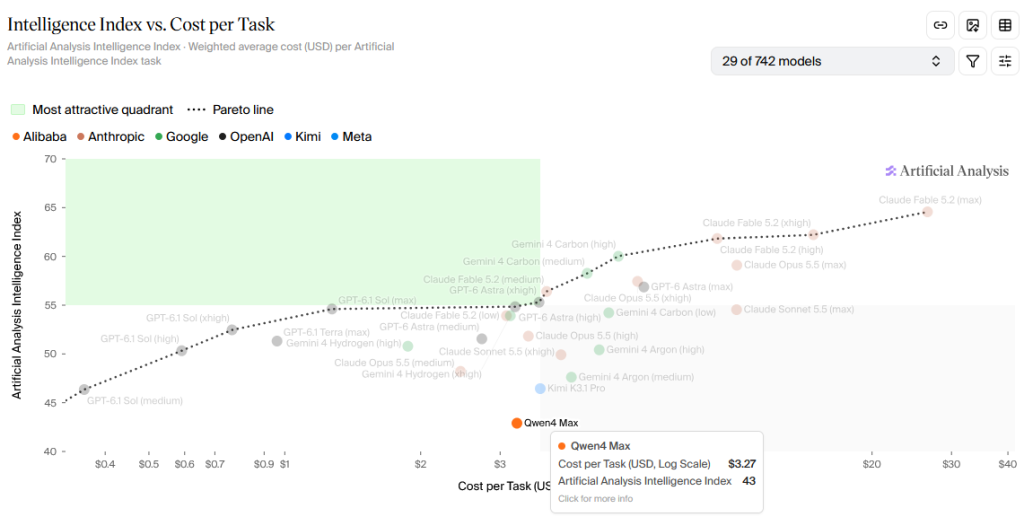
Independent evaluation by Artificial Analysis presents a different picture. The firm assigned Qwen4-Max an Intelligence Index score of 43, ranking it 38th among 81 tested models. This places it marginally above the median score of 41 for models in its price tier, but trailing major competitors including Anthropic's Claude Fable 5.2 (65), Google's Gemini 4 Carbon (60) and OpenAI's GPT-6 Astra (57).
Artificial Analysis calculated an average task cost of $3.27 and noted Qwen4-Max produced 127 million output tokens, substantially exceeding the median of 78.6 million for comparable systems.
A Reversal on Open Weights
The proprietary status of Qwen4-Max stands in sharp contrast to Alibaba's recent positioning. When introducing Qwen3.8-Max in August, the company made an unusual pledge: it would release the weights of one of its flagship Max models for the first time, enabling developers to download and operate a version on their own systems.
This represented a shift from Alibaba's earlier pattern, as Qwen3.6-Max-Preview and Qwen3.7-Max remained proprietary. In retrospect, Qwen3.8-Max appears to have been an outlier rather than the start of a broader movement toward open weights.
The August announcement reflected Alibaba's push to demonstrate competitive parity with leading proprietary systems from companies like Anthropic. The company had been issuing increasingly bold performance assertions regarding its Qwen family. Qwen3.8-Max also arrived with a showcase of autonomous software development, in which an AI coding agent labored on a project for 16 days, generating hundreds of commits and exceeding 100 pull requests.
The open-weight pledge initially drew skepticism when Alibaba announced the model release before the files were actually obtainable. Independent AI consultant Jeff Brokaw questioned the substance of promoting downloadable weights that developers could not yet access, and drew comparisons to Chinese startup Moonshot AI's Kimi K3, which had likewise been marketed as an open-weight model before the files were released.
That is not a technical footnote; that is the API business model wearing an open source jacket for the launch photo.
Jeff Brokaw, independent AI consultant
Alibaba ultimately honored its commitment on August 12, publishing the Qwen3.8-2.4T-A95B weights—but with significant restrictions. The downloadable model came under a custom license rather than the more liberal Apache 2.0 terms Alibaba had applied to earlier Qwen releases. Firms operating "model-as-a-service" or AI work assistant offerings with combined revenue surpassing $50 million across any 12-month span needed to secure a separate commercial license, though internal deployment was permitted under specified circumstances.
The license also mandated that certain commercial products exceeding 100 million monthly active users or $20 million in monthly revenue must visibly credit the model's name.
By contrast, Xiaomi released its MiMo-V2.6 models under the permissive MIT license in September, accompanied by technical documentation and public disclosure of its reinforcement-learning training expenses. The company also pledged to make thousands of training environments and related tools available, offering external developers potentially greater transparency into model development methodology.
The published Qwen3.8-Max weights also constituted a more restricted iteration of the hosted offering, missing certain capabilities available through Alibaba's API, including native image input.
Alibaba was willing to wear the "open source jacket," while keeping some of its most valuable capabilities behind a commercial API. And with Qwen4-Max, the company appears to be putting that jacket back on the hanger.
With Qwen4-Max, Alibaba appears to be abandoning that approach entirely—no downloadable weights have been announced for the new model, and the company has issued no commitment to release them. On X and in its accompanying blog post, Alibaba stated that "open weights of smaller Qwen4 models will be released," but has not specified which models or timelines. For Qwen4-Max itself, developers remain dependent on Alibaba's hosted services or third-party API intermediaries.