Texas Jury Awards Stratasys $27.6M in 3D Printer Patent Case Against Bambu Lab
A Texas court found Bambu Lab's X1, P1, and A1 printers infringe Stratasys patents covering prime tower and bed-leveling technology, but the company says it will pursue post-trial review and appeal.
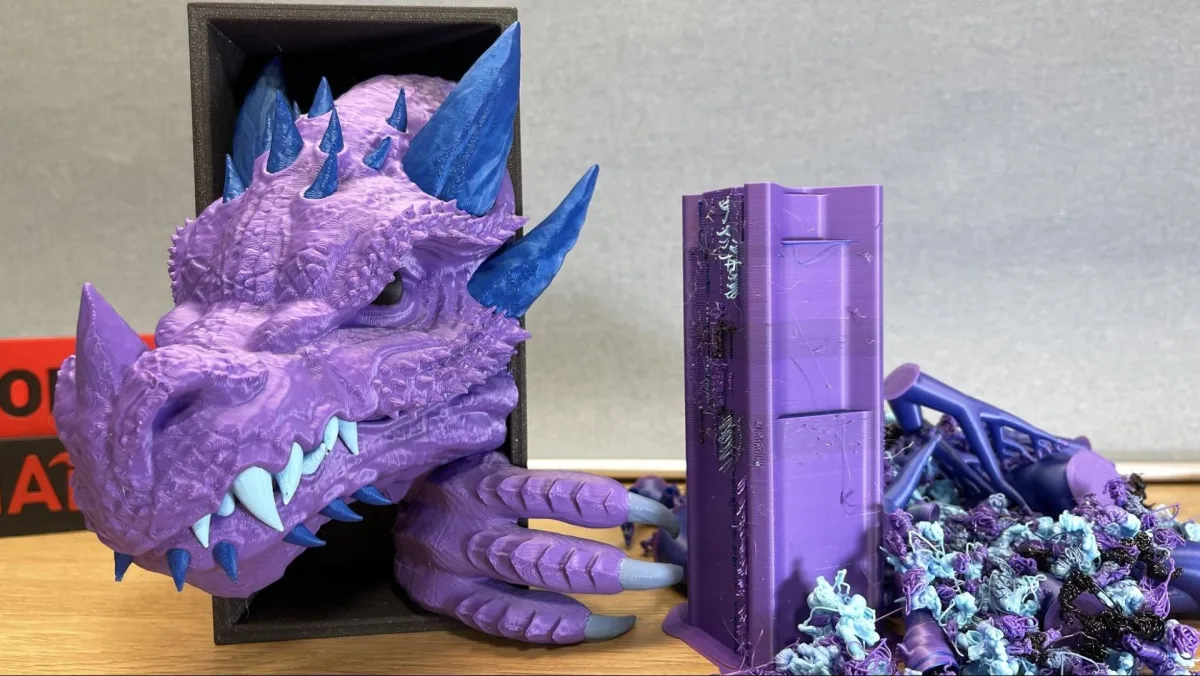
Jurors in Texas determined that Bambu Lab infringed multiple Stratasys patents in designing its X1, P1, and A1 series of 3D printers, ordering the company to pay $27.6 million in damages. The disputed patents relate to prime towers and bed leveling mechanisms found in consumer 3D printers made by several manufacturers.
Stratasys, which pioneered FDM 3D printing technology, traces its patent portfolio back to co-founder Scott Crump's US5121329, filed in 1989 for the "Apparatus and Method for Creating Three-Dimensional Objects." That foundational patent expired in 2009, paving the way for the consumer 3D printing market to flourish.
No court orders have halted sales of the machines at issue, all part of Bambu Lab's initial generation of printers. According to an unnamed source, Bambu Lab has been developing alternatives to prime tower technology in case such action becomes necessary, though nothing has been announced publicly.
Product Timeline and Current Status
Bambu Lab's X1, its debut 3D printer introduced in May 2022, was discontinued earlier this year. The P1S remains available but was effectively superseded by the P2S in October 2025. The A1 and A1 Mini continue in the company's active product range, though an enlarged A2L variant launched this summer.
Technical Details of the Infringement
Bambu Lab's first-generation machines employ single-nozzle filament purging, which falls under Stratasys US 9421713. These printers also incorporate specific strain-gauge and force-sensor designs covered by Stratasys US 9168698.
Bambu Lab's newer H2 and X2 models use dual-nozzle architecture, sidestepping the single-nozzle purging patent. These machines also feature optical sensors and redesigned bed probing systems that circumvent the force-detection mechanisms claimed in the Stratasys patent.
Alternative Approaches from Competitors
Prusa Research has developed a different path forward with the INDX, a multi-nozzle toolchanger that eliminates the need for prime or purge towers altogether. "Our motivation was to have minimal waste," a Prusa Research representative explained. "In our eyes, this is a better solution than a prime tower." The INDX system primes nozzles by wiping tiny pellets—no larger than a grain of rice—into an internal waste container.
Bambu Lab's Response
We appreciate the time and effort of the jury in considering this matter. While we respect the judicial process, we disagree with the verdict reached in this case. The law provides Bambu with the right to seek post-trial review and to appeal, and Bambu intends to avail itself of these legal processes.
Bambu Lab representative
Geographic Complications
The Texas ruling applies only to U.S. patents and thus only to machines sold within the United States. Bambu Lab successfully defended its technology in Europe against comparable patent claims. This creates a peculiar situation: an X1-Carbon sold in New York would violate Stratasys' prime tower patent, while the identical machine sold in Germany would not.
In April, the European Unified Patent Court's The Hague Local Division rejected Stratasys' request for a preliminary injunction against Bambu Lab. The court declined to expand Stratasys' patent claims, and Stratasys chose not to appeal that decision.
Broader Patent Dispute
The Friday verdict represents one piece of a larger patent conflict. Bambu Lab succeeded in invalidating Stratasys US 9592660, which covered heated build surfaces and flexible spring steel plates. The company argued that Stratasys was patenting a combination of existing designs rather than a single invention, and that these elements had been disclosed in prior art after Stratasys acquired Arevo, Inc.
Bambu Lab also prevailed in defending its use of networked, cloud-connected 3D printing with remote camera monitoring, covered under US 8562324.
Four additional patents remain pending judgment in Texas. These cover RFID material tags, remote networking capabilities, LiDAR scanning, and automatic printer detection. The LiDAR technology has only appeared on the now-discontinued X1 Carbon.
Litigation Background
Stratasys initiated two civil lawsuits in 2024 in the U.S. District Court for the Eastern District of Texas, alleging that Bambu Lab infringed ten separate U.S. patents related to 3D printing technology. Stratasys, headquartered in Eden Prairie, Minnesota, maintains its North American operations there. Bambu Lab, a Chinese company with an Austin, Texas office, found itself in the Eastern District, which has earned a reputation for favoring patent holders. U.S. District Judge Alan Albright has presided over more than 25 percent of the nation's patent cases at various points.