Grok API Reverses Course on Automatic Text Watermarking
Elon Musk's xAI company has quietly disabled automatic watermarking for its Grok models by default, reversing an earlier plan to enable the feature across its API.

A significant shift in xAI's approach to AI-generated text identification emerged this week, as the company—recently rebranded from SpaceXAI—changed course on watermarking for its Grok API. According to the company's revised documentation, the watermarking capability now ships disabled by default, allowing developers to activate it manually through their team administration settings.
The watermarking feature first surfaced publicly in late October without formal announcement. Internet Archive records show that earlier versions of the documentation, preserved on November 1 and November 6, described a very different policy: watermarking would activate automatically starting November 7. Several prominent X users flagged the pending change on October 31.
SpaceXSI is introducing text watermarking across its Grok API models, starting November 7, 2026All text outputs from supported Grok models will include a watermark by defaultModels included:• Grok 4.7• Grok 4.6• Grok 4.5• Grok 4.3• Grok 4.20 Reasoning• Grok 4.20…
X Freeze, October 31, 2026
The company subsequently reversed direction, converting watermarking into an opt-in mechanism for API developers. Documentation archiving service Spybara indicates the shift occurred between Monday night November 9 and Tuesday morning November 10—nearly three days after the originally scheduled November 7 activation. xAI has offered no public statement explaining the reversal, and whether the initial default-enabled policy ever took effect remains uncertain.
Understanding Watermarking and EU Requirements
Text watermarking embeds an invisible, machine-readable signal within AI-generated content. The technique subtly influences which words or tokens a model selects during generation, and across sufficient text length, these choices form a detectable statistical pattern. Identifying watermarked content typically requires specialized detection tools, which major AI labs restrict to authorized users.
The technology has gained urgency in Europe following the EU AI Act, which mandates transparency obligations for providers of systems generating synthetic content. Article 50(2) requires that AI-generated text, images, audio and video carry machine-readable identification, with enforcement beginning August 2, 2026. A subsequent amendment granted a limited grace period extending to December 2 for systems already deployed before August 2, creating time pressure for AI companies to implement compliance measures.
Different AI companies have adopted varying strategies for meeting these obligations. Anthropic became among the first major labs to announce text watermarking in August, rolling out the feature globally across supported Claude models and its API. The decision sparked controversy, particularly among developers worried about watermarking's impact on code generation and frustrated by the absence of an opt-out mechanism.
OpenAI introduced its own watermarking system, textGrain, in October, taking a different path by making the feature optional for API developers while automatically watermarking eligible ChatGPT and Codex output within the EU. Google has been deploying SynthID watermarking across multiple products and services over recent years, including its Gemini API, supporting text alongside images, audio and video. In July, Google confirmed its participation in the EU's Code of Practice on Transparency of AI-Generated Content.
xAI's updated documentation reveals that the company employs SynthID Text for its watermarking implementation.
The Reversal and Its Implications
xAI stood apart as the sole major AI lab that had not signed the EU's Code of Practice on Transparency of AI-Generated Content, with some reporting suggesting the company would avoid watermarking Grok output altogether. The October documentation emergence marked the first concrete signal that xAI intended to participate in watermarking efforts. The original language was unambiguous about motivation: "SpaceXSI watermarks text model output to comply with the EU AI Act," the document stated.
Watermarking can help enable compliance with the EU AI Act.
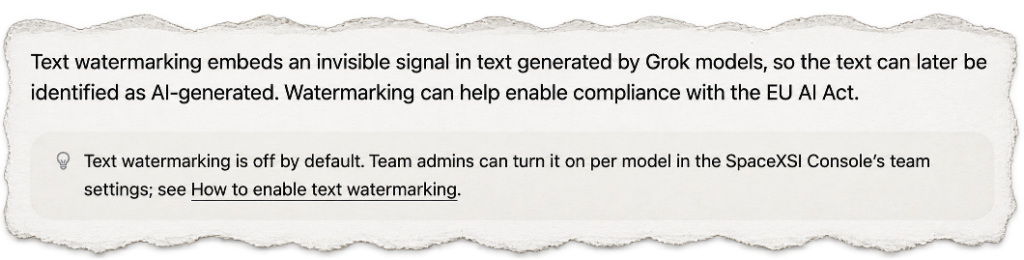
The company has since replaced this language with more cautious phrasing. The shift carries significance: the original wording reflected a policy where xAI unilaterally watermarked Grok output to satisfy EU requirements. Currently, the company appears to delegate watermarking activation to developers while adopting more guarded language about whether the technology adequately addresses regulatory demands.
Practical constraints accompany this approach. Watermarking operates at the team level, enabling administrators to toggle the feature for individual Grok models, with settings applying to all API keys within that team. No provision exists for enabling or disabling watermarking on a per-request basis, preventing developers serving customers across multiple regions from applying different watermarking policies to the same model within a single team. Maintaining separate team configurations would be necessary to achieve this.
The revised documentation confirms watermarking availability across seven Grok models, including Grok 4.7 and 4.6, though disabled by default. The rationale behind xAI's abandonment of its original automatic-watermarking plan remains unexplained.