Soverin Suite Enters the European 'Sovereignty as a Service' Market
A Dutch company has launched an integrated workplace platform built on open-source European software, part of a growing movement to offer alternatives to Microsoft and Google that keep data within the EU.
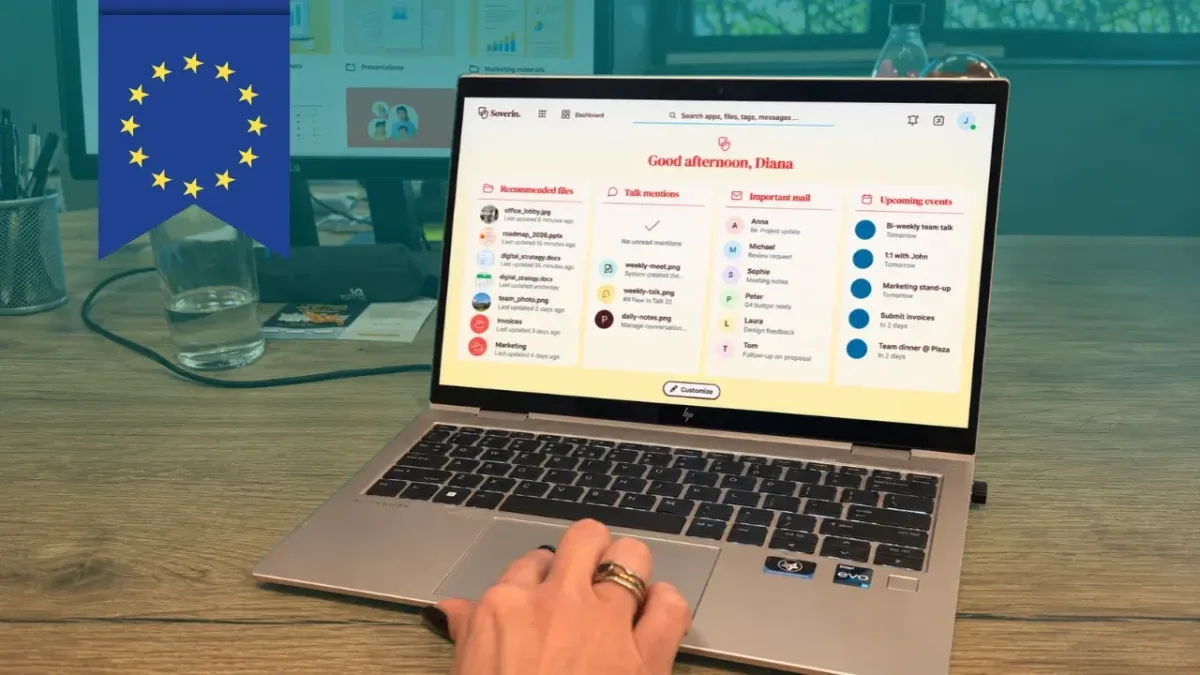
Abandoning Microsoft 365 or Google Workspace sounds straightforward in principle, but the practical challenges are substantial. Organizations must provision infrastructure, maintain security patches, transfer existing email, and—often the most difficult step—train users on unfamiliar tools. A cohort of European vendors is now addressing this implementation gap by bundling open-source applications with managed hosting and support services.
Rather than developing software independently, these companies assemble existing open-source components such as Nextcloud and Euro-Office, deploy them on European servers, and market the combination as turnkey services. This model—which might be termed Sovereignty as a Service—has attracted a new entrant: Soverin, a Dutch privacy-oriented email company that has unveiled Soverin Suite.
Soverin Suite: A workspace combining three European open-source projects
The platform targets small and medium enterprises, independent contractors and residential users, integrating email, scheduling, file management, document editing, spreadsheets, presentations, instant messaging and video conferencing under a single authentication system.
Three distinct European open-source projects power the offering. Soverin contributes email functionality, a service it has operated from the Netherlands since 2014. Nextcloud supplies the collaboration infrastructure. Euro-Office handles document creation and editing. Greenhost, a Dutch hosting provider and Soverin affiliate, operates the Nextcloud infrastructure, ensuring data residency within the Netherlands.
The company emphasizes its certifications: ISO 27001 for information security, ISO 9001 for quality management and ISO 14001 for environmental stewardship. It also maintains compliance with NIS2, the European Union's cybersecurity framework for critical and important organizations. Given the EU's stringent regulatory environment, these credentials carry meaningful weight.
Soverin Suite pricing stands at €10 monthly per license (excluding VAT, charged annually), providing one mailbox and 1 TB of shared storage. A lighter Mail Pro option costs €4 per license monthly and omits Euro-Office and messaging features but includes email, calendar and file access. Organizations can combine both license types within a single account.
Not a fork, but a unified interface
Diana Krieger, Soverin's chief executive and co-founder, clarified that Soverin Suite represents neither a fork nor a white-label implementation of Euro-Office. Instead, Soverin deploys Euro-Office exactly as the open-source community maintains it, ensuring security patches and features arrive without delay.
A private fork would split the effort Europe is trying to pool...
Diana Krieger, CEO and co-founder of Soverin
Soverin's contribution involves creating a custom visual layer that aligns the document editors with its email client's appearance and behavior, plus implementing single sign-on (SSO) functionality. This allows administrators to manage access through one account per employee rather than maintaining separate credentials across five applications. When staff arrive or depart, a single administrative action suffices.
This integration may appear incremental, yet it addresses a genuine friction point. Krieger observes that "Sovereignty only works if people actually want to use it." A consistent interface and unified authentication reduce resistance from users accustomed to Outlook and similar Microsoft products.
Why managed hosting matters beyond open-source availability
Readers familiar with open-source infrastructure will naturally ask why organizations cannot simply deploy Nextcloud independently. The software is free and available under open-source licensing, and many individuals already operate instances on personal servers.
Krieger's response directly acknowledges Soverin's target market. Most small businesses, freelancers and households lack dedicated IT personnel capable of deploying servers, applying patches and securing email systems. As she explains, "Self-hosting gives you autonomy only if you have the skills to go with it."
Open-source software eliminates vendor lock-in through licensing, but it does not eliminate the operational burden of deployment, maintenance and user support. For organizations transitioning away from Microsoft, staff training and reliable support frequently determine success more than software selection alone.
Krieger also notes that Nextcloud does not include email capabilities, which most businesses consider essential. An email-first company possesses an inherent advantage in addressing this requirement.
Part of a coordinated European initiative
Soverin ranks among the founding participants in the Euro-Office coalition, unveiled earlier this year through collaboration between IONOS and Nextcloud alongside XWiki, OpenProject, Eurostack, Abilian, BTactic and others.
Euro-Office itself originated as a fork of ONLYOFFICE, a decision that generated controversy regarding licensing and governance. ONLYOFFICE claimed the coalition violated its AGPL license terms and terminated its partnership with Nextcloud. The Document Foundation, steward of LibreOffice, raised concerns about Euro-Office's sovereignty credentials, noting its default reliance on Microsoft's OOXML format rather than the open ODF standard.
When asked whether Soverin disregards ONLYOFFICE entirely, Krieger rejected that characterization. She stated, "Euro-Office builds on ONLYOFFICE's open-source code, and we respect the engineering behind it," while emphasizing that governance structures represent the key distinction.
Euro-Office reached its first stable release in June of this year, and adoption has accelerated since. Nextcloud Hub 26 incorporates it as standard. IONOS integrates it into its Nextcloud Workspace offering. Netherlands-based Office.eu provides it as a managed service. Smaller hosting providers follow suit: German firm xaweho, for instance, includes Euro-Office preinstalled in its managed Nextcloud offerings.
This pattern reflects Krieger's observation that no single European company must independently match Microsoft or Google's capabilities. Instead, each partner contributes its core competency using open standards, and the components integrate seamlessly.
Soverin emphasizes its steward-ownership structure through its parent organization, The Sharing Group, which also operates Mijndomein, MyWheels and EnergyZero. Under steward ownership, control remains with individuals committed to the company's mission rather than with equity holders, which Krieger argues prevents acquisition by major technology firms.
Launch timing coincides with Microsoft outage
Soverin Suite's announcement arrived mere days after a major Microsoft outage disrupted email services across numerous organizations worldwide.
Krieger noted that the suite had occupied Soverin's development roadmap since late 2025, with beta testing underway well before the outage occurred. Nevertheless, she highlighted the incident's relevance: when an entire continent relies on a single provider, one operational failure cascades across all dependent organizations. Distributed provider models mitigate such single points of failure.
Europe's digital sovereignty agenda is materializing through concrete business activity. Companies of varying sizes now specialize in deploying, hosting and supporting open-source infrastructure for organizations unable to manage these functions independently. Soverin Suite represents another addition to this expanding ecosystem of European Sovereignty as a Service providers, signaling momentum in this emerging sector.