CPU demand surges as agentic AI forces data centers to rethink power constraints
Chipmakers and server vendors are repositioning central processors as the critical bottleneck in AI infrastructure, with power budgets—not GPU capacity—now driving purchasing decisions at scale.
The emergence of agentic AI is fundamentally reshaping how chipmakers and server manufacturers approach business strategy. While graphics processors continue to dominate industry conversation, the convergence of supercomputing and artificial intelligence is directing fresh demand toward central processing units that must operate within the finite power envelopes data centers have already allocated.
This realignment has roots stretching back years. Organizations that connected multiple GPUs to individual CPUs discovered a persistent problem: the processors could not feed data to the accelerators fast enough, leaving expensive hardware underutilized. Scott Tease, vice president of business development for high-performance computing and sovereign AI at Advanced Micro Devices Inc., explained the dynamic during remarks at SC26.
People have realized how important that CPU is in a GPU architecture. But beyond that, agentic is not necessarily just a GPU thing. Agentic is going to be very CPU heavy because with agentic, what you're looking at, you want to go very fast, but you also want concurrency.
Scott Tease, Advanced Micro Devices Inc.
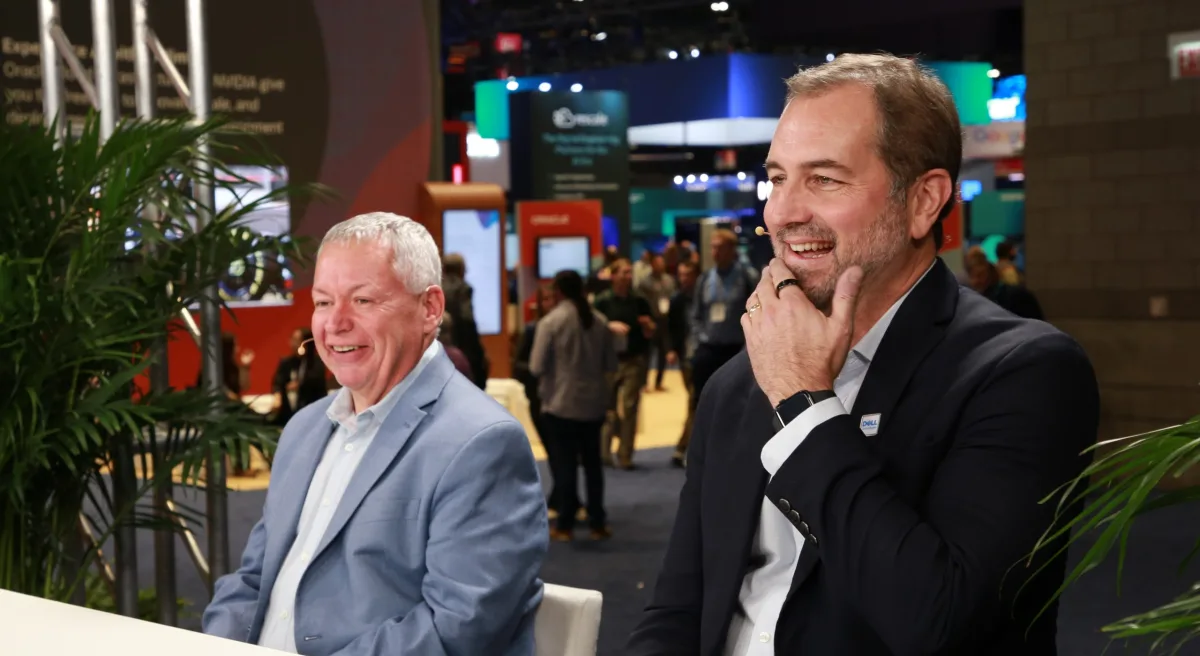
Tease and David Schmidt, vice president of PowerEdge product management at Dell Technologies Inc., discussed the implications during an exclusive conversation at SC26 with theCUBE Research's John Furrier and Gemma Allen.
Power limits reshape business development for compute
Dell and AMD have collaborated on rack-scale AI platforms, yet power availability remains the fundamental constraint. When Dell outlined its product strategy 2.5 years prior, enterprise clients indicated that rack power consumption would plateau between 15 and 20 kilowatts, with many reporting they exhausted available power before fully populating a rack, according to Schmidt. The company's response was the PowerEdge R9825, a 3U server utilizing AMD's sixth-generation EPYC 9006 processors.
It's been optimized for power efficiency and cooling efficiency. That means we're using less power to cool the system overall, and that's power that we can return to our customers.
David Schmidt, Dell Technologies Inc.
The efficiency gains compound during hardware refresh cycles. A single EPYC 9006 server can retire 13 older machines while reducing cooling-related power consumption by 80 percent, Schmidt stated. Tease anticipates that the reclaimed power will fuel agentic workloads, where autonomous agents could transform individual researcher concepts into thousands of parallel compute tasks.
https://www.youtube.com/embed/YzHMlc07c_E?feature=oembed
Same number of researchers, massive increase in the amount of compute. So agentic is going to continue to drive more and more IT, and we've got to find a way to power it.
Scott Tease, Advanced Micro Devices Inc.