Solo developer demonstrates CUDA compatibility layer for AMD GPUs on Windows
A new open-source project bridges NVIDIA's CUDA ecosystem and AMD hardware, allowing CUDA-exclusive workloads to run on consumer Radeon cards without virtualization or dual-booting.
The dominance of NVIDIA's CUDA ecosystem faces a fresh challenge from an unexpected quarter: a solo developer's automated toolkit that enables AMD graphics cards to execute CUDA-dependent software on Windows. While it remains premature to declare NVIDIA's technological moat obsolete, this development represents a meaningful step toward compatibility.
AMD has recently strengthened its Windows support through updated ROCm releases, delivering official PyTorch and HIP SDK compatibility for consumer-grade hardware including the Radeon RX 7000 and RX 9000 series. However, proprietary applications, legacy codebases, and specialized AI tools that mandate CUDA support present ongoing obstacles. The project dubbed "CUDA-for-AMD-Windows," created by Speedstu, addresses this gap by demonstrating that running CUDA-dependent workloads on AMD hardware within Windows is achievable without resorting to virtualization or separate operating system installations.
Rather than introducing a novel runtime environment, this initiative functions as a sophisticated, reproducible PowerShell automation framework. It orchestrates ZLUDA, the translation layer previously backed by AMD, alongside AMD's native HIP and ROCm software development kit for Windows. The toolkit's scripting automatically identifies GPU architecture, retrieves a pinned ZLUDA version (v6-preview.69), and theoretically integrates it seamlessly with existing ROCm mathematical libraries on Windows systems.
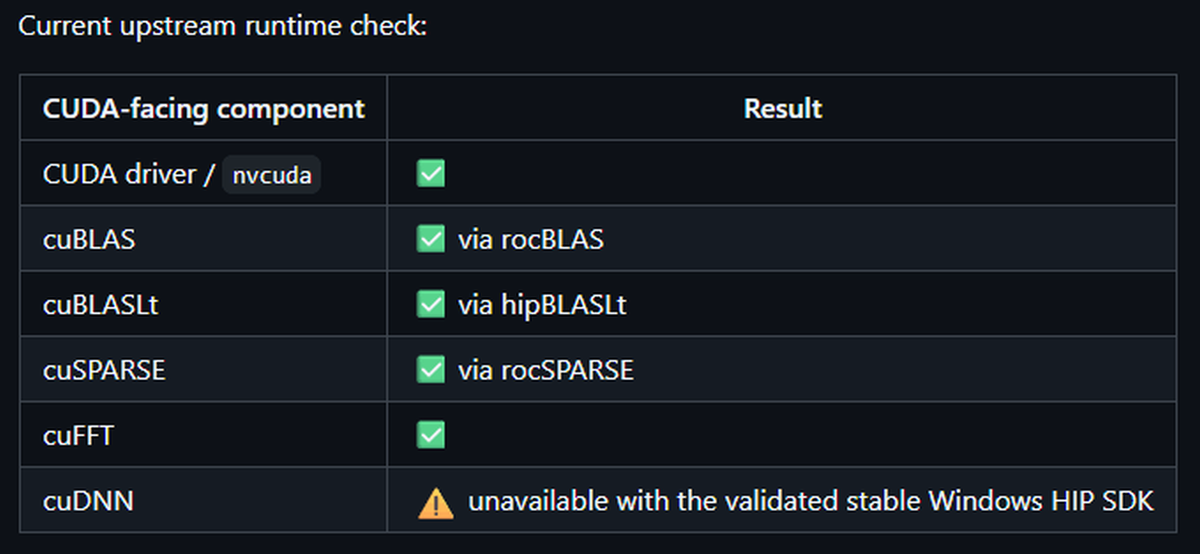
The developer successfully intercepted and redirected the CUDA driver API along with cuBLAS, cuSPARSE, and cuFFT libraries to their AMD counterparts. As validation, the project's creator trained a 2.2-million-parameter PPO reinforcement-learning model end-to-end using unmodified CUDA code on an AMD Radeon RX 9060 XT, presently the sole officially supported graphics processor.
Within the developer community, AMD's official Windows ROCm support frequently encounters limitations when experimenting with cutting-edge GitHub repositories or niche AI applications that explicitly require CUDA. For those seeking to test such CUDA-only software natively on Windows machines while avoiding WSL2 passthrough complications or awaiting HIP implementations from original developers, this project delivers a valuable translation solution. It functions as a pragmatic workaround for applications that rigidly demand NVIDIA hardware.
Performance assessments documented in the project reveal noteworthy results. Testing the 2.2M-parameter reinforcement learning workload on a Radeon RX 9060 XT showed the "public upstream path" utilizing official ZLUDA releases and AMD's standard HIP SDK 6.4 achieved median throughput of 13,278 steps per second. An alternative "recovered custom overlay" constructed from legacy ZLUDA binaries performed marginally worse at 12,876 SPS, representing roughly 3% slower execution. The author acknowledges that "a later rewrite removed LibTorch/ZLUDA from PPO and achieved substantially higher throughput," suggesting performance penalties persist within this translation stack.
Declaring NVIDIA's CUDA advantage definitively eliminated would be premature. This remains a community-driven initiative rather than an enterprise-ready platform. The creator maintains transparency regarding its constrained applicability: critical machine learning components including cuDNN, TensorRT, and NCCL remain unresolved. Compatibility therefore depends entirely on specific workload requirements; applications relying substantially on cuDNN will encounter failures. Additionally, ZLUDA itself persists as a "weekend hobby project" following the loss of commercial sponsorship for a second time. Deploying this infrastructure for mission-critical applications carries substantial risk. The repository represents an enthusiast's instrument, not a solution for organizational technology infrastructure.

Notwithstanding these constraints, "CUDA-for-AMD-Windows" demonstrates considerable promise by establishing that executing CUDA-dependent applications on AMD processors involves a solvable software translation challenge rather than an inherent hardware limitation. The entirely open-source nature of the project creates possibilities extending beyond the current demonstration. Community participation could facilitate enhanced GPU detection capabilities and targeted modifications enabling additional CUDA libraries to function correctly.