Seagate Revives Hybrid Storage With FireCuda Forge and Alkemi Platform
Seagate is betting that surging storage costs make hybrid drives viable again, launching FireCuda Forge drives that pair mechanical storage with user-supplied NVMe SSDs through a new Alkemi management layer.
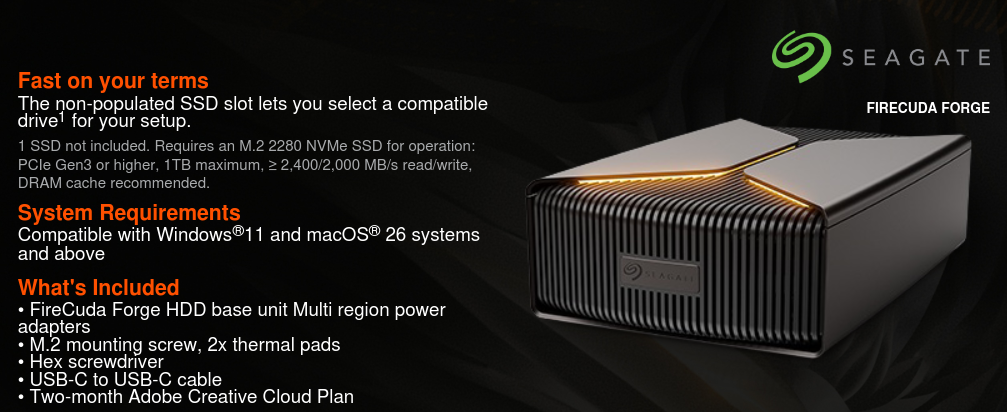
Seagate is making a case that hybrid storage still has a future. The company unveiled the FireCuda Forge line on Tuesday, a storage solution that merges the capacity of traditional hard disk drives with the speed characteristics of solid-state drives supplied by users. The system relies on Seagate's newly developed Alkemi intelligent storage platform to coordinate between the two storage tiers.
The FireCuda Forge is now available through Seagate's direct web store in two configurations: an 8TB model priced at $699 or a 20TB model at $899. Neither price includes the required SSD component. Buyers must provide their own M.2 2280 NVMe drive running PCIe Gen3 or faster. The system caps NVMe capacity at 1TB and requires minimum performance of 2,400MB/s read and 2,000MB/s write speeds, with DRAM cache recommended. Seagate specifies combined system performance of 2,500MB/s read and 2,000MB/s write, alongside USB4 connectivity and compatibility with Windows 11 and macOS 26+.
Storage pricing dynamics have shifted dramatically in recent years. After reaching historic lows in the early part of this decade, per-terabyte costs have climbed sharply during the artificial intelligence expansion. Tom's Hardware data shows certain SSDs now trading at two to three times their previous floor prices. Hard disk drives have experienced similar pressures. A Seagate Exos 24TB drive that cost $298.99 in summer 2025 carried a $699.99 price tag by August 2026, according to PCServerParts.
Hybrid storage largely disappeared from the market after its peak years in the early-to-mid 2010s. The original concept paired a large mechanical drive with a smaller SSD in a unified storage pool. Apple deployed this approach in 2012 through the Mac mini's Fusion Drive. When Ars examined a Fusion Drive unit, it revealed the system wrote in 128KB tiered blocks, typically placing information on the SSD initially before migrating it to the mechanical drive as necessary. Frequently accessed files could remain on the faster SSD tier.
As SSD prices declined substantially, the hybrid model lost its appeal. Now, with storage costs across all categories elevated in 2026, Seagate's reasoning that older technologies deserve reconsideration gains traction. The fundamental economics remain unchanged: NAND flash delivers speed but commands premium pricing, while mechanical drives offer comparatively better value per terabyte for larger capacities.
Apple's Fusion approach carried significant drawbacks. The system's vulnerability lay in its dependence on both drives functioning together as a single volume. A failure in either drive created recovery complications, since the surviving drive relied on data from the failed drive to reconstruct the complete system.
Seagate's Alkemi platform operates differently from Apple's approach. Rather than relying on operating system-level tiering as macOS did with Fusion Drives, Alkemi manages the storage pool directly from within the enclosure itself. According to Seagate's announcement, "Alkemi learns and adapts over time to keep high-demand content fast and accessible on a user's SSD, while the HDD provides space for growing libraries. Behind the scenes, Alkemi manages data placement, giving users the simplicity of a single storage drive." The FireCuda Forge product data sheet characterizes Alkemi as a two-tier storage system but provides no specifics about whether it employs SSD caching, automated tiering, or another mechanism.
Critical details about Alkemi's operation remain undisclosed. Intel's Smart Response Technology of previous generations minimized failure risks through data mirroring, maintaining the mechanical drive as the authoritative copy while caching on the SSD. An optional write-back mode allowed temporary SSD storage of new data. Apple's Fusion Drive took a different path, tiering data across both drives in 128KB blocks. These distinctions carry weight—a question Ars posed following Apple's hybrid announcement 14 years ago.
Seagate describes Alkemi's operation as employing "intelligent data tiering" without elaboration. The system promises rapid access to frequently used files through intelligent management, yet remains silent on whether a single drive failure compromises the entire system. Documentation is similarly absent regarding how Alkemi distributes data upon initial startup. Does new data flow exclusively to the SSD until the 1TB limit is reached before the system begins determining which files merit permanent SSD residence? Seagate has offered no public explanation, though with FireCuda Forge drives already shipping, answers should emerge soon.
Seagate has not released technical documentation detailing how Alkemi manages drive failure scenarios or repair procedures. Without such information, the FireCuda Forge presents the same proposition as Apple's historical Fusion Drives: the speed of SSDs combined with the capacity of mechanical storage, accompanied by the same unanswered questions about hybrid storage that existed years ago.