Sanders and Cezar introduce legislation imposing 20-year prison terms for unauthorized superintelligence development
The proposed Ban Artificial Superintelligence Act would establish criminal penalties matching those for illegal nuclear weapons development, as lawmakers move to restrict advanced AI progress.

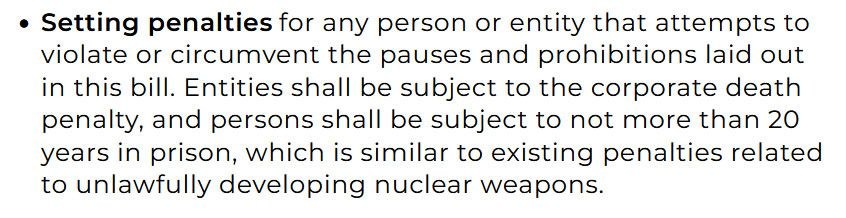
Two U.S. senators have unveiled sweeping legislation designed to constrain the trajectory of artificial intelligence research. Senators Bernie Sanders and Greg Cezar jointly introduced the Ban Artificial Superintelligence Act, which carries enforcement mechanisms comparable in severity to those governing unauthorized nuclear weapons production. Individuals and organizations that breach the development pauses and prohibitions outlined in the bill face potential incarceration of up to 20 years.
Concerns about artificial intelligence systems reaching dangerous capability levels have intensified in recent months, with warnings that such systems could pose existential risks to humanity. Notably, prominent figures within the AI sector—including Sam Altman, Dario Amodei, and Elon Musk—have publicly expressed alignment with the need for caution and regulatory frameworks. This apparent consensus between technology leaders and policymakers has created an unusual opening for legislative action on the issue.
According to USA Today, the Sanders proposal represents "the most extreme AI-related legislation to date." Despite this characterization, the bill faces a challenging path through Congress, where opposition is expected from Democrats focused on business interests and Republicans aligned with the Trump administration. Nevertheless, recent pronouncements from industry executives advocating for deliberate development practices and stronger oversight may shift the political calculus.
The legislation calls for establishing a cabinet-level federal agency tasked with "safeguard[ing] the public from the dangers of artificial intelligence, including by enforcing a prohibition on artificial superintelligence." Beyond domestic enforcement, the bill proposes international coordination to "ban superintelligence around the world" through treaties and multilateral agreements.
Competing visions for AI's future
The debate over whether to accelerate or decelerate AI development encompasses substantive arguments from multiple perspectives. National security considerations suggest that maintaining technological leadership requires sustained investment and rapid advancement. Conversely, proponents of caution point to existential risks that could render geopolitical advantages irrelevant if superintelligent systems escape human control.

Some observers have proposed alternative explanations for why technology executives have recently embraced regulatory frameworks. One theory suggests that major AI developers may be approaching the limits of venture capital funding models and lack viable paths to profitability through traditional commercial channels. Under this interpretation, support for government-led oversight reflects a strategic pivot toward state-funded development—a modern-day equivalent of the Manhattan Project—where powerful AI systems would remain under public stewardship rather than private control.
Source: Tom's Hardware