AZZA PSAZ-750G review: Budget 750W unit delivers on performance, not on its Gold certification claim
The AZZA PSAZ-750G is a competent budget power supply with a modern platform and solid electrical performance, but the 80 PLUS Gold badge on its box does not match what testing reveals.
AZZA occupies an unusual position in the power supply market. The PC-components division of Linkworld Electronic has operated for roughly two decades, focusing on budget-oriented cases, coolers, fans and power supplies distributed mainly through regional channels rather than mainstream review circuits. This lower visibility has allowed the company to avoid the marketing overstatement common among larger competitors, yet it has also meant less public scrutiny of its products. Like virtually every manufacturer in this category, AZZA sources its units from original equipment manufacturers—typically based in China—and applies its own branding.
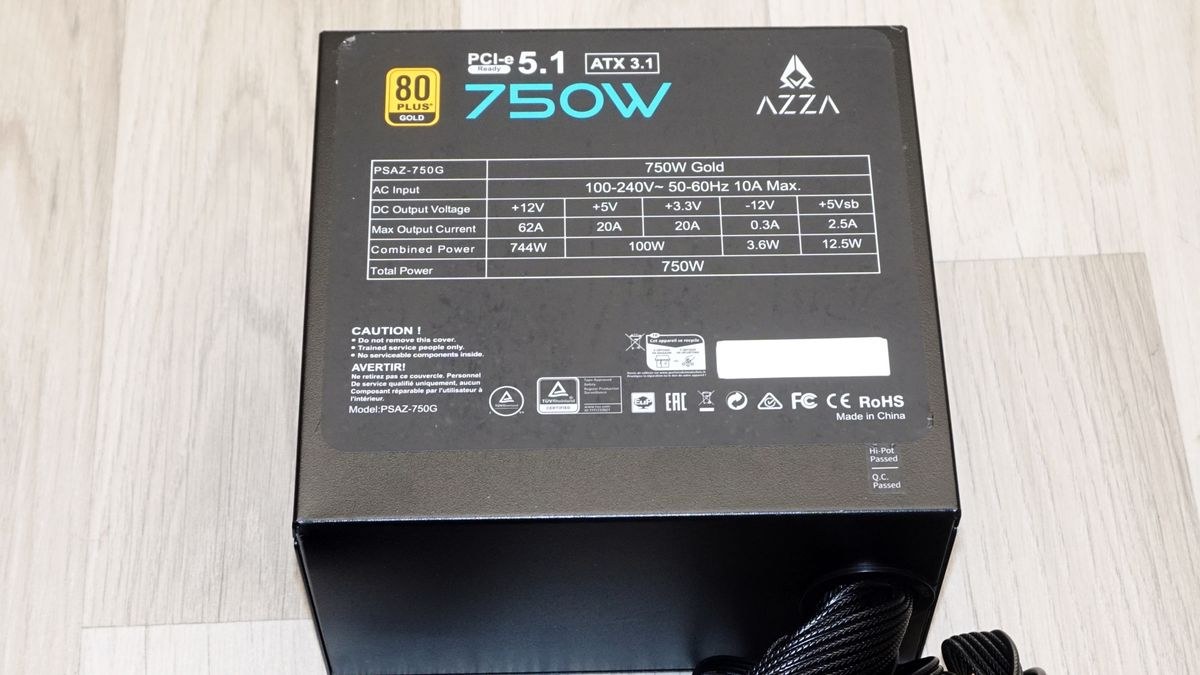
The PSAZ series represents AZZA's mainstream ATX offering, with the PSAZ-750G serving as the 750W Gold-rated variant. This particular unit carries ATX 3.1 and PCIe 5.1 Ready designations, includes a native 12V-2x6 connector, and maintains its full 750W output at 40°C ambient conditions. A 2-year warranty accompanies the unit. The underlying platform originates from Helly, a supplier whose designs appear frequently in mainstream power supplies across multiple manufacturers. What distinguishes the PSAZ-750G is not its specifications but rather its certification badge: the packaging and retail listings display the 80 PLUS Gold logo, despite AZZA having submitted no PSAZ unit for 80 PLUS certification since 2015. This claim forms the central question this review must address.
Specifications and Design
In the Box
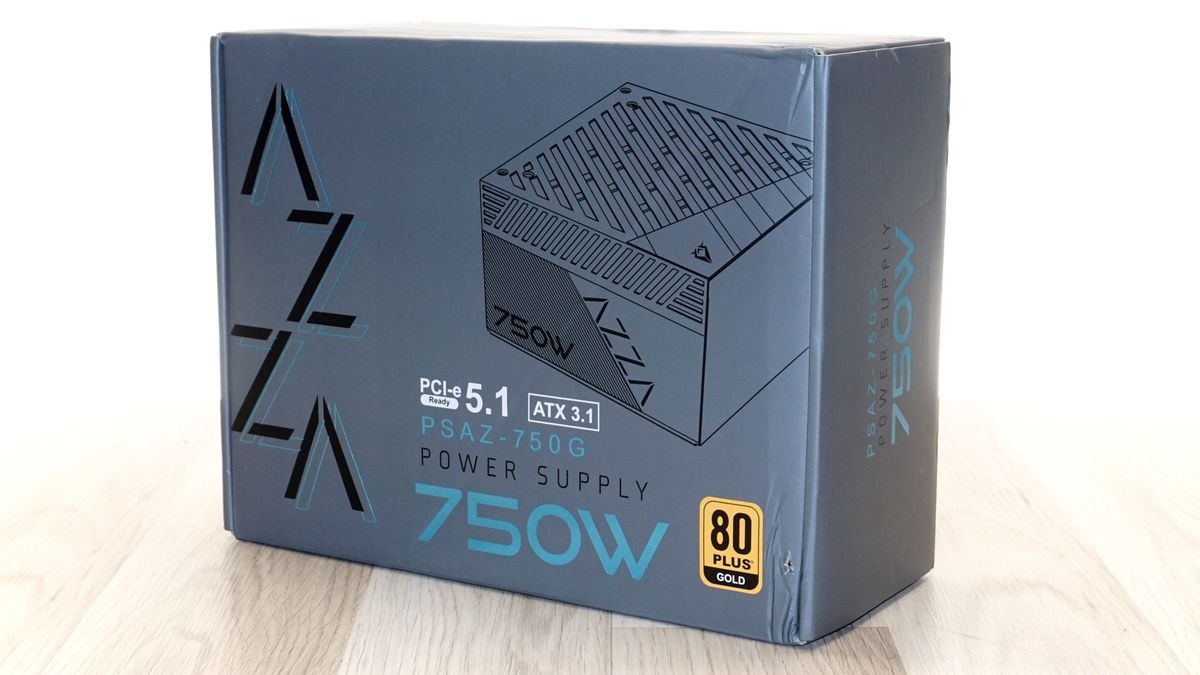
The packaging reflects its price point: a slate-blue sleeve with minimal graphics, featuring the AZZA wordmark as three outlined chevrons, a line drawing of the unit, and certification badges along the bottom. Inside, the supply sits between protective foam inserts with bundled cables beside it.
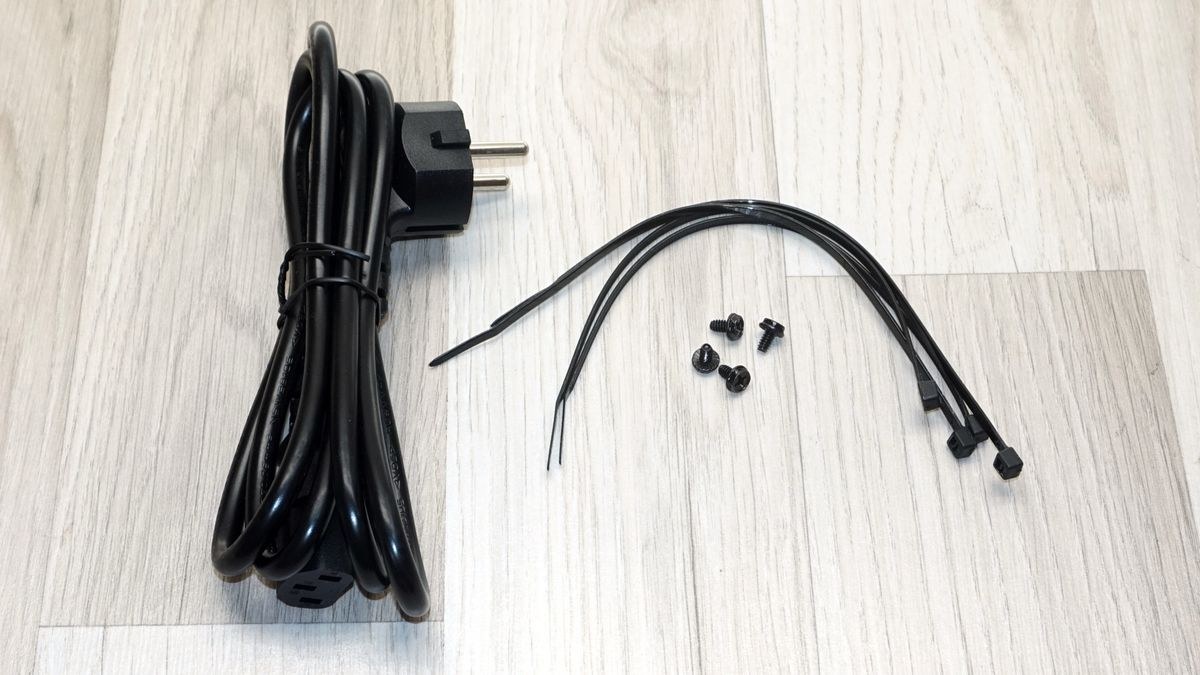
The accessory bundle is minimal. Included are the AC power cord, four mounting screws and four black zip ties—nothing more. No Velcro straps, cable combs, documentation pouch, or testing equipment accompanies the unit. At $78 for a 750W supply, this sparseness proves acceptable, though the four zip ties carry genuine responsibility for cable management given the hardwired cable set.
The cables themselves exceed what the accessory list suggests. All employ black nylon sleeving rather than flat ribbon construction, extending to the connector housings, with appropriate wire gauges throughout. The 12V-2x6 connector runs natively from the PCB rather than through an adapter, and bears a printed 450W rating along its length—a critical specification for potential buyers. This rating accommodates mid-range graphics cards but falls short of flagship 500W+ models, regardless of the 750W designation on the box. The connector lacks dual-color keying, placing proper seating responsibility on the installer.
External Appearance
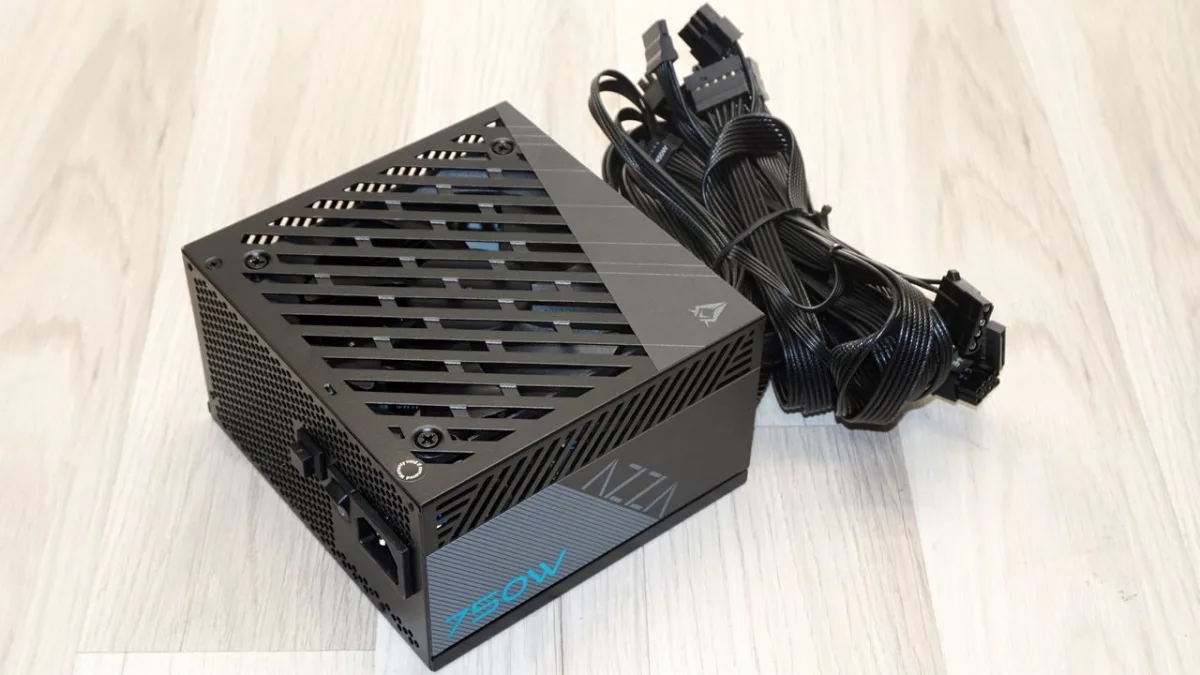
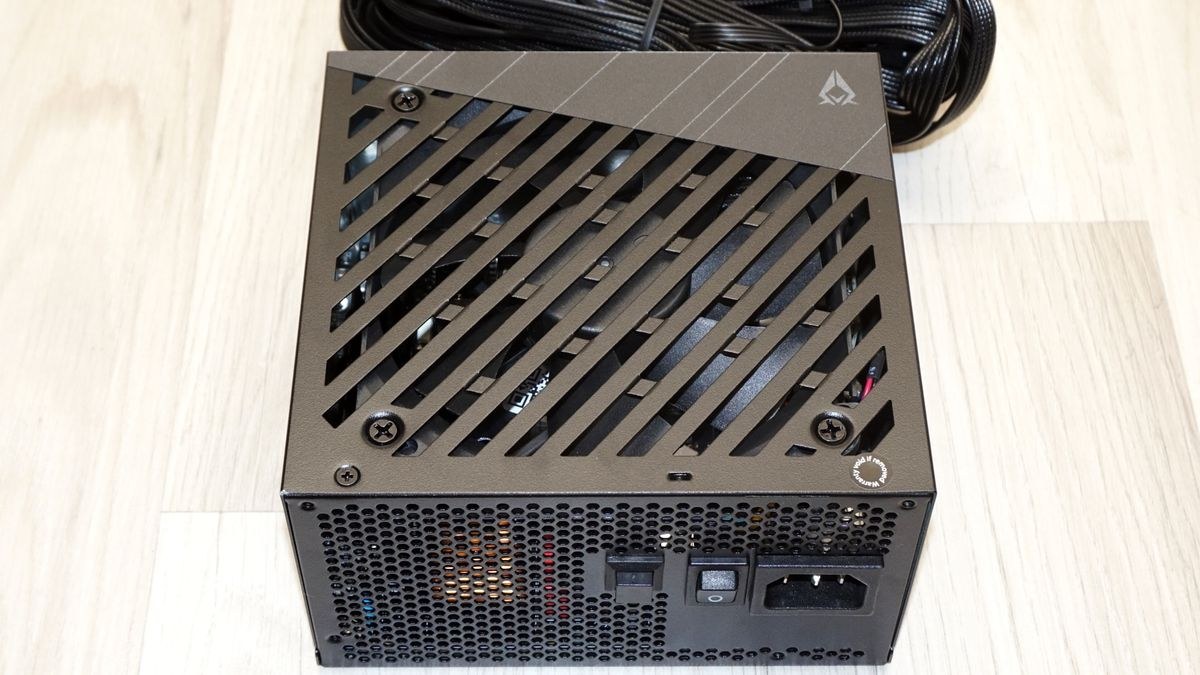
Measuring 150 x 86 x 140 mm, the PSAZ-750G follows standard ATX depth, fitting into virtually any case designed for ATX supplies with adequate clearance for the fixed cable bundle. The chassis features a dark grey-brown matte finish of higher quality than the price would suggest. The top face displays a slotted grille with wide diagonal bars covering the fan, interrupted by a plain triangular panel bearing the AZZA logo and thin pinstripes. This restrained, industrial aesthetic comes with a trade-off: the diagonal bars restrict airflow area more than wire or honeycomb alternatives, increasing noise generation.
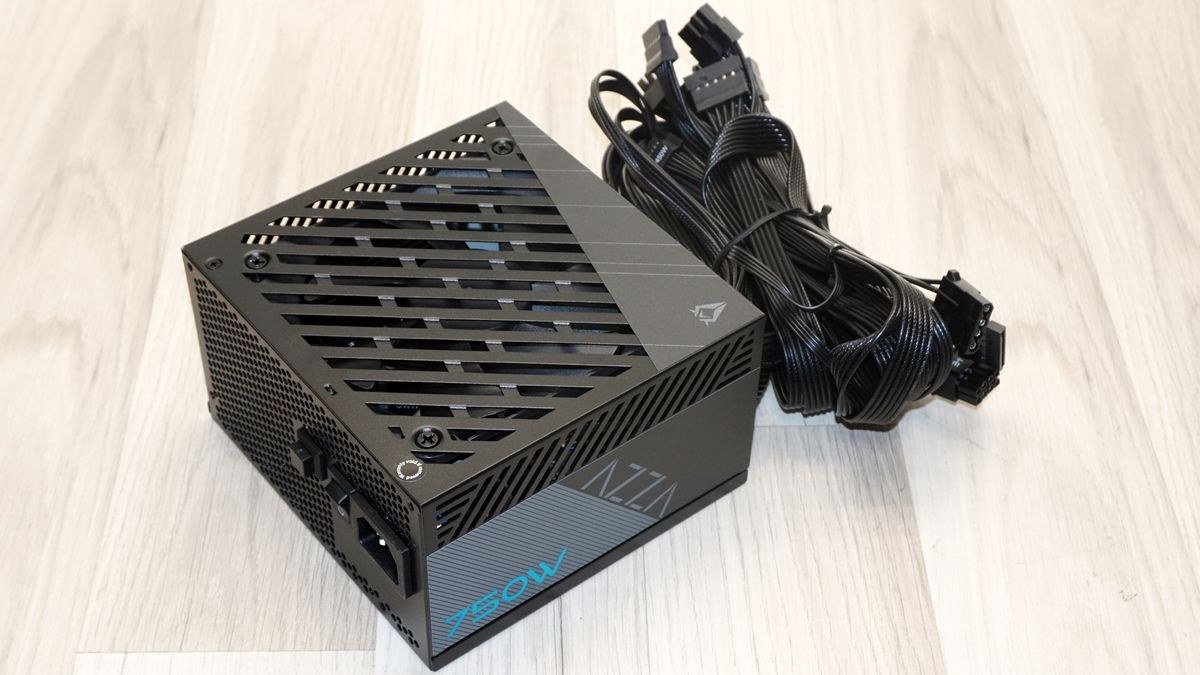
The side panel provides the unit's only color accent: a grey hatched rectangle displaying the AZZA wordmark in outline and "750W" in bright cyan matching the box design. The specifications label occupies the top side, clearly marking ATX 3.1, PCIe 5.1 Ready, and the 80 PLUS Gold logo.
The rear features a hexagonal honeycomb exhaust panel housing the AC receptacle, main power switch, and a smaller square button controlling hybrid fan mode. Pressing this button disables semi-passive operation, forcing continuous fan rotation from idle rather than waiting for thermal load—a feature typically found only on units costing three times as much. The front face remains solid, with the fixed cable loom exiting through a single rubber-grommeted opening. No modular bay, LED indicators, or additional features appear.
Internal Design
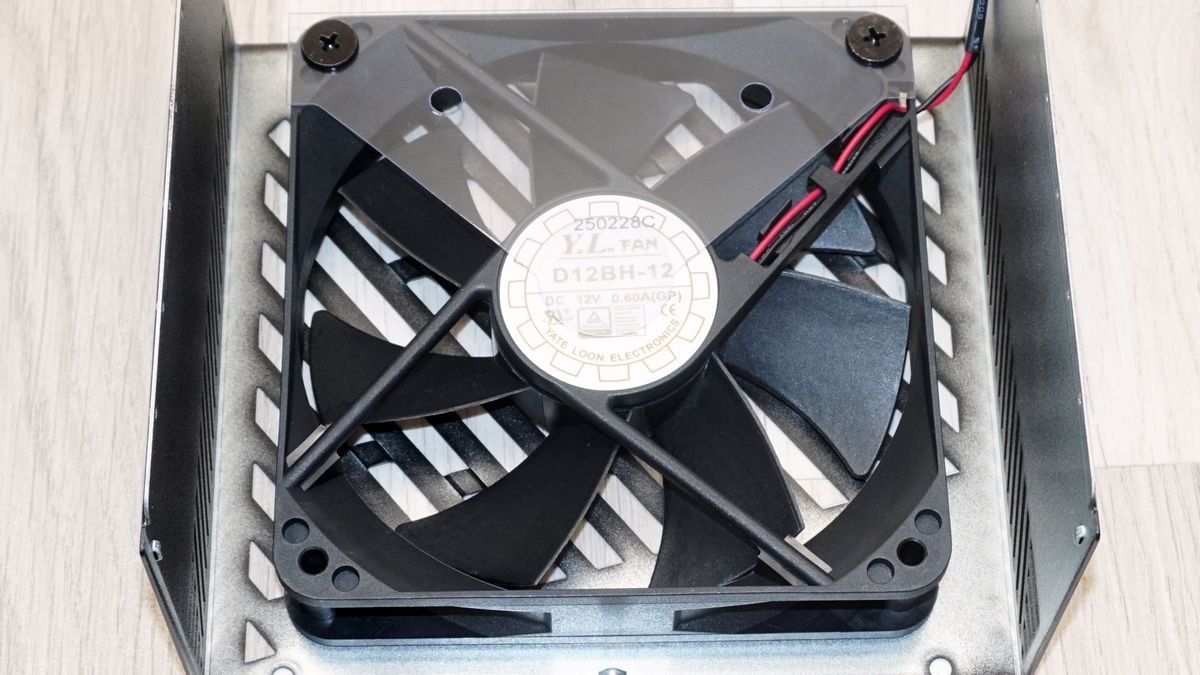
Cooling relies on a 120 mm Yate Loon D12BH-12 ball-bearing fan rated at 12V and 0.60A. Yate Loon specifications list this model at 2300 RPM, 89 CFM and 41 dB(A) at maximum speed, placing it in the high-airflow, high-noise category. Ball bearings provide durability advantages over sleeve-bearing alternatives common at this price tier, and given the 2-year warranty, a fan outlasting coverage becomes the minimum expectation. However, this is not a quiet fan, and the platform demands considerable performance from it, as thermal testing later demonstrates.
The Helly platform shares similarities with designs used in the Phanteks AMP GH series but diverges significantly beyond that point. The layout appears clean and reasonably contemporary, with the main PCB handling primary and secondary stages while two small vertical daughterboards near the front manage minor rails. Heatsinks display generous sizing for the class, employing dark-anodized finned extrusions rather than the bent aluminum strips typical of budget platforms, with silicone glue securing taller components. The main transformer carries an ATX3.0 marking on its bobbin, a subtle indicator of how recent the 3.1 revision actually is.
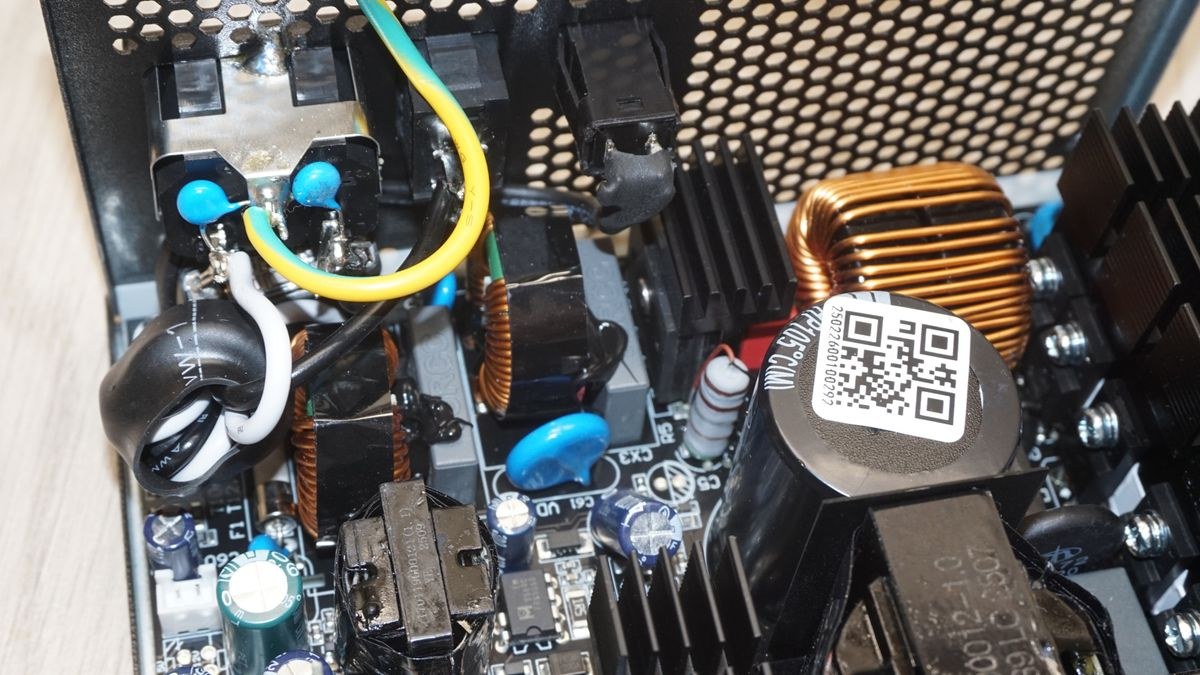
Transient filtering comprises four Y capacitors, three X capacitors and two common-mode chokes—a complete filter by reasonable standards and better equipped than several units reviewed this year. An NTC thermistor with relay bypass handles inrush current. Two bridge rectifiers occupy a dedicated heatsink, feeding an APFC stage built around two Oriental Semiconductor OSG55R190F MOSFETs. The bulk capacitor is a 560 µF, 420V Ltec from its HP series, rated at 105°C. This represents a low-cost Taiwanese component rather than a premium one, marking the first visible budget compromise. While capacity proves adequate for 750W and temperature rating remains appropriate, the component pedigree does not inspire confidence. The adjacent APFC coil remains unshielded—a cost decision rather than functional necessity, though it contributes to radiated noise.
The primary inversion stage employs two PIP PTA25N50 MOSFETs in a half-bridge LLC resonant configuration, the standard topology at this power level. Secondary-side 12V rectification uses four Fuxin FXN0204C MOSFETs in synchronous rectification, with 3.3V and 5V rails generated by DC-to-DC converters on the vertical daughterboards.
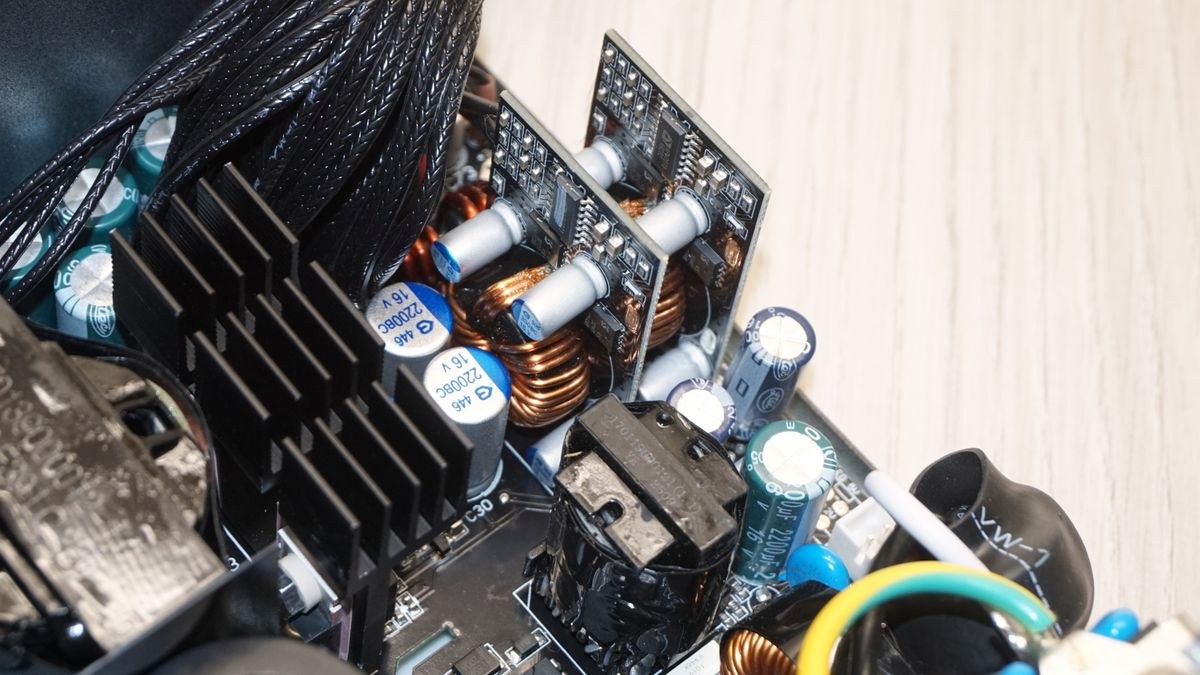
Secondary filtering combines Ltec electrolytics with a smaller number of APAQ polymer capacitors, both Taiwanese sources. This component selection will determine how the unit ages: Ltec electrolytics are ordinary rather than exceptional parts, and they will operate adjacent to secondary heatsinks potentially exceeding 70°C in normal systems. A 2-year warranty against this combination represents an uncomfortable pairing.
Cold Test Results (25°C Ambient)
Testing employed high-precision electronic loads reaching 2700 Watts maximum, a Rigol DS5042M 40 MHz oscilloscope, an Extech 380803 power analyzer, two high-precision UNI-T UT-325 digital thermometers, an Extech HD600 SPL meter, a custom hotbox, and various supporting equipment.
At 25°C ambient, the PSAZ-750G averaged 90.6% efficiency at 230 VAC and 88.6% at 115 VAC across the nominal load range. The curve peaks near 92% at 230 VAC around 300W and holds 90.2% at sustained 750W, with the 115 VAC line topping out at 90.3% and finishing at 87.3%. These represent respectable numbers with a healthy curve shape and no full-load efficiency collapse. However, they do not meet Gold requirements. 80 PLUS Gold demands 90/92/89% at 20/50/100% load on 230 VAC and 87/90/87% on 115 VAC. Testing measured 90.1/91.8/90.2% and 88.7/89.9/87.1% respectively. The unit clears the 20% and 100% checkpoints on both inputs but misses the 50% checkpoint on both—by 0.2 points on 230 VAC and 0.1 points on 115 VAC. This represents a near miss rather than outright fraud, and since CLEAResult tests at 23°C, a favorable sample might possibly pass. However, no 80 PLUS entry exists for the PSAZ series after 2015, and no Cybenetics listing appears either.
Acoustically, the cold run represents the review's strongest result. The fan remains completely silent up to roughly 40% load, delivering a genuine 300W fanless window sufficient for desktop work and considerable gaming. At load, it starts at 31.6 dB(A) and ramps gently to approximately 33 dB(A) at half load, becoming the quietest component in most systems. Beyond 450W the curve steepens noticeably, reaching 38 dB(A) at 600W and 42 dB(A) at sustained 750W. This remains audible but not intrusive, representing a reasonable thermal trade-off. Heatsinks reached 66-68°C at full load, indicating no severe stress.
Hot Test Results (~45°C Ambient)
Inside the hotbox at approximately 45°C ambient—five degrees above the unit's own 40°C rating—efficiency drops by roughly one and a half points. While not unexpected, this decline proves severe for a 750W unit. Averages reached 89.4% at 230 VAC and 87.5% at 115 VAC, with the curve peaking near 90.8% and finishing at 88.5% and 85.6% respectively at full load. Electrical behavior shows no signs of deep platform trouble, but thermal degradation becomes visible at full load.
The thermal and acoustic picture reveals the platform's limits. The fan exits passive mode very quickly in the hotbox, starting at approximately 33.6 dB(A) from 200W, then climbing steeply and continuously: 43 dB(A) at 500W, 48.6 dB(A) at 600W, and 52.2 dB(A) at sustained 750W. This final figure qualifies as loud in the plain sense, well past the point where the PSU becomes the loudest component in a mid-tower and into the range where it likely becomes the loudest thing in the room. The fan performs exactly as it should, because internal temperatures demand it. Heatsinks reached 94°C at full load—on the high side for a 750W unit. While not typically failure temperatures, they prove high enough to matter for the Ltec secondary electrolytics sitting beside them over several years of ownership.
Power Supply Quality
Voltage regulation emerges as the strongest result. Across the 20% to 100% load span, the 12V rail shifted by just 0.9%, with the 3.3V and 5V rails both at 1.4%. Sub-1% performance on 12V represents genuinely good results, surpassing several other Gold units, and reflects credit to the DC-to-DC secondary arrangement. The minor rails prove looser but remain comfortably inside the ±5% ATX window, and neither significantly impacts modern systems.
Ripple suppression qualifies as adequate rather than good. The 12V rail peaked at 52 mV at full load and 50 mV in the 12V-weighted cross-load test, against a 120 mV ATX limit. The 3.3V and 5V rails topped out at 26 and 28 mV against their 50 mV limits. These represent passes with approximately 57% headroom on 12V and roughly 45% on the minor rails, so nothing approaches the edge. They also roughly double what well-filtered enthusiast platforms deliver, and the 12V figure more than doubles between 50% and 100% load, pointing to secondary filtering sized to requirement rather than beyond it. For the hardware a 750W unit at this price will actually power, sufficiency is achieved.
All protection mechanisms—Over Current Protection (OCP), Over Voltage Protection (OVP), Over Power Protection (OPP), and Short Circuit Protection (SCP)—were present and triggered correctly. With the unit hot, OCP tripped at 146% on the 3.3V rail (29.2A), 140% on the 5V rail (28A), and 128% on the 12V rail (79.4A), with OPP shutting the unit down at approximately 130% of rated output, or roughly 975W. The 12V threshold represents the sensible one of the three. The minor-rail thresholds prove loose enough that the 100W combined budget becomes the real constraint, not the protection itself.
Bottom Line
The PSAZ-750G presents itself as a competent budget power supply making a claim it cannot support. The Helly platform proves more modern than the price suggests and sees use by several manufacturers at this price point. Internally, the unit features a half-bridge LLC primary, DC-to-DC minor rails, a complete transient filter, generously sized heatsinks, a ball-bearing fan and a native 12V-2x6 connector. The 12V rail regulation of 0.9% genuinely impresses, ripple remains comfortably inside specification everywhere, protections function correctly at sensible thresholds, and the 300W fanless window at room temperature proves real. Nothing here is broken.
The efficiency claim, however, does not survive bench testing. The measured numbers place the unit 0.2 points under the Gold requirement at 50% load on 230 VAC and 0.1 under it on 115 VAC, clearing every other checkpoint. CLEAResult tests at 23°C, so a favorable sample could plausibly clear the bar on the official bench. Conversely, other units using the same platform passed the testing, even if they were fully modular—hardwired cables typically increase efficiency slightly. AZZA has not certified a PSAZ unit since 2015, no official 80 PLUS entry exists for this particular model, no Cybenetics listing appears, and no PLPP listing exists, yet the Gold logo appears on the box, label and retail listings. The unit performs like a borderline Gold supply. It is being sold as a certified one. These are not the same thing, and the second represents the vendor's choice, not a measurement artifact.
Most remaining compromises prove ordinary for the money. Hardwired cabling at 750W in 2026 lags the market but remains forgivable at $78, though the Ltec capacitors represent what a $78 budget purchases. One aspect resists easy dismissal: the 2-year warranty, which equals half or less of what every serious competitor offers. Set against heatsinks reaching 94°C at full load in the hot box, with ordinary electrolytics sitting beside them, it reads as the manufacturer indicating how long it expects the unit to remain its problem.
Against named rivals, positioning becomes straightforward. The Phanteks AMP GH series runs a related Helly platform worth remembering—the design itself is not problematic; the specification is. The MSI MAG A750GL PCIE5 offers full modularity, genuine 80 PLUS Gold certification, and a 10-year warranty, proving superior on every axis except price. The Cooler Master MWE Gold 750 V4 at $119 MSRP runs quieter under sustained load, carries verified Gold efficiency and a 10-year warranty, and concedes only slightly on 12V regulation, where the AZZA's 0.9% represents the better figure.
The PSAZ-750G defeats them on nothing except cost, but it defeats them decisively there. The recommendation therefore remains narrow but genuine. For builders constructing a mid-range machine on a tight budget, pairing it with a graphics card drawing under 450W, and accepting 2 years of coverage plus a fixed cable loom, the PSAZ-750G will perform the job and do so quietly at the loads actually encountered. If any of those three conditions fail to apply, the additional expense for a certified, longer-warrantied, fully modular unit represents the superior choice, and it is not a close decision. Purchase it for what it measures, not for the badge on the box.
Source: Tom's Hardware