Prusa undercuts rivals with carbon-fiber ESD filament for electronics manufacturing
The 3D printing company has introduced a new electrostatic-dissipative filament that combines carbon fiber and carbon nanotubes at a lower price point than competing offerings.
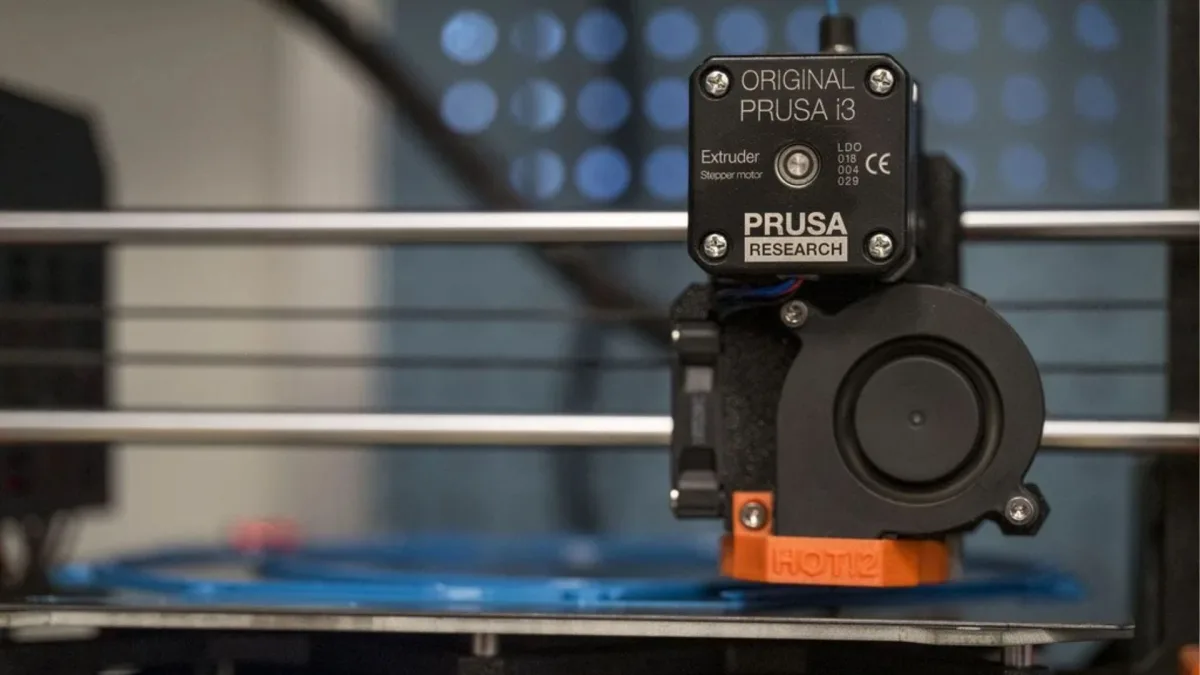
Prusa unveiled Prusament PETG ESD on Tuesday, a filament engineered to protect static-sensitive electronics during manufacturing. The material incorporates both carbon fiber and carbon nanotubes to deliver electrostatic-dissipative properties while improving dimensional accuracy and reducing warping. At $56.99 per unit, it undercuts comparable products on the market and represents the first offering to combine carbon fiber with carbon nanotubes for ESD applications.
The filament enters a market already served by 3DXTech and Polymaker, but Prusa's formulation stands apart through its carbon-fiber reinforcement. 3DXTech's ESD-PETG carries a $105 price tag, while Polymaker's Fiberon PETG-ESD costs $65.98. Prusament PETG ESD remains the only option among these three that includes carbon fiber alongside its ESD properties.
Although standard filaments like PLA, PETG, and ABS work adequately for many hobbyist electronics enclosures, Prusa is positioning this product toward industrial and semi-industrial applications rather than consumer makers. The company highlights use cases including PCB fixtures and holders for soldering, IC trays for component handling and transport, and holders for testing multiple circuit boards simultaneously. This approach allows manufacturers to replace expensive CNC-machined ESD trays with quickly printed alternatives produced on-site with minimal lead time, benefiting everyone from indie hardware developers to smaller manufacturers seeking to upgrade production capabilities without major capital expenditure.
Prusa has not yet released a complete datasheet detailing the filament's mechanical properties, though the company claims it exhibits increased stiffness and reduced toughness comparable to its existing Prusament PETG Carbon Fiber line. The carbon-fiber content in PETG ESD may differ from the standard carbon-fiber variant, given that the latter prioritizes strength over electronics manufacturing requirements.
Prusa employs its own 3D printers to manufacture components and incorporates its own materials into the machines it sells. On the product page, the company notes that it uses PETG ESD in its own production line to prevent edge overcoating when powder coating print sheets. While Prusa did not pioneer ESD filament technology, its pricing advantage and carbon-fiber inclusion position it as a compelling option pending independent testing or the release of full strength specifications.