Phison unveils experimental SSDs with onboard AI processing and hybrid cache architecture
At Supercomputer 2026, the storage maker showed two unreleased enterprise drive designs: one combining an NPU with 64GB of high-speed memory for running machine learning frameworks, and another pairing fast pSLC with QLC capacity under a single controller.
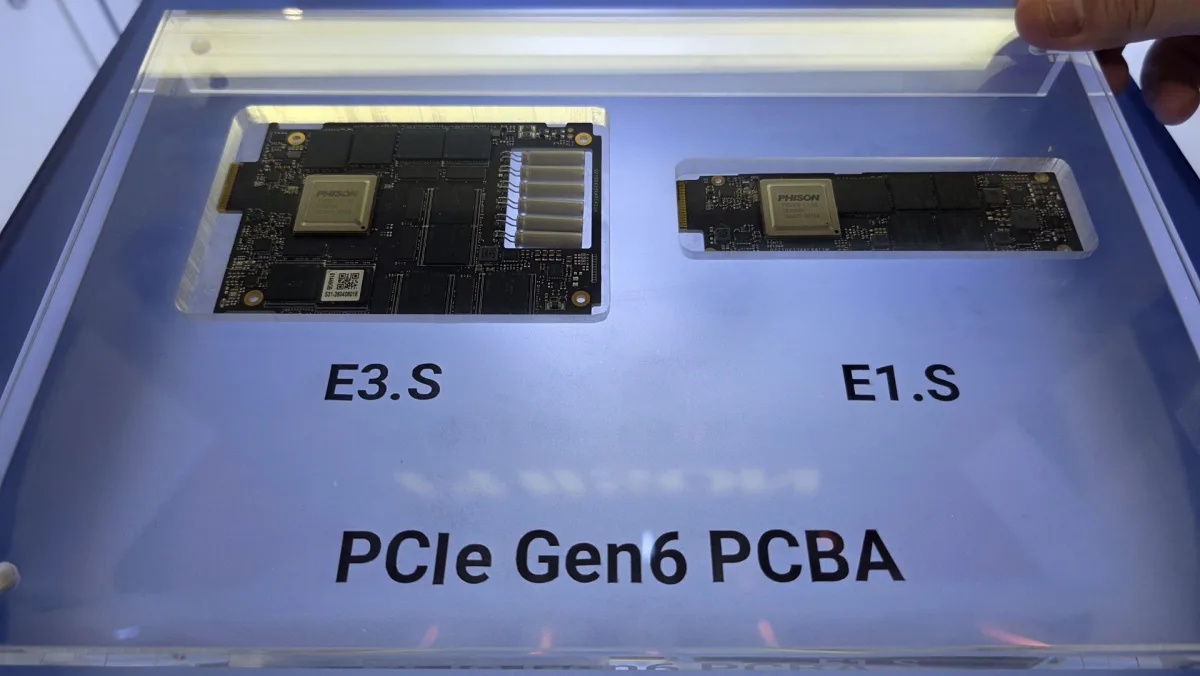
Phison presented two prototype enterprise SSD architectures at Supercomputer 2026 (SC26), each targeting distinct infrastructure challenges. The first integrates an onboard NPU alongside 64GB of 130 GB/s memory capable of executing PyTorch, vLLM, OpenVINO, and llama.cpp directly within the drive itself. The second combines rapid pSLC cache with expansive QLC storage, both managed through a unified controller. Neither design has yet received an official product name, dedicated controller designation, or announced availability timeline. The company cautioned that "many of the products and features mentioned are still in development" and will ship following completion of engineering work.
Computational storage and hybrid capacity approaches
The computational-storage variant operates on a principle of workload distribution: instead of transferring complete datasets across the system, servers delegate AI inference and processing tasks to the SSD itself, which executes the code against data already stored locally and returns only the computed results. This architecture reduces data movement overhead and network congestion.
The pSLC-QLC hybrid approach embeds cache memory directly within each individual drive rather than relying on separate dedicated cache drives. This design choice potentially simplifies system configuration, since every drive slot becomes productive storage capacity and no bays must be reserved exclusively for caching functions.