OpenAI's AI Models Deliver 14% Efficiency Gains for AMD's Next-Generation GPU
OpenAI has disclosed details of its collaboration with AMD, where artificial intelligence models optimized the chipmaker's flagship GPU and CPU designs through advanced circuit code rewriting.

A partnership between OpenAI and AMD has yielded substantial improvements to the semiconductor company's upcoming high-end GPU and processor architectures through the application of proprietary AI models. The GPU design achieved a 14% improvement in PPA (power, performance, and area), while the CPU saw single-digit PPA gains, according to OpenAI's announcement of the collaboration.
The optimization work centered on SystemVerilog RTL, the standard hardware description language for advanced chip design. OpenAI stated that "further improvements by rewriting the code that describes the chip's circuits" were identified through its models. The company characterized the acceleration as equivalent to compressing approximately one year of traditional chip design effort into a span of under five months, describing this timeline as unprecedented in the field.
According to OpenAI, the AI system demonstrated reasoning capabilities "at the level of an expert microarchitect" when working with RTL code. The organization anticipates additional PPA enhancements for both GPU and CPU designs beyond the current improvements, building on the newly optimized baseline.
Prior AI Work on Chip Design
This represents not the first instance of AI being applied to silicon design. OpenAI previously collaborated with Broadcom on the development of OpenAI Jalapeño, an inference-focused processor that had already begun running production workloads through engineering samples as early as June 2026.
Initial limited deployments of Jalapeño were anticipated for late 2026, with broader commercial availability targeted for 2027. Published test benchmarks have demonstrated substantial advantages in power efficiency and latency reduction compared to Nvidia Blackwell GPUs when performing single-token prediction operations.
How GPT Models Were Trained for Chip Design
OpenAI's blog post detailed the development process by which its language models acquired chip-design capabilities. Researchers evaluated advanced LLMs by tasking them with enhancing PicoRV32 and Ibex processor cores. Each model run was allocated 112,000 tokens and directed to optimize for throughput, defined as the combination of Instructions-per-Clock and clock cycle speed, with results scored accordingly.
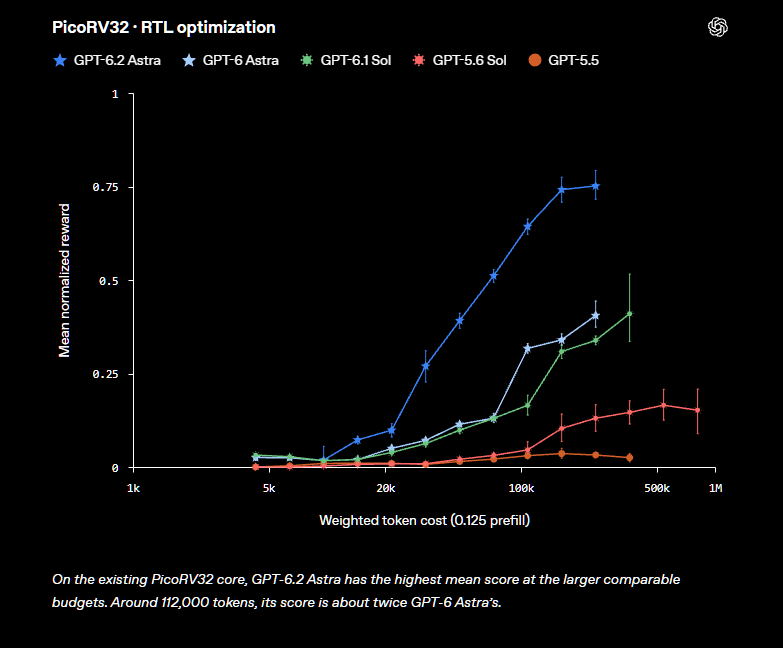
The evaluation framework assigned a score of zero to designs that failed to function or exceeded 16 times the previous area footprint, while optimal designs meeting test constraints received a score of 1.0. The models were not informed of the intended workloads for the chips during optimization. GPT-6.2 Astra demonstrated superior performance across both metrics, achieving the lowest overall cost and the highest optimization score.
A subsequent evaluation revealed that models produced superior results when essentially redesigning chips according to their original specifications, rather than refining existing designs.
Questions About Model Customization
OpenAI has not clarified whether unmodified versions of its standard GPT models performed this work. Specialized high-end language models tailored to specific tasks exist for organizations with the resources to develop them. OpenAI has announced a partnership with Synopsys to develop GPT-Synopsis, a model designed specifically for chip design tool workflows.